49 works in this view — arrow keys or swipe to move between them.
Dance in Art
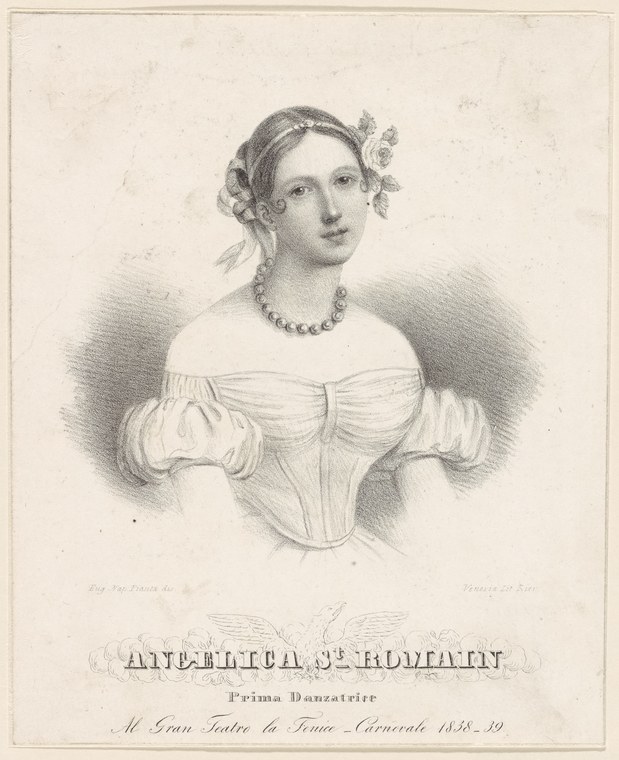
Angelica St. Romain. Prima danzatrice. Al gran Teatro la Fenice - carnevale 1838-39
Unknown artist
- Collection:
- Prints depicting dance
- Source:
- New York Public Library
- Rights:
- Public domain — free to use, share and adapt.
- Recorded as:
- Public Domain
This portrait reveals the infrastructure of dancer celebrity in the early nineteenth century—the commercial printmaking, the social positioning, and the visual culture that made a working performer into a recognizable public figure. For historians of dance, it documents not choreography or technique, but the far-reaching business of theatrical fame and the standardized aesthetic conventions used to present female dancers to the public during the Romantic era.
What you are looking at
A three-quarter-length portrait of a woman identified as Angelica St. Romain, positioned against a neutral background with subtle shading that creates depth behind the figure. She wears an elaborate off-shoulder ball gown with voluminous puffed sleeves gathered at the elbow, a fitted bodice, and a corseted waist—characteristic dress of the 1830s. Her dark hair is pulled back and adorned with a decorative bow or feathered ornament on one side, and she wears a pearl necklace. The woman's pose is serene and frontal, her gaze directed slightly to the viewer's left, her shoulders relaxed and open. The print employs fine cross-hatching and tonal gradation to model the fabric, particularly the soft folds of the sleeves and the luminosity of the bodice, creating a sense of elegant restraint typical of portraiture from this period.
The dancing
The subject stands in a stationary, formal pose with no indication of active movement or dance position. Her body is at rest, shoulders level and squared toward the viewer, arms at her sides with hands not visible in the composition. The portrait is static and commemorative rather than dynamic—this is not a depiction of St. Romain in the act of performing, but rather a formal presentation of her appearance and status.
The dance depicted
This is not a representation of dance in progress. Instead, it is a commemorative portrait of a celebrated prima ballerina, created to document her appearance and status. The inscription identifies her as performing at the Teatro la Fenice (Venice) during Carnival 1838–39, a prestigious venue and season, but the image itself shows only her portrait dress—the formal attire she would have worn to social occasions, not her performance costume. The work belongs to the tradition of theatre portraiture, which circulated images of celebrated dancers to promote their reputations and allow distant audiences a sense of their presence.
How it was made
This is an engraving (or possibly a steel engraving), recognizable from the fine parallel lines (cross-hatching) used to create tonal modeling, the crisp definition of contours, and the printed quality evident in the image. The technique allowed for relatively inexpensive mechanical reproduction and wide distribution—essential for theatrical publicity in the 1830s. The engraved name and inscription at the base suggest this was a commercial print, sold individually or in series to theatre patrons and admirers. The quality of execution indicates a skilled printmaker working from a painted or drawn original.
About this work
This engraved portrait documents Angelica St. Romain, a prima ballerina who performed at the prestigious Teatro la Fenice in Venice during the 1838–39 carnival season. Rather than depicting her in performance, the print presents her as a fashionable woman of status, dressed in the elaborate silhouette of 1830s elite fashion. It exemplifies the theatrical publicity industry of the early nineteenth century, when engraved portraits of celebrated dancers circulated among audiences, creating a market for images that conveyed both the performer's fame and the aspirational world of the opera house. Though the image itself shows no dance, it is a primary historical document of how dancers were marketed, remembered, and visualized in the decades when Romantic ballet was consolidating its dominance of European theatrical culture.
How to look at it
This is a portrait, not an action scene, so attend to what it communicates about social standing and celebrity rather than about dance itself. Notice the costly fabrics, the jewelry, the fashionable hairstyle, and the composed dignity of the pose—these elements were the visual vocabulary through which a working performer established legitimacy as a member of the elite world. The engraving technique itself—the clarity, the fine detail, the monochromatic precision—was associated with official, serious portraiture, a convention that elevated the sitter's status. The inscription at the base, naming the subject and her venue, transforms a portrait into a form of advertisement.
The artist
The artist is not recorded in the catalogue. The print bears no visible signature, though the quality of the engraving and the theatrical subject matter suggest a skilled professional working in a commercial printmaking workshop, likely in Venice or another major Italian artistic center. The format and style are consistent with 1830s theatrical portraiture produced across Europe for the opera house market.
The period
The 1830s were the height of Romantic ballet in Europe. The Teatro la Fenice was one of the continent's most prestigious opera houses, and a prima ballerina engagement there was a significant career marker. During this period, theatres invested heavily in printed publicity—engravings, lithographs, and woodcuts of celebrated performers were sold as affordable souvenirs and helped create a star system around individual dancers. This portrait coincides with the era of Marie Taglioni, Fanny Elssler, and other legendary Romantic ballerinas whose images were mass-produced and circulated internationally. The formal, dignified presentation seen here reflects the aspirational femininity promoted by Romantic ballet aesthetics—graceful, ethereal, and of elevated social status—even as the portrait omits any reference to the physical demands or artistry of performance.
Where it lives
This print is held in the New York Public Library's collection of prints depicting dance. It belongs to the broader category of theatrical publicity materials from the nineteenth century—commercial engravings produced and distributed to theatre audiences and collectors. Such works circulated widely in Europe during the 1830s–1840s and are now found in museum and library collections across the world.
Questions about this work
Is this an image of Angelica St. Romain dancing?
No. The portrait shows her in formal attire, not in performance costume or in the act of dancing. It is a commemorative image created to publicize her fame and appearance, not to document her choreography or technique.
What was the Teatro la Fenice and why does it matter?
The Teatro la Fenice in Venice was one of Europe's most prestigious opera houses. A prima ballerina engagement there during Carnival—the season of major social and theatrical festivities—was a mark of international fame and high status within the dance world.
Why were engravings of dancers sold to the public?
In the nineteenth century, before photography became widespread, engraved portraits of celebrated performers were sold as affordable souvenirs to theatre audiences. They served as publicity for the dancer and the theatre, created fan culture, and allowed people without access to live performance to own an image of a famous artist.
What does this portrait tell us about Romantic ballet?
It reveals that Romantic ballet was not only a performance art but a commercial enterprise built on celebrity, fashion, and the visual presentation of the dancer as an elevated, aspirational figure. The emphasis on elegant dress and composed dignity reflects the aesthetic values the period promoted for female dancers.
More dance artwork





