49 works in this view — arrow keys or swipe to move between them.
Dance in Art
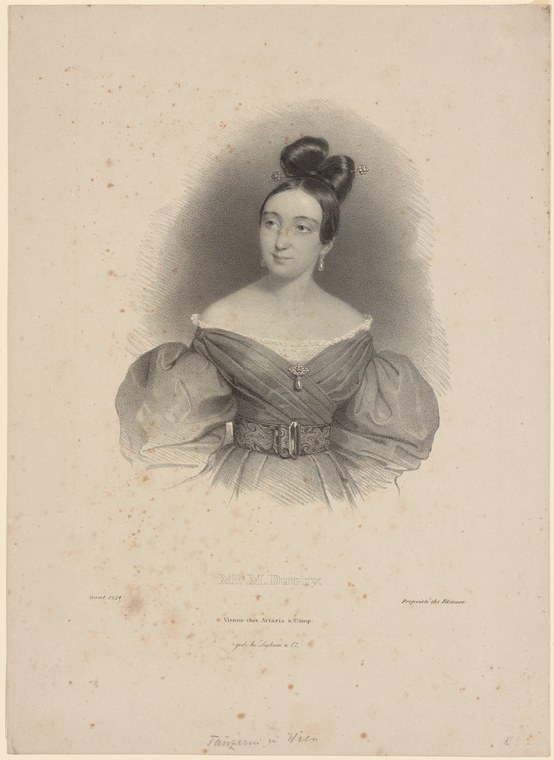
Mlle. M. Dupuy
Unknown artist
- Collection:
- Prints depicting dance
- Source:
- New York Public Library
- Rights:
- Public domain — free to use, share and adapt.
- Recorded as:
- Public Domain
Engraved portraits of named dancers are rare documentary evidence of who worked in the 1830s–1840s and how they were marketed to the public. The name inscribed on this print could anchor further research into Dupuy's career, repertory, and place in the European dance world of the Romantic period. Even a still portrait conveys information about costume, deportment, and the aesthetic ideals that shaped how dancers were seen.
What you are looking at
A three-quarter-length portrait of a young woman, identified as Mlle. M. Dupuy, rendered in a soft engraving technique with delicate stippled shading. She is shown from the waist up against a plain background with subtle tonal gradations that make her figure stand forward. Her dark hair is arranged in an elaborate upswept style with loops and ringlets pinned high on her crown, the fashion of the 1830s–1840s. She wears a dress with a wide, off-shoulder neckline in the Romantic period manner, the bodice fitted and crossed at the front, with voluminous puffed sleeves that gather tightly at the elbow. A wide belt with a buckle or ornament cinches her waist. Her gaze is directed slightly away from the viewer, giving the portrait an introspective quality. The engraving is a formal studio portrait—likely a promotional image of a dancer or performer—with a cartouche at the base giving her name and publication information.
The dancing
The sitter is depicted in stillness, not in the act of dancing. Her posture is upright and composed, her shoulders relaxed and squared. Her arms rest easily, one visible against her body. There is no indication of active movement, weight shift, or the musculature one would expect to see in a dancer at work. The portrait is a static likeness, not a study of motion or technique.
The dance depicted
The identity and profession of Mlle. M. Dupuy cannot be determined from the portrait alone. The formal dress and styling suggest she was a figure of some theatrical or social standing in the 1830s–1840s, and the existence of a published engraved portrait indicates public interest, but no dance style is visible in this image. She may have been a ballerina, given the period and the format of the print, but the portrait provides no evidence of that. The work documents her appearance, not her art.
How it was made
This is a steel or copper-plate engraving, likely hand-engraved using a combination of line work and fine stipple to create tone and shadow. The technique allows precise, reproducible registration of fine detail—particularly evident in the rendering of fabric, hair texture, and facial features—and the print was clearly made for wide circulation, as indicated by the publication line at the base. Engraved portraits in this period were a standard means of promoting theatrical performers and creating affordable, collectible likenesses for the public.
About this work
This is a mid-nineteenth-century engraved portrait of Mlle. M. Dupuy, a woman of theatrical or dance-world prominence during the Romantic era. The print is a formal studio image, not a representation of dance, but belongs in a dance archive because the subject was likely a dancer and because such portraits are primary evidence of how performers presented themselves and were circulated to audiences. The absence of action in the image is itself historically significant: Romantic-era dance portraiture often froze the dancer in a moment of grace rather than dynamic motion, emphasizing poise and allure over technical display.
How to look at it
Attend to the details of dress and grooming as period markers and professional signals. The elaborate hairstyle and expensive fabric indicate a performer of standing; the studio lighting and composed pose indicate a formal, professional image-making event. The artist has chosen not to show Dupuy in action or in character, but rather as herself—a portrait of a person, not a depiction of a dance.
The artist
The engraver is not recorded in the catalogue. The publication line indicates a Parisian house ("Imprimerie du Moniteur"), suggesting this was a professional theatrical portrait made for the Parisian stage or circulated by a Parisian publisher. The quality and finish of the engraving suggest work by a skilled practitioner in the mid-nineteenth-century portrait trade.
The period
The 1830s–1840s were the height of the Romantic ballet in Europe, when dancers like Marie Taglioni and Fanny Elssler became international celebrities. Engraved portraits and lithographs of leading performers were mass-produced and sold to fans as affordable collectibles, a parallel to modern celebrity photography. The fashion and styling of this portrait—the off-shoulder dress, the high-piled hair, the soft focus—are entirely consistent with Romantic theatrical aesthetics. Whether Dupuy was a ballerina, a dancer in opéra-comique, or a performer in another theatrical form cannot be determined from this image alone.
Where it lives
The print is held in the New York Public Library's collection of prints depicting dance. It is catalogued only by the sitter's name and the title "Mlle. M. Dupuy," with minimal documentation of artist, date, or publication details beyond what appears on the print itself.
Questions about this work
Was Mlle. M. Dupuy a famous dancer?
It is not possible to determine from this portrait alone. The existence of a published engraved portrait suggests she was a figure of public interest, likely connected to the theatrical world, and the 1830s–1840s date places her in the Romantic ballet era. Further archival research would be needed to identify her career and repertory.
Why is this portrait in a dance collection if she is not shown dancing?
Portraits of named performers are valuable historical documents even when they do not depict the performer in action. They provide evidence of costume, deportment, and beauty standards of the period, and the name inscribed on the print can anchor research into dance history and careers that might otherwise be lost.
Who made this engraving?
The engraver is not named on the print. The publication information indicates it was produced in Paris, likely by a professional theatrical portrait maker, but the artist's identity remains unknown without further research.
More dance artwork





