49 works in this view — arrow keys or swipe to move between them.
Dance in Art
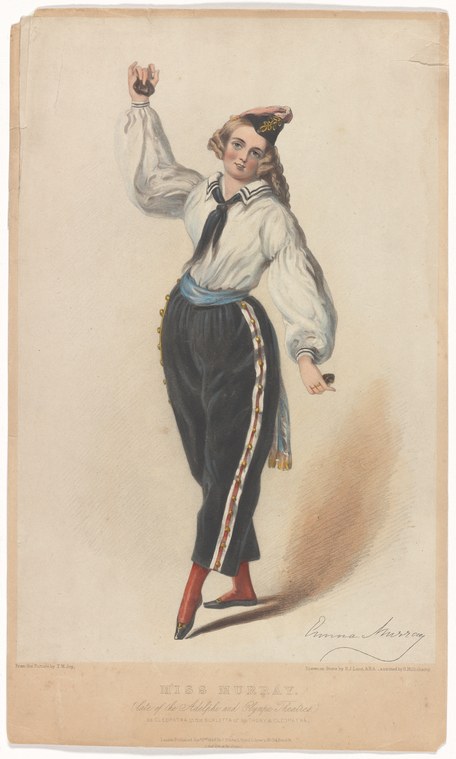
Miss Murray: (late of the Adelphi and Olympic Theatres) as Cleopatra in the burletta of Anthony & Cleopatra
Unknown artist
- Collection:
- Prints depicting dance
- Source:
- New York Public Library
- Rights:
- Public domain — free to use, share and adapt.
- Recorded as:
- Public Domain
For dance historians, this print is a window into the theatrical ecosystems within which dance existed in 19th-century London. Burletta productions included choreographic and musical moments, and understanding the broader theatrical moment—the performer, the role, the comic conventions—is essential to understanding where dance sat culturally. The image also documents the burlesque theatrical tradition, a form that would evolve into the musical theatre of the late 19th century, where dance became increasingly central.
What you are looking at
A young woman in theatrical costume stands in a classical contrapposto pose against a neutral background. She wears a white linen shirt with full sleeves gathered at the wrists, and dark (navy or black) fitted breeches or trousers with a decorative striped trim down the outer seam in red and gold. Her left arm is raised above her head in an expressive gesture, the fabric of her sleeve draped loosely; her right arm hangs at her side. She wears a jeweled ornament or crown in her dark hair, styled up. Her feet are positioned in soft shoes or slippers in red leather. The pose suggests a moment of triumph or declaration—the raised arm and turned head convey theatrical intensity rather than literal dance movement. The composition is a three-quarter length portrait in the tradition of theatrical character prints, where the performer is shown in their stage costume as a specific role rather than in action.
The dancing
A single figure dominates the composition, posed in a classical contrapposto stance with weight shifted to one leg. The raised left arm is extended upward and slightly back, palm open in a gesture of exultation or address to an unseen audience. The body is turned to face the viewer at a slight angle, the head tilted back in harmony with the arm. The costume is historically masculine in cut—breeches rather than a skirt—which is the crucial clue to the role. The pose is theatrical display rather than dance technique: a moment of performance presence rather than footwork or partnering.
The dance depicted
This is not a dance depiction but a theatrical character portrait. The title identifies the performer as Miss Murray in the role of Cleopatra in a stage burletta (a comic operatic theatrical genre popular in 19th-century Britain). The breeches suggest that Cleopatra was played by a woman in male dress—a common convention in burlesque and extravagant theatre, creating comedy through gender performance and costume. The pose is a moment of dramatic character rather than any specific dance form, though burletta invariably included musical and choreographic moments. Without seeing the performance, we cannot determine which dances (if any) were part of the production.
How it was made
This is a hand-colored engraving or lithograph, characteristic of mid-19th-century theatrical print production. The technique allowed rapid, affordable circulation of images of famous performers to theatregoing audiences—fans could purchase portraits of stars in their celebrated roles. The delicate hand-coloring (visible in the flesh tones, hair, and costume details) was typical of theatrical prints of this era, each copy colored by hand in a workshop. The inscription at the base and the artist's signature indicate this was a commercial theatrical print, likely sold in theatre lobbies or through print shops, making it a primary source for how stage costume and character were understood and disseminated.
About this work
This is a theatrical character portrait of the performer Miss Murray in her celebrated role as Cleopatra in the burletta *Anthony & Cleopatra*, performed at London's Adelphi and Olympic theatres. It documents not a dance but a moment of theatrical presentation—a character in costume, struck in a pose of exultation. The work is significant as evidence of 19th-century theatrical practice: the female performer in breeches playing a male-coded comedic role; the burletta as a theatrical form that mixed drama, music, and movement; and the commercial print as the primary means by which audiences owned and celebrated the theatre they attended. The print preserves not only an image of a performer but a record of what London theatregoers paid to see and how they remembered it.
How to look at it
Notice the deliberate theatricality of the pose—this is not a candid moment but a composed portrait designed to convey the character's essential nature. The raised arm is a gesture of power and declaration; the turned body and tilted head create dynamism within a still image. The breeches are the visual punchline of the role: a female performer in male dress playing a female historical character, a layered comedy typical of burletta. The costume details—the striped trim, the jeweled ornament—are rendered with care because they were the markers of the role's spectacle. Look also at the signature and the inscription: these establish the work as a commercial print, a product made to sell.
The artist
The artist is not recorded in the catalogue, but the work bears a signature at the base. Theatrical portrait prints of this era were often produced by semi-anonymous workshop artists working within the print industry, creating commercially viable likenesses quickly. Attribution to an individual artist was not always prioritized; the print's value lay in its authenticity as a record of a celebrated performer in a specific role, not in the artist's reputation.
The period
The burletta was a hybrid theatrical form hugely popular in London in the 1830s-1850s, occupying a space between legitimate drama and musical theatre. These productions were often extravagant, featuring spectacular costumes, music, and movement, and were known for their irreverent humor and gender-bending casting. Miss Murray was a celebrated performer of the era; the Adelphi and Olympic were major London theatres. Theatrical character prints were mass-market items, as widespread in their time as celebrity photographs became in the 20th century. The practice of documenting performers in costume was central to how theatre was consumed and remembered by the public.
Where it lives
This print comes from the New York Public Library's collection of prints depicting dance, indicating it was acquired as part of a broader effort to document choreography and theatrical movement. It is catalogued as a dance-related image, likely because burletta productions included musical and choreographic elements, though this particular image documents a dramatic moment rather than a dance step.
Questions about this work
Is this a dance image?
Not directly. It is a theatrical character portrait of a performer in role. However, it belongs in dance history because burletta was a theatrical form that incorporated music, movement, and choreography. This image documents the larger theatrical world in which 19th-century dance existed and the commercial practices (theatrical prints, celebrity culture) through which dance was circulated and remembered.
Why is Cleopatra wearing breeches?
This is a burletta, a comic theatrical form, and the humor partly derives from gender-bending casting and costume. Female performers in breeches roles was a recognized theatrical convention, used for comedy and spectacle. The role played on the audience's awareness of the performer's actual gender against the costume she wore.
Where would this have been performed?
The inscription identifies the Adelphi and Olympic theatres in London. Both were major venues in the mid-19th century, known for hosting spectacular and popular theatrical productions including burlettas.
How was this print made and distributed?
It is a hand-colored engraving or lithograph, a commercial product made to be sold to theatre audiences. Such prints were cheap and ubiquitous, sold in theatre lobbies and print shops, allowing fans to own portraits of celebrated performers. Each print was colored by hand, making them affordable but labor-intensive to produce.
More dance artwork





