49 works in this view — arrow keys or swipe to move between them.
Dance in Art
The village assembly
Unknown artist
- Collection:
- Prints depicting dance
- Source:
- New York Public Library
- Rights:
- Public domain — free to use, share and adapt.
- Recorded as:
- Public Domain
For dance historians, this work is important as a record of how 18th-century rural social gatherings were perceived and represented in visual culture—and how they were satirized. It documents what ordinary people gathered to do, even if the artist's intent was mockery rather than straight documentation. The image raises the question of what counted as 'dance' in popular culture versus formal performance: were these village assemblies sites of dance, or sites of social congregation that might involve dancing without that being the primary activity?
What you are looking at
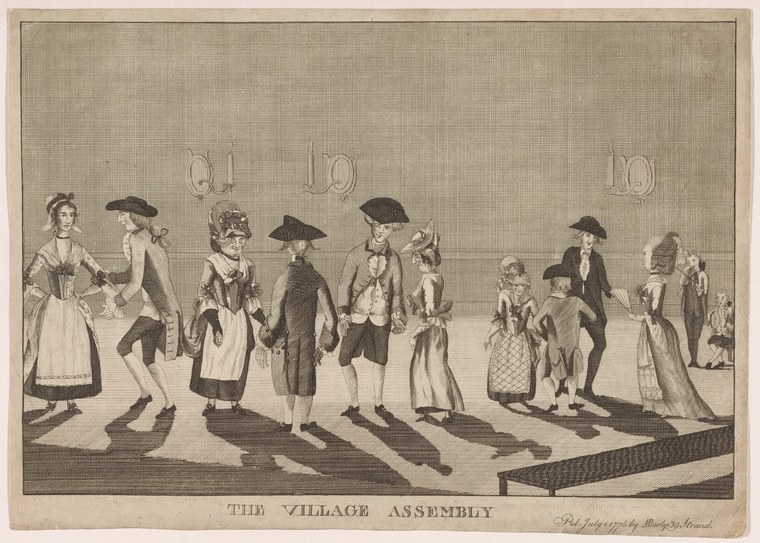
A line of figures in 18th-century dress stands in a village square or green space, arranged horizontally across the composition. The setting is minimal: a flat ground plane with what appears to be a low platform or step at the lower edge. The figures are mostly men and women in period clothing—tricorn hats, knee breeches, long skirts, and jackets—though the rightmost figures are smaller, suggesting children. The scene is rendered in the style of a satirical or humorous engraving, with exaggerated proportions in some figures' postures. Above the gathering, three oval medallions are inscribed with the numeral '19', suggesting this is one scene from a larger sequential narrative. The overall composition is a flat frieze—no perspective recession, no depth—which was typical of popular prints meant for quick reading and circulation.
The dancing
The figures stand in a loose, roughly linear arrangement, with considerable variation in their postures. Some stand upright and formal; others lean or twist awkwardly. Several appear to have one leg extended or weight shifted, though it is difficult to determine whether this represents actual footwork or simply satirical exaggeration of countrified clumsiness. There is no evidence of partner holds, closed frames, or the structured positioning of formal dance—the group looks more like people gathered to witness or participate in a casual assembly than partners executing choreography. The children on the right are distinctly smaller and less formally posed.
The dance depicted
The title 'The Village Assembly' suggests a scene of rural social gathering rather than codified dance performance. This appears to document a type of folk gathering—possibly a village fair, market day, or community assembly—where people congregated. Whether actual dancing occurred or was intended to occur is unclear from the image alone; the awkward postures and satirical treatment suggest the artist may have been mocking rustic manners rather than recording accomplished dancers. If dancing is present, it would be vernacular village dance, likely English folk tradition, but the composition and style do not clarify the specific dance type or movement vocabulary.
How it was made
This is an engraving or possibly a hand-colored engraving on paper. The fine linear work, the way light and shadow are created through cross-hatching and line density, and the overall tonal range are characteristic of 18th-century engraving technique. The inscription at the base appears to credit the artist: 'Printed and published by Hogarth, Oxford'. The three numbered medallions above suggest this is part of a larger series, possibly a narrative sequence. Engravings of this period had wide circulation among middle and lower-middle classes—they were affordable, portable, and ideal for satirical or humorous social commentary. The technique allowed fine detail and legible narrative; the medium's association with serial publication and satire suggests this work reached a broad audience.
About this work
This is a satirical engraving from the 18th century depicting a village assembly—a gathering of rural people of mixed ages and status standing in a line. The work belongs to the tradition of satirical or documentary prints that recorded social customs, manners, and amusements of the period. Though titled as an assembly, it is unclear whether structured dance is taking place or being mocked; the composition suggests social gathering more than choreographed performance. The engraving technique and the inscription crediting 'Hogarth, Oxford' places it within a tradition of popular social satire, likely circulated as a single print or as part of a numbered series meant for entertainment and social commentary.
How to look at it
Look first at the arrangement: this is a frieze composition with no vanishing point or illusionistic depth, typical of satirical prints meant to be read quickly like a cartoon. Each figure is a type or character, posed to show manners and social station. Notice the variety of postures—some figures stand stiff and formal, others slouch or gesture awkwardly. The three medallions above numbered '19' indicate this is part of a larger sequence; you are seeing one moment or scene from a series. The engraving's fine lines and cross-hatching create texture and shadow without color, making facial expression and costume detail legible from a distance. This is a print made to be owned, handled, and shared—not a monumental work.
The artist
The inscription credits publication to 'Hogarth, Oxford,' though this does not necessarily identify the engraver or designer. William Hogarth (1697–1764) was the most famous satirical printmaker of the period, known for series of moralistic and humorous prints documenting English manners. However, the attribution here is to 'Hogarth, Oxford' (likely a printseller or publisher at Oxford) rather than to Hogarth himself. Without further documentation, the true artist remains uncertain. The style and method are consistent with commercial satirical engravings of the mid-18th century.
The period
The 18th century saw a boom in satirical and social-documentary engravings aimed at a literate middle-class audience. Dance in this period existed in two strongly divided registers: formal court and ballroom dance (minuet, cotillion, country dance, quadrille), which was documented in instruction manuals and depicted in polite conversation pieces, and vernacular village and fair dance, which was often depicted satirically or mockingly as rude or uncouth. The numbering of this print (19) suggests it was part of a larger series—possibly a narrative or a typological sequence of social scenes. Village assemblies and fairs were common sites of social life in rural England, and their representation in prints tells us about class attitudes: rural gatherings were often shown as comical or contemptible by urban artists and audiences.
Where it lives
This work is held in the Prints collection at the New York Public Library, catalogued as part of their holdings of dance-related prints. The inscription and publication line suggest it was issued as a commercial print in the 18th century, likely sold individually or as part of a bound series to collectors of satirical or social-documentary engravings.
Dance in this work
Questions about this work
Is this actually showing dancing?
The title says 'assembly,' not 'dance,' and the postures are awkward and varied rather than coordinated. This appears to be a representation of a village gathering—a social and commercial occasion—rather than a formal or structured dance. Whether dancing occurred is not visually clear from the composition. The satirical style suggests the artist was mocking rustic manners, not celebrating accomplished dancing.
Why are there three ovals with the number 19?
This indicates the print is one scene (scene 19) from a larger series. The series format was common for satirical engravings, which told stories or presented types of people and occasions. To understand the narrative or thematic context, you would need to see the other numbered prints in the series.
What does 'Hogarth, Oxford' mean?
This was likely a publisher's or printseller's name—'Hogarth' may have been a shop name, not necessarily the designer William Hogarth. The attribution of 18th-century commercial prints is often uncertain; many engravings were produced in workshops or by anonymous engravers for commercial publishers.
What kind of people are shown here?
The group includes figures in different styles of dress, suggesting mixed social status. The presence of children, adults in various states of dress formality, and the rural setting indicate this is meant to represent a cross-section of village society—not an aristocratic or fashionable assembly, but common people.
More dance artwork





