49 works in this view — arrow keys or swipe to move between them.
Dance in Art
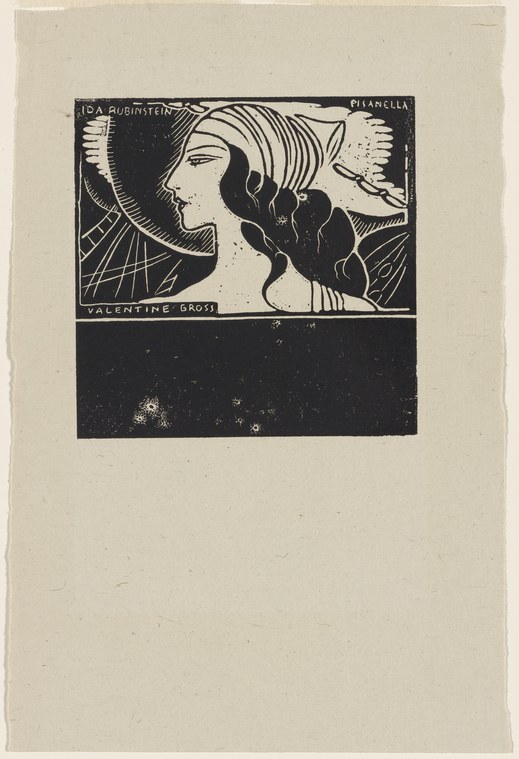
Ida Rubinstein, Pisanella
Unknown artist
- Collection:
- Prints depicting dance
- Source:
- New York Public Library
- Rights:
- Public domain — free to use, share and adapt.
- Recorded as:
- Public Domain
Ida Rubinstein was a transformative figure in early modern dance and theater, bridging Russian Imperial ballet aesthetics with avant-garde theatrical innovation. This portrait is evidence of her cultural prominence and the modernist visual language used to market and commemorate her performances. For historians of dance and theater, it illustrates how a performer's image was constructed and circulated in the early 20th century.
What you are looking at
A woodcut portrait of a woman in profile, facing left, her face serene and idealized in the Art Nouveau manner. She wears an elaborate headdress with radiating lines that suggest wings or a halo, and her hair flows in Art Nouveau curves down her back. The background is divided into two zones: the upper portion features geometric patterning with angular rays emanating from behind her head, while the lower half is solid black. The composition is strictly frontal and symmetrical, emphasizing the decorative quality of the figure rather than narrative or movement. Text at the top reads "IDA RUBINSTEIN" and "PISANELLA," identifying both the dancer and the role. The technique creates strong contrasts between the white of the face and hair and the black ground, characteristic of early 20th-century woodcut aesthetics.
The dancing
The figure is stationary and shown in profile, with no indication of physical movement or dance posture. The body is not articulated beyond the head and shoulders; the lower body and limbs are absent or merged with the decorative border. The face is rendered with idealized, aristocratic features—a small mouth, refined nose, and elegant cheekbone—and the gaze is directed outward, not downward in concentration. This is a portrait of a dancer rather than a depiction of dancing.
The dance depicted
The print documents Ida Rubinstein in the role of Pisanella, a character from a 1913 theatrical production. Pisanella was a fantastical play by Gabriele d'Annunzio with choreography and dance interludes, performed by Rubinstein and her company. Rubinstein was a celebrated Russian-born dancer and actress who specialized in exotic, orientalist, and literary roles in the early 20th century. The costume and headdress visible here—elaborate, symbolic, otherworldly—are consistent with the aesthetic of d'Annunzio's avant-garde theatrical vision. This is a commemorative portrait rather than a documentation of specific dance technique or movement.
How it was made
This is a woodcut, a relief printing technique in which an image is carved into the surface of a wooden block. The bold line work, strong value contrasts, and flattened perspective are characteristic of the medium. Woodcut allowed for affordable multiple impressions and was favored by avant-garde and modernist artists in the early 20th century. The technique here emphasizes decorative line and silhouette over anatomical detail, reflecting the influence of Art Nouveau and Expressionism on contemporary printmaking. The print would have been circulated among theater-goers and collectors interested in modern dance and theatrical innovation.
About this work
This is a commemorative woodcut portrait of the Russian dancer Ida Rubinstein in the role of Pisanella from the 1913 d'Annunzio theatrical production. It is not a representation of dance in action, but rather a portrait of a celebrated performer in costume. The work belongs in a gallery of dance in art because it documents a major figure in early modern theater and the aesthetics of early 20th-century avant-garde performance. Rubinstein was a pioneering force in bringing exotic, literary, and experimental performance to European audiences, and this print captures the visual language of her theatrical persona: otherworldly, decorative, aligned with Art Nouveau aesthetics.
How to look at it
The portrait is best understood not as a frozen moment of dance, but as a stylized emblem of Rubinstein herself. Observe the way the artist has used the headdress and radiating lines to suggest otherworldliness and theatrical artifice rather than naturalism. The profile pose and the strong linear patterning are conventions of early modernist portraiture, designed to convey both beauty and cultural significance. The absence of the body below the shoulders is typical of the woodcut medium and reflects the artist's focus on the face as the primary vehicle of the dancer's identity and appeal.
The artist
The artist is not recorded in the catalogue. The style is consistent with early 20th-century European modernism, particularly Art Nouveau and German Expressionism. The woodcut technique and the decorative, linear approach suggest an artist working in the avant-garde circles of 1910s Europe, possibly associated with the circles around Rubinstein's productions or with experimental printmakers of the period.
The period
This print dates from or shortly after 1913, a pivotal moment in European modernism. Rubinstein's Pisanella was part of a broader movement toward literary and artistic theater, influenced by Symbolism and by the aesthetics of the Ballets Russes. The early 20th century saw a flourishing of the decorative arts and the elevation of the dancer as a symbol of modernity, sensuality, and artistic innovation. Woodcut and other bold graphic techniques were being revived and reinvented by modernist artists seeking to break with academic tradition and academic realism.
Where it lives
The print is held in the New York Public Library's collection of prints depicting dance. It is a standalone work of graphic art rather than part of a larger album or series, though it likely circulated alongside other theatrical documentation and prints from the period.
Questions about this work
Who was Ida Rubinstein?
Ida Rubinstein (1885–1960) was a Russian-born dancer, actress, and patron of the arts. She performed in the Ballets Russes under Diaghilev and later created her own company, commissioning works from leading modernist artists and composers including d'Annunzio, Stravinsky, and Ravel. She was known for her dramatic intensity, beauty, and commitment to avant-garde theatrical innovation.
What was Pisanella?
Pisanella (1913) was a play written by Gabriele d'Annunzio, the Italian Symbolist poet and dramatist, with dance sequences and music. It was a fantastical tale set in medieval Venice, featuring exotic costumes and otherworldly spectacle. Rubinstein starred in the production, which exemplified the cross-genre theatrical experiments of the early 20th-century avant-garde.
Why is this a woodcut rather than a photograph or painting?
Woodcut was a popular and economical medium for theatrical portraiture in the early 20th century, allowing multiple reproductions to be distributed to fans, critics, and collectors. The bold graphic style also suited the modernist aesthetic of the period and conveyed a sense of artistic innovation and cultural prestige that aligned with Rubinstein's avant-garde reputation.
More dance artwork





