49 works in this view — arrow keys or swipe to move between them.
Dance in Art
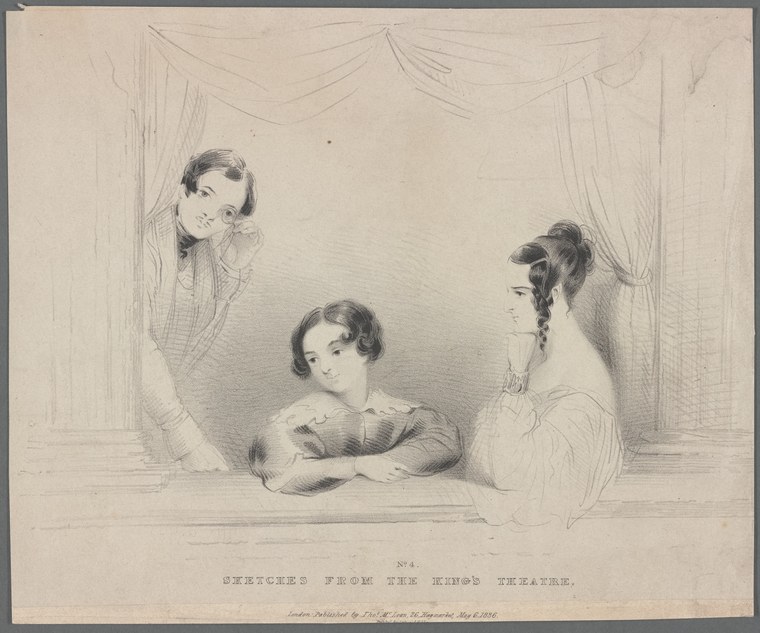
Sketches from the King's Theatre
Unknown artist
- Collection:
- Prints depicting dance
- Source:
- New York Public Library
- Rights:
- Public domain — free to use, share and adapt.
- Recorded as:
- Public Domain
The image documents the aesthetic and social world of early 19th-century theatrical life and fashion, showing how performers were depicted for audiences of the period. It reveals that theatrical imagery was not always about choreography or spectacle, but often about capturing the personality and grace of individual performers in moments of ease.
What you are looking at
Three young women in Regency or early 19th-century dress occupy a curtained interior space, rendered in fine pencil with careful cross-hatching and tonal modeling. The setting is minimal—a simple interior with draped curtains and a floor line—but the artist has lavished attention on the figures' faces and the fall of their clothing. The woman on the left leans forward with her head tilted, smiling directly outward; the woman in the center sits with her body relaxed, her gaze lowered; the woman on the right is shown in profile, her posture more reserved. All three wear high-waisted empire-silhouette gowns and have their dark hair arranged in the fashion of the 1800–1820 period. Their positioning suggests a moment of intimate social interaction—perhaps at a ball or private gathering—rather than formal choreographed movement. The overall tone is delicate and refined, with light seeming to fall softly across the faces and drapery.
The dancing
The three women are not in any closed or formal dance hold. Their bodies are relaxed and conversational: the leftmost figure leans forward expressively, the center figure sits or rests her weight lightly, and the rightmost stands with a gentle contrapposto. The artist has captured the elegance of the period silhouette—the high waist, the long fall of the skirts—but the postures are those of repose and social ease rather than active dancing. No footwork is visible; the emphasis is on the head, shoulders, and the graceful line of the torso.
The dance depicted
This does not depict an active or identifiable dance step or technique. The title *Sketches from the King's Theatre* suggests these may be figures from a theatrical production or entertainment venue, but the image shows them in a moment of rest or casual social interaction rather than in performance. If these are theatrical dancers or performers, the artist has chosen to capture them off-step, in the stillness between movements. The work functions more as a study of feminine grace, fashion, and emotional expression than as a record of choreography.
How it was made
This is a pencil drawing or possibly a graphite and wash work on paper, executed with considerable refinement. The artist employed fine hatching and cross-hatching to model form and create tonal depth, particularly in the drapery and the subtle modeling of the faces. The technique suggests a work intended for circulation as a finished drawing or as the basis for an engraving—the precision and finish are consistent with professional practice of the early 19th century. The delicate linework and careful attention to light effects are characteristic of Regency-era drawing practice, when such sketches of theatrical and fashionable society were popular subjects for prints and private collections.
About this work
This is a finely executed pencil sketch of three young women in Regency dress, titled as sketches from the King's Theatre—likely the Theatre Royal, Drury Lane or another major London venue of the early 19th century. The work captures a moment of social ease and refined femininity rather than active dance, yet it belongs to the tradition of theatrical and dance imagery insofar as it documents performers or figures associated with the stage. The artist demonstrates knowledge of contemporary fashion and a keen sensitivity to portraiture and emotion. The work offers insight into how female performers were represented during the Regency period—not always in action, but often in moments of elegance and intimate social interaction that emphasized their refinement and appeal to a fashionable audience.
How to look at it
Notice the artist's choice to freeze a moment of stillness and social interaction rather than dramatic movement or performance. The careful rendering of the faces and the play of light on the fabrics invite close looking; the composition asks you to read the personalities and relationships of the three figures. The precision of the line work and the refinement of the technique signal this as a work intended for educated viewers familiar with both drawing and fashionable society.
The period
The King's Theatre in Pall Mall was a major venue for opera and dance during the Regency era (1811–1820) and beyond. The period saw a fashion for lithographic and engraved theatrical prints, which were widely collected and circulated. Sketches such as this were often made as studies for prints or as independent artworks for collectors interested in theatre, dance, and fashionable society. The Regency saw a particular enthusiasm for ballet and spectacular theatrical productions, though this image captures the quieter, more intimate side of the theatre world.
Where it lives
The work is held by the New York Public Library as part of its collection of prints depicting dance. It is catalogued under the title *Sketches from the King's Theatre* with an unknown artist and unknown date, though the style and subject matter strongly suggest an early 19th-century origin and likely British provenance.
Questions about this work
Are these figures actually dancing?
Not in the moment captured here. The artist has chosen to depict them in a moment of social ease and conversation, not in active performance. They may be theatrical performers or figures from the King's Theatre, but the image itself documents a pause rather than choreography.
What was the King's Theatre?
The King's Theatre in Pall Mall, London, was one of the major venues for opera, ballet, and theatrical entertainment from the late 18th century onward. It was a fashionable gathering place and a center for the performance of both dramatic and dance works.
What does the clothing tell us?
The empire-waist gowns, hairstyles, and overall silhouette are consistent with Regency-era fashion (approximately 1800–1820). The refinement and elegance of the dress suggest these are women of some social standing, likely performers or ladies of fashion rather than working-class figures.
Why is this image included in a dance collection?
Although it does not show active dancing, the work is a document of theatrical life and the aesthetic world surrounding performance and performers. It offers historical evidence of how dancers and theatrical figures were represented and understood during the Regency period.
More dance artwork





