49 works in this view — arrow keys or swipe to move between them.
Dance in Art
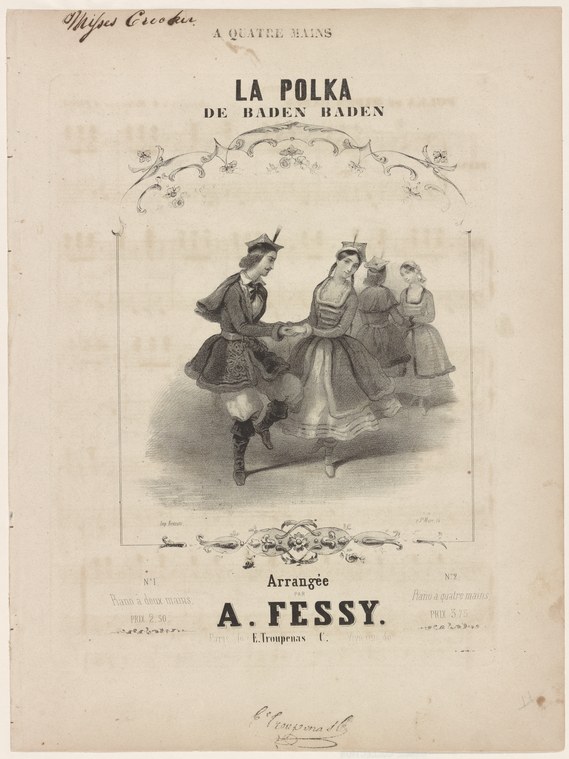
La polka de Baden Baden.: Arrangée par A. Fessy. A quatre mains
Unknown artist
- Collection:
- Prints depicting dance
- Source:
- New York Public Library
- Rights:
- Public domain — free to use, share and adapt.
- Recorded as:
- Public Domain
The polka was a transformative dance in the nineteenth century, one of the first to cross class and national boundaries with speed and enthusiasm, and this print is direct evidence of how it was visualised and marketed to its dancers. For historians of social dance, costume, and gender relations in the ballroom, the image provides specificity about posture, proximity, and the conventions of public dancing that no written description alone could convey. It also reveals the commercial apparatus—sheet music, engravings, fashionable resorts—that made popular dance a matter of public spectacle and domestic practice simultaneously.
What you are looking at
This is a cover sheet for a polka arrangement, engraved in the mid-nineteenth century. The title, in French and German, announces "La Polka de Baden Baden" arranged for four hands—that is, for piano duet. The central vignette shows four figures in fashionable dress of the 1840s–1850s. A man in dark coat and trousers stands at left, one arm extended toward three women who face him. The women wear full skirts with horizontal stripes or bands, fitted bodices, and bonnets or headdresses typical of the period. The figure nearest the man appears to lean or turn toward him, her skirt swept outward by motion. The other two women stand further back, also in the characteristic silhouette of the era. The composition is framed by a delicate ornamental border of flowering vines at top and bottom. The engraving is finely detailed, with subtle shading that gives the figures volume and presence against a pale background.
The dancing
The central couple occupies the foreground in what appears to be a moment of social encounter or invitation. The man's posture is open and engaging, his extended arm creating a dynamic diagonal line. The nearest woman's body responds to this gesture—her weight appears shifted, her skirt billowed outward in a way that suggests active motion. The other two women are positioned as spectators or waiting partners, creating a sense of anticipation or sequence within the dance. The spacing and arrangement suggest the formal, upright carriage expected in ballroom dance of this period, with the figures arranged to create theatrical depth and narrative.
The dance depicted
The polka was one of the most fashionable social dances of the mid-nineteenth century, spreading rapidly from Central Europe to the ballrooms of Paris, London, and Vienna in the 1840s. This print documents the dance in its heyday as a ballroom phenomenon, showing the dress and social context of polka dancing among the respectable middle and upper classes. The composition suggests a moment of courtship or invitation typical of the social dance floor—the moment before or at the opening of a dance, when partners engaged and the dance began. Baden-Baden, a famous spa town in Germany's Black Forest, was a fashionable resort where such dances would have been performed to orchestral music; the arrangement for piano duet allowed amateur musicians at home to reproduce and practice the music.
How it was made
This is a steel or copper engraving, a technique that allowed for fine detail, broad circulation, and commercial reproduction. The delicate hatching and cross-hatching visible in the shading of the figures and the ornamental borders demonstrate the skill required to work in this medium. Such engravings were typically published as sheet music covers or as independent prints, and their circulation through music shops and drawing-room pianos made them a primary visual record of fashionable dance for the period. The fact that this sheet survived in a holding of printed dance imagery attests to its value as both a musical and visual document.
About this work
This engraving documents the polka at the height of its fashionable currency in mid-nineteenth-century Europe. It serves both as a cover for a published musical arrangement and as a visual record of how the dance was dressed, presented, and understood by the ballroom public of its time. The work belongs in a dance collection because it captures not only the movement and posture of the dance but also the social ritual surrounding it—the moment of invitation, the formal dress, the presence of observers, and the context of the ballroom as a space of courtship and social performance. The combination of musical text and figured image makes it a unusually complete historical document of a vanished social practice.
How to look at it
Attend to the moment the artist chose: not the vigorous middle of the polka, but the formal, ritualised opening—the invitation and acceptance. Notice how the man's extended arm and the woman's responding lean create a gesture of social negotiation that is as important to understanding ballroom dance as the step itself. The ornamental frame around the scene signals that this is a refined, drawn-room activity—not street dancing or folk dancing, but a ballroom practice. The precision of the engraving, especially in the rendering of the fabrics and the subtle modelling of the faces, communicates the seriousness with which fashionable dress and appearance were regarded: these are people on display, and the print itself is part of that display.
The artist
The arranger is named as A. Fessy (the first name is not given in the inscription visible on this cover). Fessy was a music publisher and composer active in Paris in the mid-nineteenth century, producing numerous arrangements of fashionable dance music for the amateur market. The engraver is not identified on the visible portions of this impression. The practice of publishing dance music with engraved vignettes was standard in the period, and the involvement of trained engravers in these commercial projects ensured a high standard of visual documentation.
The period
The polka emerged in Bohemia in the 1830s and became a craze across Europe in the 1840s and 1850s. It was faster and more playful than the waltz, and it allowed for greater informality and spontaneity in the ballroom. The rise of lithography and steel engraving made it possible to mass-produce images of fashionable life, and dance prints became a major category of popular visual culture. At the same time, the expansion of middle-class leisure, the growth of spa towns and resort culture, and the emergence of the piano as a fixture of respectable domestic life created a vast market for sheet music and dance instruction. Baden-Baden, where this polka is set, epitomises this convergence: a spa resort catering to the wealthy and fashionable, where music, dance, and the display of fine dress were central to the social calendar.
Where it lives
This work is held in the New York Public Library's collection of prints depicting dance. It survives as a published sheet music cover, one of many thousands of such documents produced during the height of the polka's popularity. The handwritten inscription at the top ("Myss Crache" [?]) suggests this was a owned copy, perhaps belonging to an amateur musician or dancer.
Dance in this work
Questions about this work
What is a polka and who danced it?
The polka was a lively couple dance that originated in Bohemia in the 1830s and became an international craze by the 1840s. It was danced in ballrooms across Europe and America by the respectable middle and upper classes. Unlike the waltz, it was faster, more playful, and allowed for greater informality. It remained popular throughout the nineteenth century.
Why was Baden-Baden significant for dance?
Baden-Baden was a fashionable spa resort in Germany's Black Forest, known for attracting wealthy and aristocratic visitors. Music, dance, and social gatherings were central to life at the resort, making it a showcase for the latest fashions in dress and dance. A polka named after the town would have had considerable prestige and cachet.
What does 'arrangée à quatre mains' mean?
This French phrase means "arranged for four hands"—that is, arranged for two pianists playing on the same instrument. Such arrangements were common in the nineteenth century, allowing amateur musicians and music students to perform orchestral or ballroom music at home. It democratised access to fashionable music.
How does this print record the dance itself?
The posture, spacing, and dress of the figures all convey conventions of ballroom dancing in the period. The upright carriage, the formal proximity between partners, the woman's skirt caught in motion, and the presence of observers all document how the polka was actually performed and experienced as a social ritual, not merely as a set of steps.
More dance artwork





