49 works in this view — arrow keys or swipe to move between them.
Dance in Art
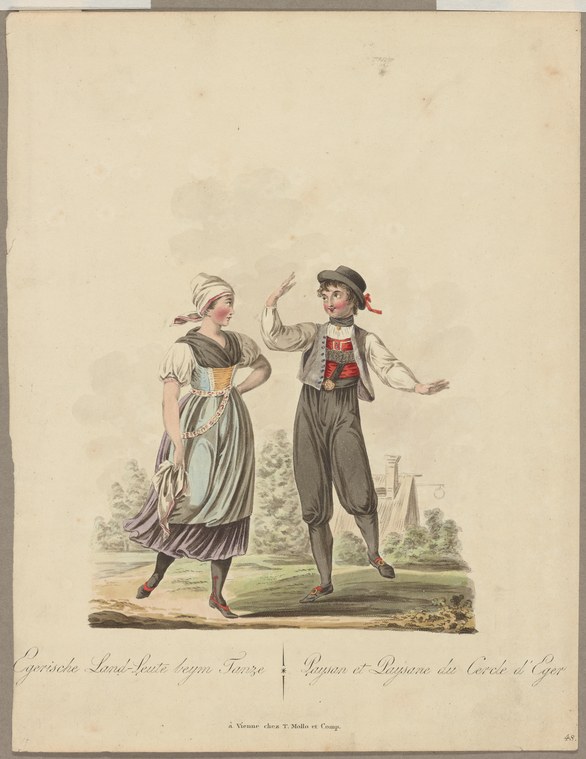
Egerische Land-Leute beym Tanze
Unknown artist
- Collection:
- Prints depicting dance
- Source:
- New York Public Library
- Rights:
- Public domain — free to use, share and adapt.
- Recorded as:
- Public Domain
The work is evidence of how 18th-century print culture visualized the distinction between courtly and rural dance, and how regional identity was encoded in movement and dress. For dance historians, it shows the moment when folk dance began to be collected and represented as a subject worthy of artistic attention—a shift that would accelerate through the Romantic period and into modern ethnography.
What you are looking at
A young woman in peasant dress and a young man in folk costume dance together outdoors, suggesting a rural celebration or courtship ritual. The woman wears a pale linen shift with puffed sleeves, a fitted bodice laced over it, and a long skirt with visible underskirts; a white headcloth is tied under her chin. The man is dressed in dark breeches, a white shirt, a dark embroidered waistcoat with red decorative elements, and a dark cap with a red ribbon or feather. He gestures expansively with one arm raised and bent, his body angled toward her in an animated posture; she holds her skirt in one hand and appears to step back or away, her torso turned and her free arm raised. A simplified landscape of grass and distant trees fills the background. The print's hand coloring shows careful attention to the textiles and their regional character.
The dancing
Two figures in an engaged but asymmetrical spatial relationship: the man is the active, gestural partner, his body weight forward and his raised arm expressing emphasis or invitation; the woman responds with a step or pivot away, her body angled and her skirt lifted to clear her feet. The pair do not touch, suggesting either a moment of separation within the dance or a courtship exchange involving approach and retreat. The man's posture is open and communicative; the woman's is more guarded, with her arm raised in a gesture that could be deflection or reciprocal expression.
The dance depicted
This appears to be a central or eastern European folk dance, most likely Hungarian or Austrian Alpine given the costume elements and the German-language caption. The title translates to 'Egerische country people dancing,' placing it geographically and socially in folk tradition rather than theatrical performance. The compositional choice—the man as aggressor or pursuer and the woman as selective responder—is typical of courtship dances of the 18th and 19th centuries in which dance encoded social negotiation. The raised skirt and animated gesture suggest vigorous, ornamented movement rather than the smooth suspension of courtly dance.
How it was made
This is a hand-colored engraving or possibly a hand-colored etching, typical of the 18th-century European print trade. The fine line work, the careful modeling of fabric through hatching and cross-hatching, and the precision of the figure outlines are consistent with copper-plate engraving. The hand coloring—applied after printing—is visible in the washes of ochre, blues, reds, and greens, and shows the kind of selective emphasis common to popular and pedagogical prints of the period. This technique allowed for affordable wide circulation and suggests the image served as a record of regional costume and dance practice for audiences beyond the region itself.
About this work
This is a colored engraving documenting rural dance practice in what appears to be 18th-century Hungary or Austria, part of a broader European print tradition of recording national and regional character through costume and movement. The work captures a moment of social dance outside the courtly or theatrical sphere, showing how bodies and dress conveyed identity, region, and social negotiation. It belongs in a dance archive as a historical document of how peasant dance was understood, represented, and circulated in the period—not as folk practice itself, but as an educated European's image of folk practice.
How to look at it
Attend to the asymmetry of the figures: the man's outward, expansive energy contrasted with the woman's more contained and deflecting posture. This imbalance is not compositional accident but a record of the social dance itself, in which partners take distinct roles. Notice also the precision with which textiles are rendered—the texture of linen, the structure of the bodice, the weight and movement of the skirt—showing that costume is integral to the dance's meaning and execution. The outdoor setting with minimal architecture suggests this is documentation of actual practice rather than a staged or imagined scene.
The period
In the 18th century, European artists and printsellers developed a strong commercial interest in documenting regional costume and dance. This coincided with the emergence of national consciousness and Romanticism's later celebration of folk culture as an authentic wellspring of national character. Peasant dance was not yet performed on stage for aristocratic audiences in the manner it would be by the 19th century, but it was actively studied, illustrated, and circulated in prints. The engraving tradition allowed for the mass production and international distribution of such records, making regional practices visible to distant audiences.
Where it lives
The work is held in the New York Public Library's Prints collection. It is a single-sheet engraving from a series documenting European regional dances and costumes, typical of the commercial print trade of the 18th and early 19th centuries.
Dance in this work
Questions about this work
What region or country does this dance come from?
The German caption 'Egerische Land-Leute' refers to Eger, a city in what is now the Czech Republic (historically part of Bohemia and Austria). The costume—especially the man's embroidered waistcoat and the woman's laced bodice and bound headcloth—are consistent with Central European folk dress of the 18th century, likely Hungarian or Austro-Hungarian in character.
Is this a real dance or an invented one?
The caption and costume suggest this documents an actual regional dance practice, though we cannot verify the accuracy of the depiction from the print alone. The work is a printed representation made for circulation, so it reflects both observation and the conventions of how prints represented dance to educated audiences of the period. It is a historical document of how folk dance was understood and represented, whether or not it depicts the practice with ethnographic precision.
What is the relationship between the two dancers?
The spatial configuration and gesture suggest courtship or social interaction rather than a formalized partnership. The man's open, invitational posture and the woman's more reserved response are typical of courtship dances in which the man initiates approach and the woman responds with acceptance or deflection. This dynamic would have been immediately legible to contemporary audiences familiar with the social meanings of dance.
How was this print made and circulated?
This is a hand-colored engraving, made by incising a design into a copper plate, inking it, and printing it on paper. The color was then applied by hand, likely in a workshop setting. Such prints were produced and sold in quantities to a broad European market, making them affordable educational and decorative objects for people interested in costume, dance, and regional culture.
More dance artwork





