49 works in this view — arrow keys or swipe to move between them.
Dance in Art
Bal d'Asnières
Unknown artist
- Collection:
- Prints depicting dance
- Source:
- New York Public Library
- Rights:
- Public domain — free to use, share and adapt.
- Recorded as:
- Public Domain
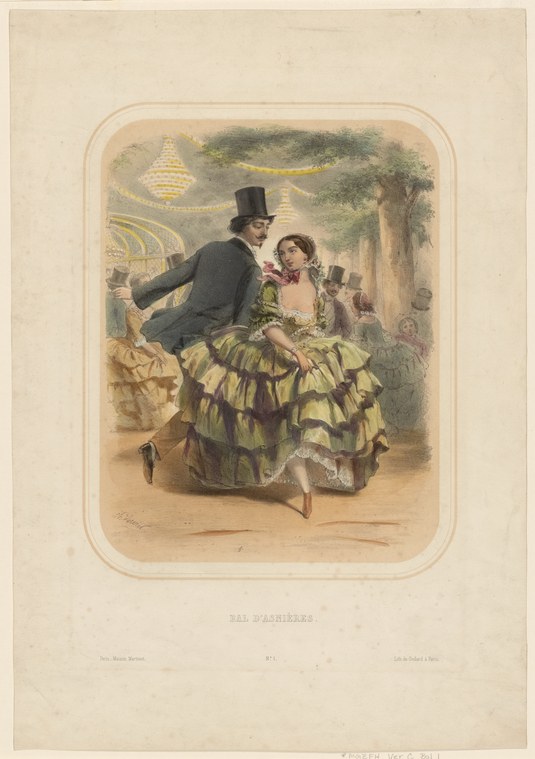
This image reveals the social logic of nineteenth-century ballroom dance: that the waltz and quadrille were not primarily about movement but about negotiating desire and social standing through dress, gesture, and the body's spatial relationship to another. For historians of dance, gender, and courtship, it is a precise record of how Romantic-era society staged intimacy within constraint.
What you are looking at
A hand-colored engraving depicting a moment of social flirtation in what appears to be an elegant interior or ballroom. A man in dark formal dress—tailcoat, top hat, and white shirt—leans toward a woman seated or half-seated in a voluminous dress of yellow and black striped silk, with deep flounced layers. His posture is animated and gallant, one arm extended as if in invitation or mid-gesture; hers is more demure, her head tilted slightly away. The composition is intimate and playful, capturing a moment of courtship rather than active dance. Behind them, the setting suggests an aristocratic interior with classical architectural details—pilasters, architectural molding—and foliage or drapery in muted greens and golds. A second female figure appears dimly in the background. The overall tone is one of Romantic-era salon society: elegant, flirtatious, and bound by strict conventions of dress and deportment.
The dancing
The central couple occupies the foreground in a close conversational or pre-dance arrangement. The man's weight is forward, his body language open and inviting; the woman is seated or in a moment of rising, her body angled away in a gesture that reads as coquettish hesitation. Neither figure is in an active dance hold or frame. The woman's enormous skirt dominates the composition, its heavy fabric and structured flounces suggesting the material constraints of 1840s–1850s fashion. No footwork is visible. The positioning suggests the moment just before a dance rather than during it.
The dance depicted
This appears to document a moment of social dance courtship in the Romantic ballroom tradition rather than a depiction of active dancing. The context—elegant dress, formal interior, the gestural language of flirtation—places it within the world of the waltz, polka, or quadrille of the mid-nineteenth century. However, the image captures the social negotiation that preceded the dance rather than the dance itself. The title 'Bal d'Asnières' (Ball at Asnières) indicates a specific event or venue, suggesting this may document a recognizable moment from contemporary social life or literature, though without attribution or date this cannot be confirmed. The work functions as a record of ballroom etiquette and courtship ritual as much as of dance technique.
How it was made
This is a hand-colored engraving, characterized by fine line work in the figures and architectural elements, with watercolor or gouache applied to create the bold patterns of the woman's dress and the warm tones of the interior. The technique allowed for precise rendering of costume detail and social register while maintaining the reproducibility of the engraved line. The careful hand-coloring suggests a work intended for the middle-to-upper-class market—circulating among people who could afford both the original print and the cost of professional coloring. The style and execution are consistent with French or Belgian popular prints of the 1840s–1860s.
About this work
Bal d'Asnières is a social document disguised as a dance scene: a hand-colored engraving capturing the moment of courtship negotiation on the ballroom floor of the Romantic era. Rather than depicting the mechanics of dance, it records the codes of flirtation and invitation that governed heterosexual encounter in elite society. The woman's resistance—her body angled away, her posture controlled—and the man's ardent lean toward her embody the dynamic tension that made the ballroom a space of both strict propriety and genuine risk.
The work belongs in a gallery of dance art not because it shows bodies moving but because it shows what the ballroom *meant*: a licensed arena for controlled courtship between strangers of different sexes, governed by fashion, form, and the eye of society. The print circulated to an audience that understood these codes intimately; it flattered that knowledge by assuming viewers would read the temperature of the exchange in the angle of a shoulder and the distance between faces.
How to look at it
Attend first to the woman's posture: her body pulls back, her face turns away, creating a visual tension with the man's forward lean. This is not the body language of a woman mid-dance; it is the body language of refusal or hesitation. The artist has frozen a moment before yes or no, capturing the social risk inherent in the dance invitation. Second, observe how completely the woman's skirt dominates the composition: its volume and pattern are the visual subject, more prominent than either figure's face. This tells you how costume functioned in Romantic-era society—not as adornment but as a statement of status and a barrier to physical closeness. The man's formal dark coat is nearly invisible beside it.
The period
The image dates to the heyday of the Romantic ballroom (circa 1840–1870), when the waltz and polka had transformed social dance into a vehicle for heterosexual courtship in elite society. The enormous skirts visible here—with their deep flounces and elaborate construction—are consistent with the fashion of the mid-1840s through 1860s, the era of the crinoline. During this period, hand-colored engravings of ballroom life were a popular genre in France and northern Europe, feeding middle-class appetite for images of fashionable society and its rituals. The specificity of the title (a named location or event) suggests this may document an actual ball or a scene from contemporary literature or theatrical tradition.
Where it lives
The work is held in the Prints collection of the New York Public Library, catalogued as 'Prints depicting dance.' It is a hand-colored engraving, likely French or Belgian, from the nineteenth century. No artist attribution has been recorded.
Dance in this work
Questions about this work
Is this actually a dance scene?
Not in the sense of depicting active movement. It captures the moment of social negotiation that preceded the dance—the invitation, the acceptance or refusal, the dance as courtship ritual rather than choreography. Many nineteenth-century ballroom prints work this way: they document the social meaning of dance more than its technique.
What does 'Bal d'Asnières' mean?
The title translates as 'Ball at Asnières,' where Asnières is a riverside town northwest of Paris. This may refer to an actual ball held there, or it may be a generic reference to a fashionable venue. Without further documentation, we cannot determine which.
Why is her skirt so enormous?
This is the fashion of the 1840s–1860s, the era of the crinoline: a cage of steel or whalebone under layers of heavy fabric, designed to create volume while maintaining rigid shape. For dancers, it was both a status symbol (only the wealthy could afford such elaborate dress) and a practical constraint—it limited how close a dancing couple could come to each other and restricted the woman's movement to a narrower range.
What dance are they about to dance?
The formal dress, the indoor ballroom setting, and the period all suggest a waltz, polka, or quadrille. Any of these would have been appropriate for a ball at a fashionable venue. The print does not give us enough information to determine which.
More dance artwork





