49 works in this view — arrow keys or swipe to move between them.
Dance in Art
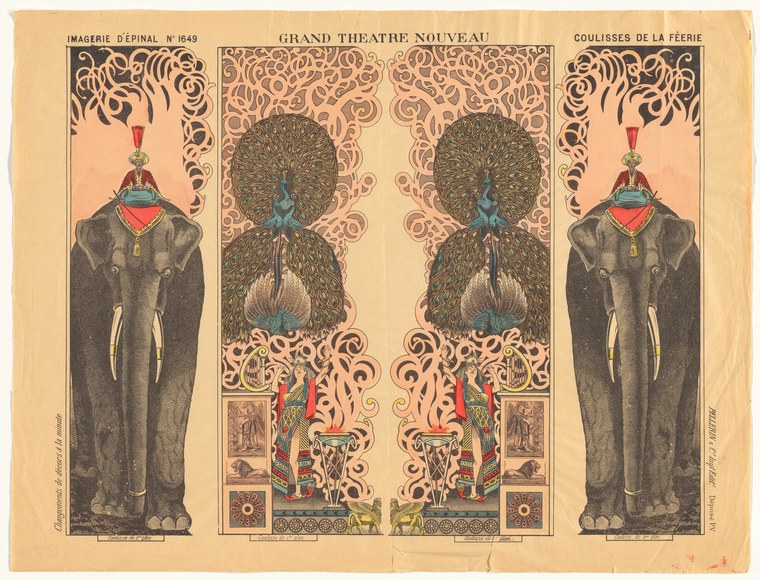
Coulisses de la féerie
Unknown artist
- Collection:
- Prints depicting dance
- Source:
- New York Public Library
- Rights:
- Public domain — free to use, share and adapt.
- Recorded as:
- Public Domain
Féerie was a major form of dance theater in France, yet few detailed records survive of how movement was staged within these lavish spectacles. This design reveals the aesthetic priorities of the form—symmetry, ornament, fantastic transformation, and the human figure as one element within an overwhelming visual environment. For historians of 19th-century dance and theater, such costume and set designs are among the few concrete evidence of how these productions looked.
What you are looking at
This is a symmetrical theatrical design for a fairy spectacle, rendered as a chromolithograph in the decorative style of early 20th-century stage design. The composition is divided into three vertical panels, with a central pair of identical fantastical trees with dense, feathered foliage rendered in dark green and pale cream, crowned with stylized flame-like ornaments in turquoise and gold. On either side stand two identical figures in long, dark formal coats with high collars faced in red and gold trim, each topped with a tall ornamental headdress featuring a red plume. The figures appear to be standing at attention, their bodies rigid and frontal. Below the trees are ornate decorative pedestal forms with scrollwork and geometric patterns, rendered in warm cream and gold tones. The entire design is framed by elaborate Art Nouveau-style borders featuring curling organic forms. The overall effect is of a stage set or backdrop for a spectacular theatrical production, with an emphasis on symmetry, ornament, and fantastic rather than naturalistic form.
The dancing
The two figures are identical mirror images, standing with completely upright posture and frontal orientation. Their bodies show no bend or curve; the arms appear to hang straight down at the sides, and there is no indication of active movement or dance. The stance is formal and processional rather than dynamic. The stiffness and rigidity of the pose suggests these are costumed performers in standing positions rather than bodies captured mid-movement. The ornate dress and headdress dominate the visual composition far more than any indication of physical action.
The dance depicted
This is a stage design for a theatrical fairy spectacle (féerie), a genre of lavish French theater popular in the 19th and early 20th centuries that combined dance, pantomime, acrobatics, and elaborate scenery. The two costumed figures may represent fairy characters or personified elements in such a production. However, the image captures no dancing action itself—it is a costume and scenery design rather than a depiction of choreography or movement. The formal, processional stance suggests this is a design for an entrance, tableau, or ceremonial moment rather than an active dance sequence. Féerie productions frequently featured such spectacular static moments of transformation and revelation alongside more kinetic dance sequences.
How it was made
This is a chromolithograph, a color printing technique that uses separate stones for each color layer. The catalogue identifies it as from the Imagerie d'Épinal, a famous French printmaking house known for mass-producing decorative theatrical designs, broadside illustrations, and popular imagery from the 19th century onward. The technique allowed for affordable, vivid color reproduction and wide circulation. Chromolithographs from Épinal were typically sold as inexpensive prints for domestic display, theater lobbies, or souvenirs, making theatrical imagery widely accessible. The numbered reference in the upper left (N°1649) is the Épinal catalogue number.
About this work
This is a stage design for a spectacular French fairy theater production, rendered as an affordable chromolithograph from the Imagerie d'Épinal. It depicts two costumed figures—likely fairy or celestial characters—flanking an elaborate tree form set against an ornate Art Nouveau border. Although fairy spectacles (féeries) were dance-heavy theatrical forms, this particular design captures a static ceremonial or tableau moment rather than active choreography. It is valuable as a record of how dance was framed and contextualized within popular spectacular theater, and of the aesthetic values the theater industry wanted to project.
How to look at it
Note the absolute symmetry of the composition—each element mirrored on either side of a central axis. This is not a naturalistic stage space but a formal, heraldic arrangement that emphasizes spectacle and visual display over spatial logic. The solidity and stillness of the figures, combined with the extreme ornament surrounding them, suggests this represents a transformative or revelatory moment rather than active dance. Attend to the decorative border: the elaborate Art Nouveau scrollwork tells you this is a designed object circulating in the world as a commodity, not a unique record of a specific performance.
The artist
The work is printed by the Imagerie d'Épinal, a publishing house in Épinal, northeastern France, founded in the early 19th century and famous for producing cheap, colorful woodcuts and chromolithographs for popular consumption. The house issued thousands of designs for theatrical, religious, historical, and decorative purposes, employing workshops of artisans rather than named individual artists. The Épinal style is instantly recognizable: bold colors, clear outlines, symmetrical composition, and accessible imagery designed for broad distribution. By the early 20th century, the house was producing chromolithographs alongside its traditional woodcuts.
The period
This design dates to the high period of féerie in France, a form that flourished from the 1870s through the early 20th century. Féeries were extravagantly produced spectacles combining pantomime, acrobatics, transformation scenes, and elaborate machinery, often performed during the Christmas season or at summer fairs. They sat at the intersection of ballet, music hall, and popular entertainment, and attracted mass audiences. The Art Nouveau style visible in the borders and ornamental forms situates this design in the 1890s–1910s. At this period, the Imagerie d'Épinal was at the height of its production and cultural reach, supplying theatrical imagery to a broad working and middle-class market.
Where it lives
This print comes from the New York Public Library's collection of prints depicting dance. The Imagerie d'Épinal catalogue number N°1649 appears in the upper left margin, indicating its place within the thousands of theatrical designs the house published. Such prints were sold individually, in sets, or in compilations, and copies survive in libraries and museums across Europe and North America.
Questions about this work
What is a féerie?
Féerie is a French form of spectacular theater combining dance, pantomime, acrobatics, and elaborate magical scenery. Popular from the 1870s onward, féeries were often performed during the Christmas season and featured transformations, flights, and fantastic costumes. They were mass entertainment, drawing large audiences and employing extensive technical resources.
Who were these costumed figures?
Without additional documentation, we cannot identify them with certainty. In féerie they may represent fairy characters, celestial or supernatural beings, or personifications of abstract concepts. The ornate headdress and formal dress suggest characters of high status or magical significance within the narrative.
Is this design actually depicting a dance?
No. This is a static costume and scenery design, likely representing an entrance, tableau, or transformative moment within a larger production that certainly included dance. Féeries integrated dance with other performance modes, and this particular design freezes a non-kinetic ceremonial moment.
Why is this print so symmetrical?
Symmetry was a central aesthetic principle of 19th-century spectacular theater design, conveying order, formality, and magical transformation. It also reflects the conventions of decorative printmaking from the Imagerie d'Épinal, which favored balanced, heraldic compositions that were visually striking and easy to reproduce.
More dance artwork





