49 works in this view — arrow keys or swipe to move between them.
Dance in Art
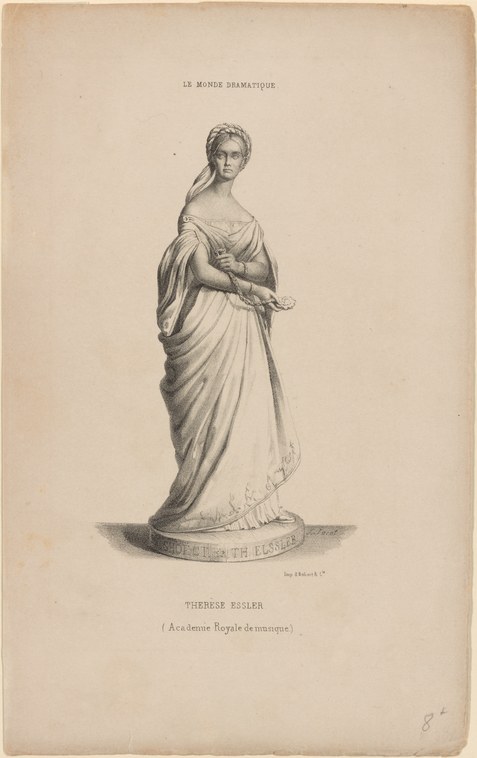
Therèse Essler [sic].: (Academie Royale de Musique)
Unknown artist
- Collection:
- Prints depicting dance
- Source:
- New York Public Library
- Rights:
- Public domain — free to use, share and adapt.
- Recorded as:
- Public Domain
This engraving documents the visual culture of Romantic-era ballet and the standardized way in which celebrated dancers—particularly women—were commemorated and circulated as images. It shows how the figure of the ballerina was idealized through classical drapery and pose, a convention that shaped public perception of ballet for generations. For dancers and historians, it is evidence of the ballet portrait as a distinct genre with its own aesthetics and conventions, separate from depictions of choreography or narrative performance.
What you are looking at
A single female figure in classical drapery stands in contrapposto against a plain background, the whole composition vertically oriented and formally symmetrical. She wears a high-waisted white or cream gown with short sleeves that expose the shoulder, the fabric arranged in graceful folds that fall from the figure's left side; her right arm is extended downward in a gesture of repose or gentle presentation, while her left arm is drawn across her body. Her hair is arranged in a classical style with what appears to be a net or snood. The figure stands on a simple rectangular plinth or base. The engraving is finely executed in black ink on cream paper, with careful attention to the fall of light and shadow across the drapery. The inscription on the base reads "THERESE ESSLER" (or "THÉRÈSE ESSLER"), and below the image the text indicates this is from the "Academie Royale de Musique."
The dancing
A single standing figure in a pose of classical dignity, neither actively dancing nor in a theatrical attitude. The body is upright and symmetrical, with weight appearing to rest equally on both feet rather than in the asymmetrical stance of active movement. The arms are arranged for visual composition rather than dynamic gesture—the right arm hangs at the side with hand visible, the left crosses loosely at the torso. There is no evidence of partnering or ensemble movement. The overall frame is frontal and static, suggesting this is a portrait or commemorative image rather than a depiction of movement in progress.
The dance depicted
This is almost certainly a portrait of a professional ballet dancer, likely from the Romantic era (early-to-mid 19th century), shown in formal dress rather than in character or in the act of dancing. Thérèse Essler was a member of the famous Essler family of dancers and performed at the Opéra de Paris (Académie Royale de Musique). The image follows the convention of the ballet portrait print—a format in which dancers were commemorated in classical costume, dignified pose, and elegant drapery, rather than captured mid-movement. This was standard circulation for celebrated dancers of the period, particularly at major European opera houses. The absence of theatrical props, active pose, or narrative suggests this is a memorial or promotional engraving rather than a document of choreography or performance.
How it was made
This is a steel or copper engraving, finely detailed and tightly rendered in the neoclassical tradition. The technique is evident from the fine parallel lines (hatching) that model the form and create tonal gradation, particularly visible in the drapery and the subtle modeling of the face and neck. The quality and finish suggest professional execution, likely by a skilled theatrical engraver working for the Parisian opera house or a major publishing house. Such prints had wide circulation among the theater-going public and served both as souvenirs and as a form of celebrity portraiture. The medium's capacity for fine detail and clear reproduction allowed wide distribution of images of celebrated performers, making them accessible to audiences beyond those who could attend performances.
About this work
This is a formal commemorative engraving of a Romantic-era ballet dancer, Thérèse Essler of the Opéra de Paris, shown in neoclassical drapery and dignified standing pose. The work belongs to the tradition of theatrical portrait prints that circulated in the 19th century, celebrating professional dancers by rendering them as idealized classical figures rather than documenting them in active performance. It is both a document of Romantic ballet aesthetics—the valorization of the dancer's body and presence—and a record of how dance culture was distributed and consumed through the print market.
The image matters not for what it shows of actual dancing technique or choreography, but for what it reveals about how dancers were represented, celebrated, and commercialized in the 19th-century theater world. The format—a lone idealized figure in classical dress—became the standard way of immortalizing celebrated performers, particularly women, and these prints were avidly collected by the opera-going public. Understanding such portraiture is essential to the history of ballet celebrity and the visual culture of the Romantic stage.
How to look at it
Notice the careful attention to how the drapery clings to and falls from the body, defining form through light and shadow rather than through line alone. Observe the classical pose—the slight turn of the head, the hang of the arms, the equal distribution of weight—which conveys dignity and stillness rather than the energy of dance. Compare this formal, static presentation with images of the same dancers in character roles or mid-movement, to see how the portrait print operated as a distinct visual genre with its own conventions of idealization and presentation.
The artist
The engraver is not recorded in the catalogue. However, the quality and style are consistent with professional Parisian theatrical engravers of the early-to-mid 19th century, a period when such portrait prints were produced in high volume for the opera house audiences. The work may bear a signature or publication mark elsewhere on the plate not visible in this view.
The period
The Romantic era (c. 1820–1860) saw ballet become a major cultural institution, with the Opéra de Paris at its center. Celebrated dancers—particularly women—became celebrities whose images were in high demand, leading to a flourishing market in theatrical portrait prints. These engravings were produced by professional printmakers and distributed through theaters, print shops, and collectors. The aesthetic of the period elevated the idealized female form in classical drapery, reflecting broader neoclassical and Romantic sensibilities in art and design. The Essler family was one of the most celebrated dancing dynasties of the era, with members performing across major European opera houses.
Where it lives
This engraving is held in the New York Public Library's collection of prints depicting dance. It is part of a larger genre of 19th-century theatrical portrait prints, many of which documented celebrated performers of the Romantic ballet era.
Questions about this work
Is this woman actually dancing?
No. This is a formal portrait engraving, not a depiction of choreography or active performance. The figure stands in a dignified, static pose designed to showcase the dancer's presence and elegance rather than her movement or technique. Such portraits were a distinct genre in 19th-century ballet culture—parallel to the photograph or modern celebrity portrait, but using classical costume and pose as the vehicle of idealization.
Who was Thérèse Essler?
Thérèse Essler was a professional ballet dancer associated with the Opéra de Paris (Académie Royale de Musique) during the Romantic era. She was a member of the famous Essler family, one of the major dancing dynasties of the period. Members of the family performed at leading opera houses across Europe and were celebrated figures in the ballet world of the 1830s–1850s.
Why is she wearing a simple white dress rather than a costume?
The white drapery is itself a costume—a classical or Grecian style that was standard in ballet portrait prints of this era. It presented the dancer as an idealized classical figure rather than a character role, and it was neutral enough to be reusable across multiple prints. The simplicity of the costume was part of the neoclassical aesthetic that dominated Romantic-era ballet imagery.
What is this engraving for?
These prints were popular souvenirs and collectibles, sold to theater audiences and distributed to fans. They served as publicity for the dancer and the opera house, and as a form of celebrity portraiture. Collectors of ballet memorabilia avidly sought them, and they were often pasted into scrapbooks or framed and displayed. They are evidence of an active market for ballet images in the 19th century.
More dance artwork





