49 works in this view — arrow keys or swipe to move between them.
Dance in Art
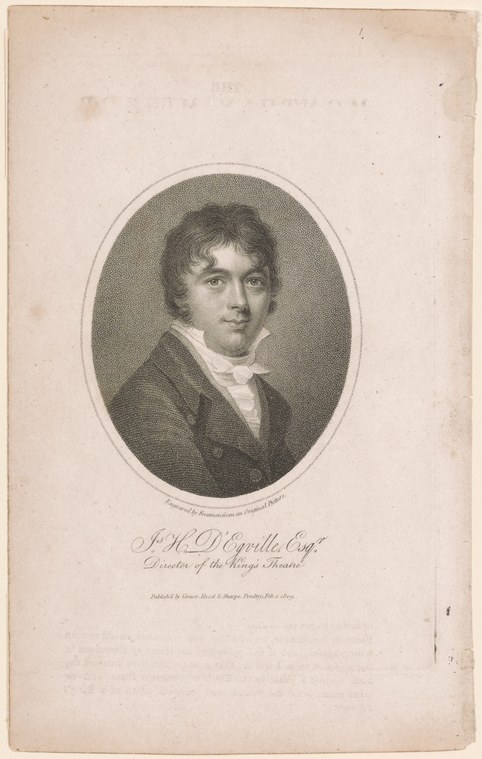
Js. H. D'Egville, Esqr. Director of the King's Theatre
Unknown artist
- Collection:
- Prints depicting dance
- Source:
- New York Public Library
- Rights:
- Public domain — free to use, share and adapt.
- Recorded as:
- Public Domain
Dance history depends on understanding not only the dancers and choreographers but also the directors, impresarios, and administrators who created the conditions for performance. D'Egville's role at the King's Theatre makes him a crucial figure in the institutional life of Regency dance, and this portrait offers visual evidence of how he was presented to the public of his time.
What you are looking at
A half-length portrait in oval format of a young man in early 19th-century dress, shown from roughly the chest up against a plain background. He wears a dark coat over a white shirt with high collar, typical of the Regency era. His hair is dark and styled in the romantic fashion of the period, with some length and natural waves. The expression is direct and composed, with the figure turned slightly to one side, presenting a three-quarter view to the viewer. The engraving technique has rendered the face with fine detail and careful modeling of light and shadow, creating volume and presence. The oval frame emphasizes the formal, commemorative character of the portrait.
The dancing
The figure is stationary, depicted in a pose typical of formal portraiture rather than in movement or dance. The shoulders are relaxed and squared; the head is held with dignity. There is no indication of dance posture, weight distribution for movement, or the kind of physical engagement visible in performance imagery. This is a portrait of a person associated with dance rather than a depiction of dancing itself.
The dance depicted
The portrait does not depict dancing. Instead, it identifies the sitter as a figure instrumental to theatrical dance: James Harvey D'Egville, Director of the King's Theatre. D'Egville was a significant figure in London's dance and theatre world, responsible for programming and oversight of dance at one of the capital's major venues. The image records his status and appearance rather than any dance movement or practice.
How it was made
This is an engraving, identifiable by the fine parallel lines (hatching) used to model form and create tone, and the characteristic precision of the medium. The inscription below indicates it was published by Hookham and Co., suggesting this was a commercial print issued for public sale or distribution. Engraving allowed for multiple impressions and wide circulation among audiences interested in theatre, dance, and public figures. The oval format and formal composition follow conventions for celebrity or commemorative portraiture of the period.
About this work
This is a commemorative engraved portrait of James Harvey D'Egville, the director of London's King's Theatre during the Regency era. Though it does not show dancing itself, it documents a key administrative and curatorial figure whose decisions shaped what audiences saw on stage. D'Egville's role as director places him among the gatekeepers of theatrical dance practice in early 19th-century Britain. The engraved format and commercial publication suggest he was a public figure of sufficient standing to warrant portraiture in a medium designed for mass circulation.
How to look at it
This is not an action portrait but a formal presentation of identity and status. The viewer should attend to the costume—the high collar, dark coat, and white shirt signal both fashion and social rank—and to the direct gaze and composed bearing, which project authority and respectability. The oval frame, refined engraving technique, and publication details together indicate that D'Egville was deemed worthy of memorialization in a form that could circulate widely. The absence of any dance costume or performance context is itself informative: this is how a theatre director, not a dancer, wished to be seen.
The artist
The engraver is not recorded in the catalogue. The publication credit to Hookham and Co., a London printer and publisher active in the late 18th and early 19th centuries, indicates this was a professional commercial enterprise. The style and technique suggest a skilled engraver working in the neoclassical portrait tradition of the period, though attribution would require further research.
The period
This portrait dates to the Regency era, when London's theatrical world was flourishing and dance was gaining prominence on the stage. The King's Theatre (later Her Majesty's Theatre) was one of the two licensed patent theatres in London, and its director held considerable cultural authority over what ballets, pantomimes, and theatrical dances were seen. D'Egville's tenure coincided with a period when Romantic ballet was emerging in Europe and theatrical dance was becoming more ambitious in its artistic pretensions. The engraved portrait was a standard medium for celebrating public figures—actors, dancers, composers, and impresarios—allowing admirers and the curious to own an image of someone they might have seen perform or whose work they admired.
Where it lives
This engraving is held in the New York Public Library's collection of prints depicting dance. It is a commercial print, likely issued for sale to the public or to subscribers interested in theatre and performance during the Regency period.
Questions about this work
Who was James Harvey D'Egville?
D'Egville was a prominent figure in London's theatrical world during the Regency era, serving as director of the King's Theatre. He held significant power over the selection and staging of ballets and theatrical dances. He was also a choreographer and dancer in his own right, though this portrait emphasizes his administrative role.
Why is a portrait of an administrator in a gallery about dance?
Dance history includes not only performers and choreographers but also the directors and impresarios who shaped what was created and seen. D'Egville's decisions about programming and production directly influenced which works were performed and how. Understanding institutional figures like him is essential to understanding the dance world he oversaw.
What does the engraving technique tell us?
Engraving was an expensive, skilled process that produced multiple prints. Its use here signals that D'Egville was considered important enough to warrant this investment. The prints could be sold individually or as part of theatrical portrait collections, making him accessible to a wide public audience interested in theatre and celebrity.
More dance artwork





