49 works in this view — arrow keys or swipe to move between them.
Dance in Art
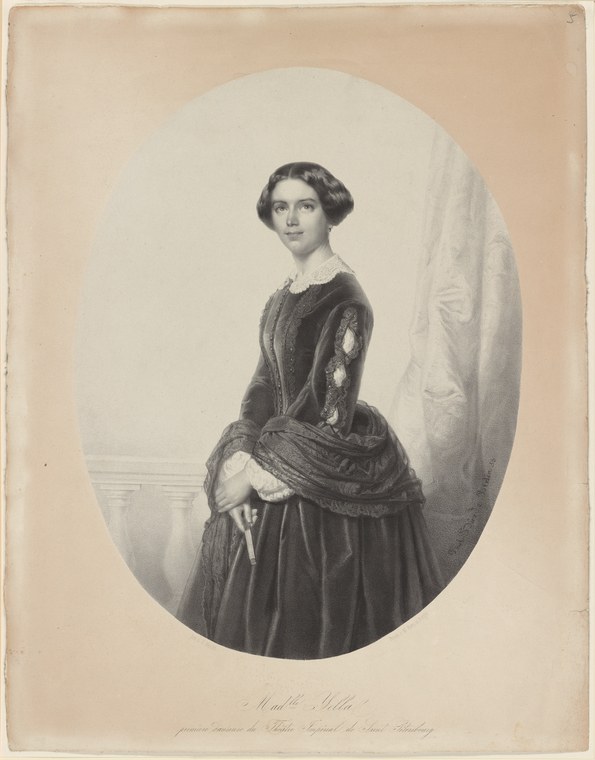
Mad'lle Yella, première danseuse du Théâtre Imperial de Saint Pétersbourg
Unknown artist
- Collection:
- Prints depicting dance
- Source:
- New York Public Library
- Rights:
- Public domain — free to use, share and adapt.
- Recorded as:
- Public Domain
This portrait bears witness to the prominence of Russian Imperial Ballet dancers in the mid-19th century and their recognition as celebrities across Europe. The image also demonstrates the circulation of theatrical portraiture as a commercial and cultural product, through which dancers' fame and professional identity were disseminated to a broad public.
What you are looking at
A three-quarter-length portrait of a woman in mid-19th-century dress, posed against a draped cream or pale blue backdrop. She stands in a composed, graceful stance wearing a dark velvet or silk dress with white lace cuffs at the wrists and what appears to be white lace trim at the neckline. The dress has a fitted bodice with decorative circular ornaments or buttons down the front, and a full skirt gathered at the waist with a dark shawl or wrap draped artfully across her hips and lower body. Her dark hair is styled in the fashion of the 1840s–50s, parted and swept back. Her gaze is directed slightly away from the viewer, lending a contemplative quality. The composition is intimate and dignified rather than active—this is a portrait of a celebrated performer in her professional presentation, not a representation of dancing itself.
The dancing
A single standing figure, poised with an upright carriage and slight contrapposto weight shift. The pose is formal and static, with arms loosely positioned at the sides—one arm hanging naturally, the other held with the hand at the level of the skirt, as if resting on the drapery. There is no suggestion of active movement, elevation, or the dynamic musculature associated with active dance. The body reads as posed for portraiture rather than caught mid-performance.
The dance depicted
This is not a representation of dance in action, but a professional portrait of a named dancer—Mademoiselle Yella, identified in the inscription as a premier dancer of the Imperial Theatre of Saint Petersburg. The image documents her as a public figure and celebrated artist of the Russian Imperial Ballet in what appears to be the Romantic era (1840s–50s). The absence of motion, costume for a specific ballet role, or stage setting indicates this is a commemorative portrait rather than a scene of performance. Without seeing the dancer in motion or in character costume, we cannot determine her specific repertoire or technique from the image alone.
How it was made
This is a hand-colored engraving or lithograph, characteristic of mid-19th-century theatrical portraiture. The technique allowed for broad distribution of images of celebrated performers, making them available to the public as affordable prints sold in theaters and print shops. The soft tonal modeling, particularly in the backdrop and the careful rendering of fabric textures and lace, suggests either a skilled engraving with hand-coloring or a lithographic process. The oval vignette format—with soft edges fading to the plain background—was a conventional choice for theatrical portraits of the period, conferring dignity and focus on the sitter.
About this work
This is a professional portrait of a celebrated dancer at the Imperial Theatre of Saint Petersburg during the Romantic era of ballet. Mademoiselle Yella is presented not in performance but in formal dress, a convention of theatrical celebrity portraiture in the 19th century. Such prints circulated widely in European art markets and documented the public identities of dancers whose performances were increasingly appreciated as high art. The work belongs in a dance gallery not because it depicts dancing, but because it documents an individual dancer's status, training, and place within a major European ballet institution at a pivotal moment in ballet history.
How to look at it
Attend to the care taken in rendering costume details—the lace cuffs, the ornamental buttons, the quality of the drapery—which signal the sitter's wealth, status, and professional success. The formality of the pose and the restrained emotion of the gaze reflect early 19th-century conventions of artistic portraiture, where the subject's achievement was expressed through dignity and composure rather than animation. The inscription at the foot identifies her by name and professional title, making this a document of her place in ballet history, not an illustration of technique or performance.
The artist
The artist is not recorded. The style and format are consistent with the work of commercial engravers and lithographers active in Paris and other European print centers in the 1840s–50s, who specialized in theatrical portraiture. Such works were often produced in print workshops with multiple contributors, and attribution was sometimes lost or never formally assigned.
The period
This portrait dates to the height of Romantic ballet (c. 1840–60), when dancers like Marie Taglioni and Fanny Elssler had achieved international fame and celebrity status comparable to opera singers. The Imperial Theatre of Saint Petersburg was one of Europe's premier ballet institutions, and dancers trained there or performing there held high prestige. Portraits of celebrated dancers were major commercial products, circulated as prints in major European cities and collected by ballet enthusiasts. The Romantic era emphasized the otherworldly and ethereal qualities of the ballerina, a cultural ideal that shaped how dancers were represented in portraiture—poised, dignified, and often shown in street dress rather than costume, to emphasize their status as cultivated artists.
Where it lives
The work is held in the New York Public Library's collection of prints depicting dance, indicating it was acquired as a historical document of dance and theater. Such prints were originally sold as popular commercial items in print shops and theaters across Europe in the 19th century.
Questions about this work
Is this a photograph?
No. This is a hand-colored engraving or lithograph, a printing technique that allowed multiple copies to be made and distributed. Photography existed in the 1850s but was not yet common for theatrical portraits; prints like this were the primary way performers' images were circulated.
Who was Mademoiselle Yella?
The inscription identifies her only as a premier dancer (première danseuse) of the Imperial Theatre of Saint Petersburg. Beyond this document, details of her career are not widely recorded in English-language ballet histories, reflecting how many 19th-century dancers—particularly those outside the major European capitals—have been lost to historical memory.
Why is she not dancing in this portrait?
Professional portraits of performers in this era typically showed them in formal dress rather than costume or mid-performance, to emphasize their status as cultivated artists and celebrities. The formal seated or standing pose was a convention of portraiture meant to convey dignity and enduring fame, distinct from the ephemeral moment of performance.
What does 'première danseuse' mean?
It means principal or leading dancer—the highest rank in a ballet company. This title indicates Yella was among the most celebrated dancers at one of Europe's major ballet institutions.
More dance artwork





