49 works in this view — arrow keys or swipe to move between them.
Dance in Art
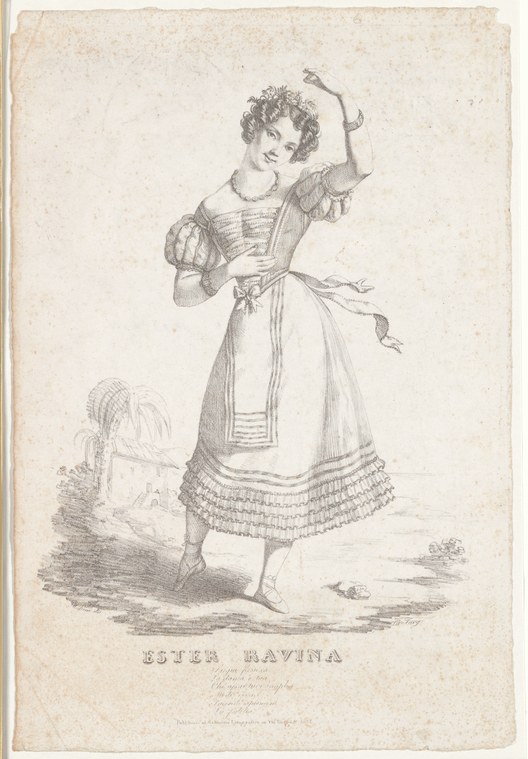
Ester Ravina
Unknown artist
- Collection:
- Prints depicting dance
- Source:
- New York Public Library
- Rights:
- Public domain — free to use, share and adapt.
- Recorded as:
- Public Domain
The work documents the theatrical culture in which dance was embedded: the costumes, the gestures, the way performers were marketed and remembered. It shows that early 19th-century theatrical performance was not always choreographed dance but often dramatic tableau and pantomime—staged moments held still for maximum theatrical effect. For historians of performance, the named attribution to Ester Ravina is a rare trace of an individual performer whose work is otherwise unrecorded.
What you are looking at
A young woman in early 19th-century dress stands alone against a plain background, captured mid-gesture in what appears to be a performance or theatrical moment. She wears a white chemise with horizontal striped bands at the hem, puffed sleeves gathered at the shoulder, and a fitted corseted bodice with vertical ribbing. Her dark curled hair is styled close to the head. Her right arm is raised with bow and arrow, drawn as if in the act of shooting, while her left arm hangs at her side. Her weight appears to rest on her left leg, with the right leg slightly forward. At the lower left of the composition, a small figure (possibly a cherub or putto) appears crouched or reclining on the ground. The inscription at the foot reads "ESTER RAVINA."
The dancing
A single standing figure in a posed, asymmetrical stance. The raised right arm holds a bow drawn back at shoulder height, suggesting tension and forward momentum; the left arm is relaxed at her side. The weight distribution—left leg bearing load, right leg advanced—creates a dynamic diagonal line through the body. The head is held upright and tilted slightly, gazing toward or past the bow. The pose suggests a moment of dramatic action held still, rather than the continuous flow of social dance movement.
The dance depicted
This does not depict social or theatrical dance in the conventional sense. The pose and prop (bow and arrow) suggest a theatrical or allegorical tableau or pantomime, possibly a character from classical mythology or Romantic-era melodrama—the figure of a huntress or Diana-like character. The drawing freezes a moment of dramatic action within what may be a staged performance or ballet divertissement. Without more context, the specific dance form cannot be determined, but the costume and pose are consistent with early 19th-century theatrical performance rather than codified dance technique.
How it was made
An engraving or etching on paper, rendered in fine line work with cross-hatching to create form and shadow. The technique is consistent with early 19th-century theatrical prints and portraits. The clean, legible lines and uniform scale suggest professional reproduction for circulation—likely a published print intended for audiences to purchase as a souvenir or record of a specific performance or performer. The delicate rendering of fabric and the careful attention to costume detail are characteristic of theatrical portraiture of this era.
About this work
This is a theatrical or allegorical figure study from the early 19th century, presented as a named portrait of "Ester Ravina." The work captures a single performer in a charged dramatic moment—armed, posed, and isolated against a void. It belongs in a dance gallery not because it depicts dance technique but because it records how bodies were staged, dressed, and frozen in theatrical performance during this period. The print preserves a moment of acted or pantomimed action that was part of the entertainment culture of the era, whether in ballet divertissement, melodrama, or pantomime spectacle.
How to look at it
Attend to the pose: the raised arm with bow held in tension, the weight shifted and ready, the head tilted in attention. This is not a position of repose but of held action—a moment chosen for dramatic maximum. The tiny figure at the lower left (possibly a cupid or attendant figure) remains unexplained and suggests this may be an allegorical or narrative scene, not a simple portrait. The costume is historically specific and reveals the fashions of the early 19th-century stage. The print quality and inscription indicate this was a professional record of a named performer, not an imaginative invention.
The artist
The artist is not recorded. The work is a professional theatrical print, likely created by a commercial engraver working in the early 19th-century print trade. These prints were typically created from stage designs or posed portraits of performers and sold to theater audiences as mementos. The quality of execution and legible inscription suggest production by an established workshop.
The period
The early 19th century saw the rise of Romantic ballet and the blurring of boundaries between dance, pantomime, and melodrama on the theatrical stage. This was the era of Marie Taglioni and the Romantic ballet boom, but it was also a period when theatrical spectacle encompassed a wide range of movement forms and posed tableaux. The costume and pose here are consistent with the theatrical fashion of the 1820s–1840s. The practice of printing and selling portraits of performers was a booming commercial enterprise; theaters were places where performers could become celebrities, and their images circulated as portable commodities.
Where it lives
The work is held in the New York Public Library's prints collection, catalogued as part of a broader collection of theatrical prints. It is a commercial print from the early 19th century, likely produced and sold in quantity as a theatrical souvenir or performer portrait.
Questions about this work
Who was Ester Ravina?
The inscription identifies this figure as Ester Ravina, but biographical information is not currently available. She appears to have been a performer active in the early 19th-century European or North American theatrical world. Prints like this one were the primary means by which theater performers became known to the public and by which their images survived into the historical record.
Is this a ballet dancer?
This is not a depiction of codified ballet technique. Rather, it appears to be a theatrical tableau or pantomime character—possibly a huntress or mythological figure. Early 19th-century theatrical performance encompassed dance, pantomime, and dramatic action, and performers often worked across these forms. The pose and costume are theatrical, but the work records performance culture rather than dance strictly speaking.
Why is there a small figure at the bottom left?
The crouching or reclining figure may be a cherub, putto, or attendant character, suggesting this is part of a narrative or allegorical scene rather than a simple portrait. Its meaning is unclear without additional context or documentation of the original performance or play from which this figure derives.
More dance artwork





