49 works in this view — arrow keys or swipe to move between them.
Dance in Art
Madame Celeste
Unknown artist
- Collection:
- Prints depicting dance
- Source:
- New York Public Library
- Rights:
- Public domain — free to use, share and adapt.
- Recorded as:
- Public Domain
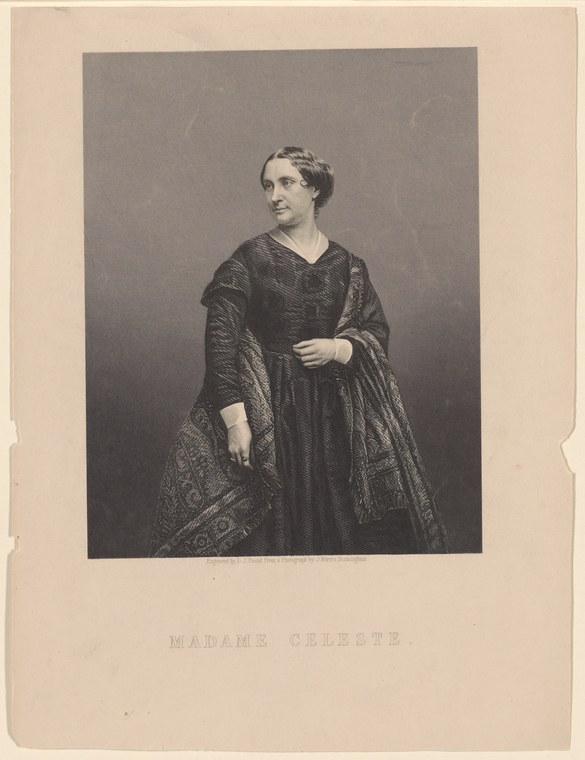
Madame Celeste was a major international star of mid-19th-century theatre and dance, known for her physical virtuosity in pantomime and dramatic roles; this engraving is a record of how she was presented to the public and how theatrical celebrity was visualized in print culture. The portrait's inclusion in collections of dance imagery reflects the historical importance of theatrical performance—combining dance, acting, and stagecraft—and the role of celebrity portraiture in the circulation of performance culture before the age of photography and film.
What you are looking at
A single female figure occupies the center of the composition, posed in three-quarter view against a plain gray background. She wears a dark dress with long sleeves and a high neckline, draped with an ornate patterned shawl or cape that falls across her left side and arm. The fabric of the outer garment shows intricate detailing, possibly lace or embroidery. Her posture is upright and composed, with her weight distributed evenly; her right arm hangs naturally while her left arm is partially obscured by the drapery. Her dark hair is styled in a center part in the fashion of the mid-19th century. The image has the soft gray tones and high finish characteristic of a fine engraving or steel plate print, with careful attention to the modeling of fabric and the subtle play of light across the clothing. There is no action or movement; this is a formal, static portrait of a woman identified as Madame Celeste.
The dancing
The single figure stands in a relaxed contrapposto stance, neither in motion nor in a formal dance position. Her frame is upright but not rigid, and her arms are positioned naturally at her sides, with no tension suggesting active choreography. The posture and bearing convey dignity and composure rather than the dynamic energy typical of dance imagery. Her gaze is directed slightly to the left, suggesting a moment of composed reflection rather than engagement in movement.
The dance depicted
Without additional context, the image does not clearly depict an active dance or dance style. However, the subject's identification as "Madame Celeste" is significant: Céleste Celine Martin, known professionally as Madame Celeste, was a celebrated Anglo-French actress and dancer who performed from the 1820s through the 1850s, renowned particularly for her pantomime and theatrical roles. She was known for dramatic and passionate roles in theatrical productions, often in elaborate costume. This portrait documents her as a public figure of the stage, though it captures her in formal dress rather than in performance or character.
How it was made
This is a steel plate engraving, identifiable by its monochromatic gray tones, the fine linear hatching visible in the fabric rendering, and the characteristic smooth finish and subtle gradations of the engraved line. The technique allowed for precise detail and fine tonal control, particularly visible in the intricate rendering of the patterned shawl and the modeling of the dress fabric. Steel plate engraving was the standard reproductive medium for mid-19th-century portraiture of theatrical celebrities, allowing for multiple high-quality impressions for circulation to the public and for inclusion in illustrated periodicals and portrait collections.
About this work
This is a formal portrait engraving of Madame Celeste, a prominent theatrical and dance performer of the mid-19th century. The work documents her as a public figure and celebrity of the stage, rendered in the polished, detailed style characteristic of commercial theatrical portraiture of the period. While the image itself does not depict her in performance or in active dance, it is historically significant as a record of a major performer and of the visual culture surrounding theatrical celebrities in the decades before photography became standard.
How to look at it
Attend to the formal, composed nature of the portrait—this is not a dynamic action shot but a statement of dignity and star status. The elaborate, costly fabrics and precise rendering of fine detail announce wealth, refinement, and international sophistication. The artist's careful attention to the modeling of the shawl and dress, the subtle lighting, and the composed expression all serve to elevate Celeste as a figure of consequence. The portrait style itself—formal, frontal, engraved to the highest finish—was a marker of fame and importance in the theatrical world of the era.
The artist
The engraver is not identified in the record. The work belongs to the tradition of commercial theatrical portraiture in the mid-19th century, a thriving industry producing images of celebrated performers for sale to the public, for theatrical playbills, and for inclusion in illustrated collections. The quality and finish suggest a skilled commercial engraver, working in the conventions of mid-Victorian celebrity portraiture.
The period
This portrait dates to the height of Madame Celeste's international celebrity, when theatrical performance—combining music, dance, drama, and spectacular stagecraft—was the dominant form of popular entertainment in Europe and America. The mid-19th century saw the development of a sophisticated print culture around theatre, with engraved portraits serving as a primary means of circulating images of celebrated performers. Romanticism and the cult of theatrical personality were at their peak; performers like Celeste were international stars comparable to film celebrities of the 20th century. The fashion of the dress and the style of the engraving place this work firmly in the 1840s–1850s period.
Where it lives
The work is held by the New York Public Library as part of its collection of prints depicting dance. It belongs to the category of mid-19th-century commercial theatrical portraiture, originally produced and sold to the public as individual prints and included in illustrated theatrical collections and celebrity portrait series.
Questions about this work
Who was Madame Celeste?
Madame Celeste (Céleste Celine Martin, 1810–1882) was an Anglo-French actress and dancer of international renown in the 19th century. She was celebrated for her virtuosity in pantomime and for dramatic roles in theatrical productions, and she performed across Europe and America. She was one of the first international theatrical celebrities and helped establish the tradition of the star performer.
Why is this portrait in a dance collection?
Madame Celeste was as much a dancer as an actress; her fame rested on her physical virtuosity, which combined elements of dance, pantomime, and dramatic acting. In 19th-century theatre, these forms were inseparable. Portraits of major performers of this era are part of dance history because theatrical dance was the primary context in which virtuosic movement was performed and celebrated.
Is this a painting or a print?
This is a steel plate engraving, a printmaking technique that allowed for multiple copies to be produced from a single plate. Engraving was the standard method for reproducing theatrical portraits for public sale in the 19th century, far more economical and practical than painted portraits.
What does the costume tell us?
The elaborate, expensive fabrics—the fine wool dress and ornately patterned shawl—announce wealth and refinement. However, this is formal dress rather than a stage costume. It represents how Celeste was presented to the public as a cultured, sophisticated figure, not necessarily how she appeared in character on stage.
More dance artwork





