49 works in this view — arrow keys or swipe to move between them.
Dance in Art
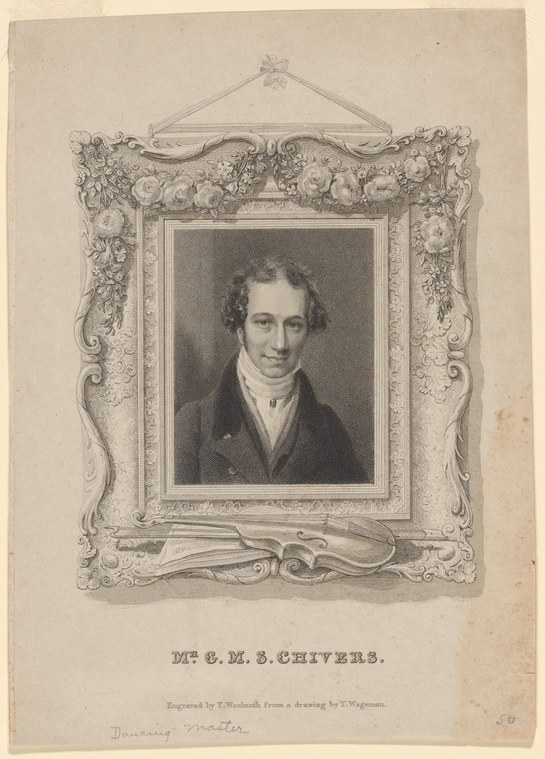
Mr. G.M.S. Chivers
Unknown artist
- Collection:
- Prints depicting dance
- Source:
- New York Public Library
- Rights:
- Public domain — free to use, share and adapt.
- Recorded as:
- Public Domain
Chivers is not a widely documented figure in dance history, making this print a potential primary source for identifying performers or personalities active in early 19th-century British theater. The work demonstrates how engravings functioned as the media for theatrical celebrity and cultural memory before photography.
What you are looking at
A half-length portrait of a young man, facing three-quarters toward the viewer's left, set within an ornate rococo frame of scrollwork, fruit swags, and acanthus foliage. The subject wears a dark coat with a white shirt front and cravat, his dark curled hair brushed back from his forehead in the fashion of the early 19th century. The portrait is rendered as an engraving or mezzotint in grayscale tones, with the face modeled in subtle half-tones against a darker background. The frame itself dominates the composition, its elaborate carved or printed ornament suggesting this is a formal presentation of a notable figure. Below the frame runs the legend "MR G.M.S. CHIVERS."
The dancing
The subject presents a frontal, composed stance typical of formal portraiture—shoulders squared to the picture plane, head tilted slightly. The expression is alert but reserved, with direct eye contact toward the viewer. There is no visible gesture or body language suggesting movement or dance. The clothing and posture indicate a gentleman of some standing, but the portrait conveys stillness and formality rather than any hint of physical exertion or performance.
The dance depicted
This is a portrait of an individual identified as Mr. G.M.S. Chivers, but the image itself contains no visible evidence of dance—no movement, costume, or setting associated with performance. The catalogue assigns it to "Prints depicting dance," yet the portrait shows only a stationary figure in formal dress. Without additional documentation or inscription linking Chivers to dance, the connection remains unclear. It is possible Chivers was a noted dancer, dance master, or impresario of the period, and the print was collected as a record of a theatrical personality, but the image alone does not depict dancing or a dancer in action.
How it was made
This is an engraving or mezzotint—a printed work in grayscale, as indicated by the tonal modeling and line work visible in the image. The technique allowed for fine detail in the face and hair, and the ornate frame was likely engraved separately or printed from a single plate. Engravings of this type were the standard medium for distributing portraits of public figures in the early 19th century, circulating widely among collectors, theaters, and libraries. The presence of engraver and artist credits (visible in the inscription) confirms this is a commercial print, not a unique work.
About this work
This is a formal engraved portrait of Mr. G.M.S. Chivers, presented in the style of early 19th-century theatrical celebrity prints. The work belongs in a collection of dance-related imagery likely because Chivers held a position of note in the theater or dance world of his time—as a performer, teacher, or impresario—though the portrait itself shows only a still, composed figure in contemporary formal dress. The image is a record of a person of interest to dance history, rather than a depiction of dance itself. It exemplifies how theatrical identity was circulated and preserved in print form during the period.
How to look at it
Attend to the formal conventions of the early 19th-century portrait: the three-quarter pose, the direct gaze, the careful modeling of light across the face. Note the ornate frame, which adds prestige and suggests this was a commissioned or significant portrait. The dark coat and white cravat are the standard dress of a gentleman of the period, offering no clue to Chivers's profession. The engraved medium itself was the mark of a figure deemed worthy of circulation and collection.
The artist
The print credits indicate it was engraved by E. Woodall from a drawing by T. Wageman, identifying it as a collaborative work typical of the period. Neither artist is widely prominent in recorded art history, but both were competent commercial practitioners serving the theater and print markets of early 19th-century Britain. Such prints were manufactured to meet public demand for images of performers and personalities.
The period
In the early 19th century, theatrical portraits became a major market for print publishers. Engravings of dancers, actors, and performers were collected and displayed in homes, theaters, and public spaces, serving as a form of celebrity documentation. This period saw the rise of the Romantic ballet and the cult of the ballerina—figures like Marie Taglioni became international celebrities whose images circulated widely in print. While this portrait does not show Chivers in performance, it was likely produced to capitalize on his reputation within theatrical circles.
Where it lives
The print is held by the New York Public Library in a collection identified as "Prints depicting dance." The inscription credits E. Woodall as engraver and T. Wageman as the artist of the drawing, with the date and place of publication not recorded in the available metadata.
Questions about this work
Who was Mr. G.M.S. Chivers?
The available record does not identify Chivers beyond his name. His presence in a collection of dance prints suggests a connection to theater or dance in early 19th-century Britain, but no biographical information is provided. Researchers wishing to identify him would need to consult theater histories, dancer registries, or archival records of the period.
Why is a formal portrait in a dance collection?
Theatrical portrait prints were commonly collected as records of performers and personalities of the stage. Chivers was likely a noted figure in dance or theater whose image was valuable enough to circulate as an engraving. The collection preserves such prints as historical documents of theatrical life and celebrity, even when the portrait itself does not show performance.
What does the ornate frame tell us?
The elaborate rococo-style frame signals prestige and formal presentation. It suggests this was a published work of some care, not a casual sketch, and that Chivers was deemed important enough to warrant such an ornamental treatment. Such framing was typical for celebrity portraits of the era.
More dance artwork





