49 works in this view — arrow keys or swipe to move between them.
Dance in Art
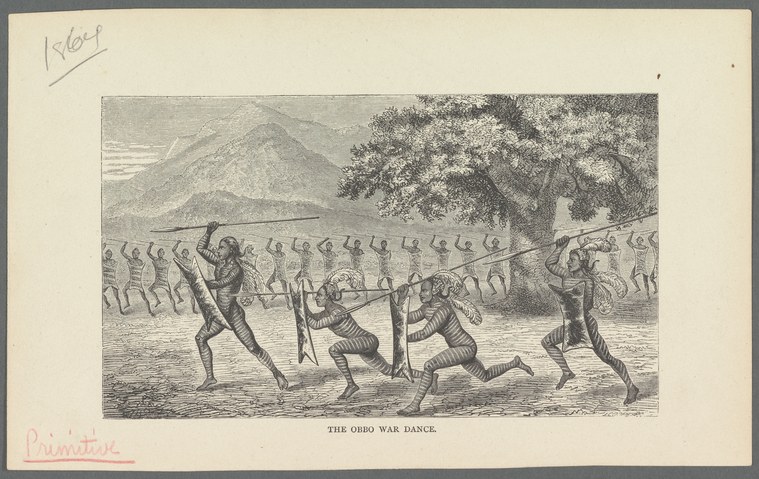
The Obbo war dance
Unknown artist
- Collection:
- Prints depicting dance
- Source:
- New York Public Library
- Rights:
- Public domain — free to use, share and adapt.
- Recorded as:
- Public Domain
War dances were among the most visually distinctive and physically demanding movement forms in African culture, yet they are underrepresented in European art collections relative to their cultural importance. This print offers a window into how 19th-century observers understood African martial and ritual movement—the anatomical confidence, the attention to formation and coordination, and the integration of weapons into the movement vocabulary all suggest a tradition of considerable sophistication, even if filtered through colonial eyes.
What you are looking at
A line of Indigenous warriors executes a coordinated war dance across an open landscape, their bodies arranged in a dynamic diagonal formation that drives across the composition from left to right. The dancers are unclothed except for minimal ornamentation and appear to be wearing body paint or natural pigmentation; their musculature is rendered with anatomical precision. Each figure holds a long spear or staff held at varied angles, some thrust upward and forward, others angled down or across the body, creating a visual rhythm of weaponry that punctuates the line. In the foreground, four dancers are shown in close focus: one lunges forward with spear raised, two crouch or drop into lower positions with knees bent, and another strides with high energy. The background recedes into misty mountains and overhanging foliage; a large tree anchors the right side of the composition. The entire scene has the quality of ethnographic documentation rendered through 19th-century print technique.
The dancing
The dancers maintain a loose linear formation rather than a closed partnered hold; their weight shifts between grounded strides and athletic lunges suggest vigorous traveling movement rather than stationary figures. Arms are free and emphatic, either gripping and brandishing the spear or extended for balance; the torsos twist and angle forward, engaging the full body in forward propulsion. The legs show high energy—some dancers appear mid-stride with long steps, others have dropped into deeper stances. The variation in stance and arm angle across the line suggests a coordinated but not perfectly synchronized movement phrase, consistent with collective or ensemble ritual action rather than formal choreography.
The dance depicted
This depicts what the caption identifies as an Obbo war dance, a ceremonial combat movement associated with East African peoples (the Obbo are an ethnic group of South Sudan and Uganda). War dances functioned both as military preparation and as ritual performance, combining athletic display, weapon handling, and synchronized group movement. The composition emphasizes the athletic and martial character of the form: the spears are integral to the movement, not decoration, and the dancers' low stances and explosive forward momentum suggest a function related to building courage, coordination, and collective identity before or during conflict. The documentation of this form in a 19th-century European print likely reflects colonial-era ethnographic interest in African martial practices, though the artist has captured genuine movement qualities—the distributed weight, the variety of body angles, the use of leg and torso—that suggest observation of an actual performed tradition rather than pure invention.
How it was made
This is an engraving or wood-engraving, rendered in black and white with fine linear hatching to suggest musculature, shadow, and terrain. The technique allowed for wide circulation as a printed sheet or page illustration; such images were commonly bound into ethnographic treatises, travel narratives, or illustrated newspapers of the 19th century. The precision of the line work and the anatomical detail suggest the hand of a skilled printmaker, though the composition and likely the initial observation came from a traveler, missionary, or ethnographic observer. The print's accessibility and reproducibility made it influential in shaping European audiences' understanding of African dance and warfare practices, regardless of its accuracy.
About this work
This is a 19th-century engraved scene of an Obbo war dance from East Africa, depicting a group of warriors executing a coordinated ceremonial movement with spears. The composition captures both the formal qualities of the ritual—the linear formation, the emphasis on group cohesion—and the explosive physicality of the movement itself. As a printed image, it functioned as a document of colonial-era ethnographic interest, circulating in European publications to readers with little direct knowledge of African cultural practices. The work belongs in a gallery of dance art not as a fine art painting, but as a historical record of how European artists and printmakers represented non-Western dance traditions during the period of empire, and as evidence of the movement forms themselves as reconstructed through the engraver's eye.
How to look at it
The viewer should attend to the variety of body positions within the coordinated line: no two dancers are in identical stance or arm angle, yet the composition reads as a unified movement phrase rather than chaos. This variation is the engraver's way of suggesting the dynamism and power of the form. Look at the spears as compositional and functional elements—they are not merely held, but actively angled and deployed, suggesting that the dance is fundamentally a weapon practice as well as a ritual spectacle. The mountains and tree in the background root the scene in a specific landscape, a convention of ethnographic illustration designed to anchor the 'exotic' practice in a real place. The anatomical precision of the bodies—the tension in the legs, the definition of the torso—serves a double purpose: it documents the physical reality of the dancers while also making them objects of visual study for a European audience.
The period
The engraving dates to the era of intensive European exploration, missionary activity, and the early stages of colonial territorial division in East Africa (roughly 1850s–1890s). This period saw a surge in ethnographic illustration: travel narratives, missionary accounts, and scientific publications relied heavily on woodcuts and engravings to bring African, Asian, and Pacific practices to European audiences. At the same time, European academic art had largely abandoned indigenous European dance forms (such as folk and courtly dances) as serious subjects; non-Western movement, by contrast, was positioned as exotic spectacle and evidence of cultural 'otherness.' The representation of war dances held particular currency, as they aligned with European anxieties and fascinations regarding African martial strength and perceived savagery. The print medium ensured wide distribution; such images shaped the visual imagination of readers across multiple social classes.
Where it lives
The work is held in the NYPL Prints collection under the heading 'Prints depicting dance.' The minimal catalogue information (no artist, date, or medium recorded) suggests it may be an unattributed illustration extracted from a larger publication or bound collection, a common practice in library cataloguing of 19th-century prints.
Dance in this work
Questions about this work
Was this a real dance or an invention?
War dances were real and widespread practices across East and Central Africa, serving both martial and ceremonial functions. What we cannot determine from the print alone is how much the engraver modified, stylized, or romanticized the actual movement. The anatomical confidence and attention to detail suggest observation of real dancers, but the print is a European interpretation of an African practice, not a direct record.
Who were the Obbo?
The Obbo (also spelled Obo or Obbo-Sudan) were an East African people primarily located in what is now South Sudan and Uganda. By the 19th century, when this print was likely made, they had experienced significant disruption and displacement due to slave raids and colonial expansion. Their martial traditions, including war dances, were documented by European travelers and ethnographers.
Why did European publishers include images like this?
Ethnographic illustrations served multiple audiences: they satisfied curiosity about 'exotic' peoples, provided visual evidence for travelers' narratives and scientific claims, and were used in missionary and educational publications to instruct Europeans about the world. Such images also reinforced colonial ideologies about difference and cultural hierarchy.
More dance artwork





