49 works in this view — arrow keys or swipe to move between them.
Dance in Art
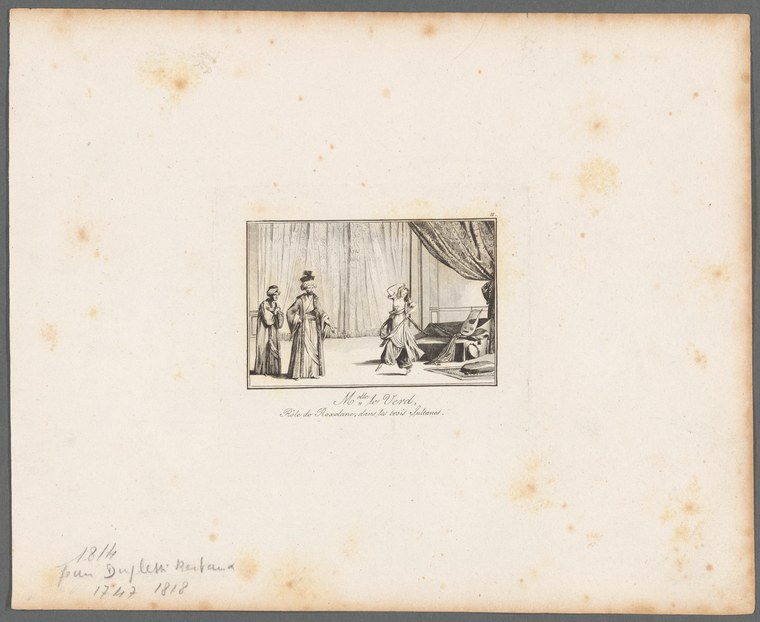
Melle. le Verd, rôle de Roxelane, dans les trois Sultanes
Unknown artist
- Collection:
- Prints depicting dance
- Source:
- New York Public Library
- Rights:
- Public domain — free to use, share and adapt.
- Recorded as:
- Public Domain
This print documents the gestural vocabulary of 18th-century theatrical performance, a language that lay between spoken drama and formalized dance. Understanding how actors and dancers of the period used their bodies to express character and emotion is essential to reconstructing lost choreography and the hybrid forms that preceded modern theatrical specialization. The Roxelane character itself was a vehicle for exploring European fascination with Ottoman and Oriental courts, a theatrical fantasy that shaped how dance and narrative interacted on stage.
What you are looking at
An engraved theatrical scene depicting a moment of court or stage drama. A woman in an elaborate gown stands at center-right, her body angled in a gesture of attention or appeal toward two figures at left—a woman in similar court dress and a man in masculine theatrical costume. The setting is defined by draped curtains at back and right, with what appears stage furniture or architectural elements suggesting an interior palace or drawing room. The composition uses classical theatrical space: the figures are arranged in a shallow stage plane, with clear sightlines and balanced positioning. The woman at center appears to be in a moment of heightened emotion or demonstration, her posture suggesting address or supplication. The engraving technique creates sharp, precise linearity throughout, with particular attention to the fall of fabric and the definition of each figure's silhouette.
The dancing
Three figures occupy the scene in a loose triangular arrangement. The central woman stands with her weight forward, her arms and upper body oriented toward the couple at left in a posture suggesting emotional address or declaration. Her elaborate skirt and bodice are rendered with attention to the volume and movement of fabric. The two figures at left stand closer together, the woman in profile and the man facing more toward the center, suggesting a couple or pair witnessing or responding to the central action. No dancers are in active step or bound in closed hold; the movement here is gestural and dramatic rather than choreographic.
The dance depicted
This is not a depiction of ballroom or social dance, but rather theatrical action—likely from a scripted drama or comedy performed on stage. The title references Mlle. le Verd in the role of Roxelane in a work called *Les trois Sultanes* (The Three Sultanesses), suggesting this is a scene from a French 18th-century theatrical work, possibly with music and dance interludes. Roxelane was a popular character in European theatrical works of the period, drawn from Ottoman court narratives. If dance occurs in the scene, it is not the primary subject; the image documents dramatic gesture and character interaction rather than choreography. The work appears to be a theatrical character or scene print rather than a dance documentation.
How it was made
This is an engraving, created through incised lines on a metal plate and printed by relief. The technique is evident in the consistent linearity, the use of parallel hatching for shadow and fabric texture, and the crisp black-and-white reproduction. The style and finish suggest it was a commercial theatrical print, likely made for circulation among theater-goers or collectors in the 18th century—this is confirmed by the annotation visible at bottom left ("Jun Dufour Pinxum 1743 1788"), suggesting it documented a specific production or performer. Engravings of this type were distributed as souvenirs or records of celebrated stage performers and memorable scenes.
About this work
This is a theatrical scene engraving documenting a moment from *Les trois Sultanes*, a work in the European stage tradition. The print records the actress Mlle. le Verd in the character of Roxelane, a role drawn from Orientalist theatrical fashion. Rather than capturing choreographed dance, it documents a dramatic gesture—the emotional and physical language of theater performance in the 18th century. For a dance history collection, it matters as evidence of the proximity between theatrical gesture and dance on the 18th-century European stage, and as a record of how performers inhabited characters through body position and address.
How to look at it
Attend to the woman's posture and arm position at center: her forward lean and the trajectory of her gaze and gesture toward the couple at left establish the dramatic moment the artist chose to capture. The print freezes a moment of address or declaration within a larger narrative—the viewer is seeing neither the beginning nor the climax, but a sustained moment of emotional communication. The precision of the engraving allows each figure's costume and body position to be read clearly; note how the artist has differentiated the three figures not only by dress but by the angle and openness of their bodies, signaling hierarchy and relationship within the scene.
The artist
The annotation at bottom left appears to read "Jun Dufour Pinxum" with dates 1743–1788, suggesting the engraving was made by or after a design by a Dufour active in mid-18th-century Paris. French theatrical prints of this period were made by specialized engravers working from original drawings (pinx. = pinxit, "painted") by theater designers or portrait artists. Without a clear signature or publishing mark visible, the exact division of labor and the shop responsible cannot be determined from the image alone.
The period
The mid-18th century was a period of intense fusion between narrative theater, dance, and music on the European stage. Theatrical works often included dance interludes or choreographed moments within a dramatic frame. The popularity of Orientalist subjects—Turkish, Persian, and Indian settings—in European theater reflected both colonial curiosity and exotic fantasy. Actresses like Mlle. le Verd were celebrated performers whose bodies and interpretations of character became public property, recorded and circulated through prints. The formal gestural language visible here—the upright carriage, the angled posture, the hands positioned to express emotion—follows conventions of theatrical decorum codified in acting manuals of the period.
Where it lives
The print is held in the New York Public Library's collection of prints depicting dance. It is inscribed at lower left with a date and artist attribution, suggesting it was a commercial theatrical print made for wide circulation. Such prints were sold to theater patrons as souvenirs and records of celebrated performances.
Questions about this work
Is this a dance scene?
Not primarily. This engraving documents a dramatic moment from a theatrical work, showing gestural and emotional address rather than choreographed dance. Dance and music may have been part of the larger performance, but this particular scene captures theatrical acting—the physical language of character and emotion on stage.
Who was Roxelane and why does she appear in European theater?
Roxelane was a historical figure—a concubine who became influential at the Ottoman court—who captured European imagination in the 18th century. Her story became a vehicle for exotic theatrical fantasy, appearing in multiple European plays and operas. The character allowed writers and performers to explore themes of power, seduction, and cultural encounter through an Orientalist lens.
What can we learn about 18th-century performance from this print?
The engraving shows the formal gestural language of elite European theater: upright carriage, angled positions, controlled arm movement, and composed emotional expression. These conventions of theatrical decorum shaped how actors and dancers moved and related to one another on stage, establishing a visual grammar of character and narrative that influenced both dramatic and choreographic practice.
More dance artwork





