49 works in this view — arrow keys or swipe to move between them.
Dance in Art
Redington's new and improved stage front
Unknown artist
- Collection:
- Prints depicting dance
- Source:
- New York Public Library
- Rights:
- Public domain — free to use, share and adapt.
- Recorded as:
- Public Domain
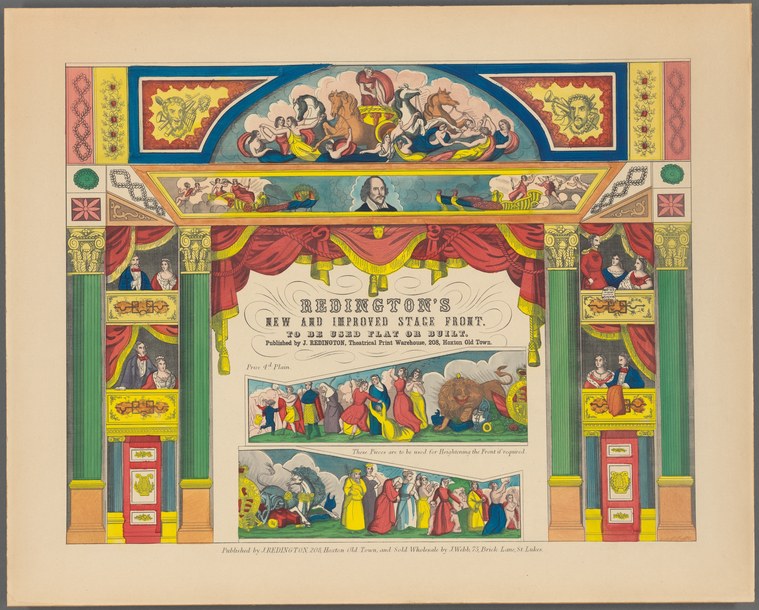
This print preserves evidence of English theater architecture and theatrical social practice at a specific historical moment, offering material context for understanding how dance was presented and experienced. The image demonstrates that 18th-century theater was a social spectacle in which the architecture, the audience, and the performers were equally part of the visual and cultural event—knowledge essential to interpreting dance of the period.
What you are looking at
This is a hand-colored theatrical print depicting a proscenium stage interior viewed from the audience. The composition frames a grand theater façade with a raised stage opening flanked by green fluted columns and swags of red and gold drapery. The proscenium arch is ornate, with gilt decoration and a deep blue ground. Above the stage opening, a curved tympanum features an elaborate allegorical scene of cherubs and classical figures among clouds. Below the stage, two distinct narrative scenes are depicted: the upper shows a crowded interior gathering of figures in 18th-century dress; the lower shows an outdoor scene with numerous figures in similar period costume, some seated, others standing or in motion. The side walls of the theater are decorated with smaller framed scenes and additional ornamental details. A decorative cartouche at the center top bears the text 'REDINGTON'S / NEW AND IMPROVED STAGE FRONT.' The print employs the conventions of English theatrical publicity, with hand-coloring in muted reds, yellows, greens, and flesh tones applied to a linear engraving.
The dancing
The figures throughout are rendered in the stiff, formal manner of 18th-century theatrical prints. In the lower outdoor scene, bodies are arranged in loose groupings rather than organized couples or lines. Postures are mostly upright and static, with little evidence of vigorous movement. The figures appear to be conversing, promenading, or standing in social arrangement rather than executing steps. Some seated figures and the overall composition suggest a social assembly or intermission scene rather than active dancing. The scale of figures in both scenes is relatively uniform, with no marked perspective foreshortening that would suggest depth or dynamic spatial arrangement.
The dance depicted
The content of the two scenes below the stage does not clearly depict any identifiable dance form. The figures appear to represent theatrical spectators or social gatherings of the kind that would occur during intermissions or as part of theatrical entertainment in the 18th century. The dress and pose conventions align with the period of Regency or late-Georgian social life rather than with codified dance. If dance is present, it exists as background to a theatrical architectural display. The primary subject is the stage house itself, not the choreography or movement of performers.
How it was made
This is a hand-colored engraving, most likely produced by commercial theatrical print makers of the 18th or early 19th century. The linear work was executed by engraving (incised lines on a copper plate), allowing for fine linear detail in the architectural ornament and decorative borders. Hand-coloring was then applied in a workshop setting using watercolor or gouache, evident in the translucent quality of the yellows and reds and the slight irregularities where color has been laid over the printed line. This method of production was standard for theatrical trade cards, broadsides, and promotional prints intended for distribution to theater audiences and the general public. The relative sophistication of the engraved architecture suggests a London or major provincial printer, and the circulation would have been local or regional.
About this work
Redington's New and Improved Stage Front is a theatrical architecture print, not a dance picture in the conventional sense. It documents the design of a theater interior—its decoration, proportions, and the social milieu it framed—at a moment when theater design was becoming a subject of popular visual culture. The print advertises or documents a specific stage house (presumably designed by or associated with someone named Redington) through an image of the proscenium, its ornament, and the audience and performers it contained. For dance historians, the print is valuable as evidence of the theatrical context in which dance was presented: the architecture of the space, the social conventions of theater attendance, the dress of the period, and the relationship between stage and spectators. The two subsidiary scenes show the theater as a social institution, not merely as a performance space.
How to look at it
Approach this print as a document of theatrical space and social practice rather than as a representation of dance. The eye should move from the ornate proscenium arch inward to the stage, then outward to the subsidiary scenes that show how the theater functioned as a social space. Notice the hierarchy of ornament—the elaborate tympanum above the stage opening, the formal columns and swags, the geometric borders—which reflected contemporary ideas about taste and theatrical refinement. The two lower scenes should be read as documentation of who attended theater and how they conducted themselves, providing the social and architectural frame within which dancing took place.
The artist
The engraver and the designer of the original theatrical scheme are not recorded in the catalogue. The print was published by Redington (whose first name and biographical details are not preserved), described as a theatrical print warehouse keeper on Hames Old Town. The style of engraving and hand-coloring is consistent with London commercial print production of the late 18th or early 19th century, but without further documentation, the individual artists cannot be identified.
The period
This print dates to an era of English theatrical efflorescence and technical innovation. The late 18th and early 19th centuries saw rapid development in stage machinery, lighting, and scenography, driven by competition between patent theaters (Drury Lane, Covent Garden) and the growing popularity of theater among urban audiences. Redington's advertisement of a 'new and improved' stage front reflects this atmosphere of technical and aesthetic innovation. Theater architecture itself became a subject of public interest and pride. The formal dress and social arrangement depicted in the subsidiary scenes reflect Regency-era theater etiquette, when attendance was as much a social event as a performance event.
Where it lives
This print is held in the New York Public Library's collection of prints depicting dance. It came to the collection as part of a broader assemblage of 18th- and 19th-century theatrical and dance-related prints. The collection classifies it as a dance-related image, though its primary subject is architecture and social milieu rather than choreography or technique.
Questions about this work
Is this print showing a dance performance?
Not directly. The two scenes below the stage proscenium appear to depict theatergoers and social gatherings rather than an active dance. The primary purpose of the print is to advertise or document the design of the theater building itself—its proscenium, columns, draperies, and ornament. If dancing occurred on this stage or at these social gatherings, the print does not depict it in detail.
What was Redington's stage front used for?
The print documents the architectural and decorative scheme of a theater interior, presumably designed by or commissioned by Redington. Such 'stage fronts' or 'proscenium frames' were the formal architectural boundary between the audience space and the stage proper. This particular design—with its columns, swags, and ornamental tympanum—reflects the aesthetic preferences of the late 18th or early 19th century English theater.
How was this print made and distributed?
The image was engraved (incised into a copper plate) and then hand-colored in a print workshop. Copies were produced and sold or distributed to the public as promotional material or as a record of the theater design. Such prints were common merchandise in London and other theater towns, sold at the theater itself or through print sellers and booksellers.
What can this print tell us about dance in this period?
Indirectly, it shows the social and architectural context in which dance was performed and viewed. The formal dress of the figures, the orderly social arrangement, and the prominent role of the theater building itself all reflect the conventions of Regency-era entertainment. For dance historians, the print is evidence of how dance fitted into a larger theatrical and social spectacle.
More dance artwork





