49 works in this view — arrow keys or swipe to move between them.
Dance in Art
Alceste
Unknown artist
- Collection:
- Prints depicting dance
- Source:
- New York Public Library
- Rights:
- Public domain — free to use, share and adapt.
- Recorded as:
- Public Domain
This work illustrates the classical mythological narratives that furnished subjects for court ballet and early opera, and shows how theatrical spectacle of the period was recorded and disseminated through prints. Understanding the visual and compositional language of such engravings illuminates the aesthetic context in which dance was performed and understood as part of a unified theatrical whole.
What you are looking at
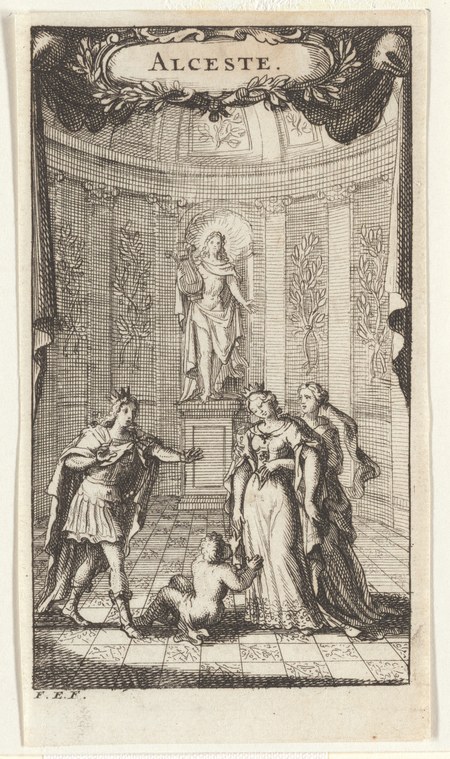
This engraving depicts a scene from classical mythology, likely illustrating a moment from a theatrical performance or dramatic narrative centered on the figure of Alceste. A woman in flowing drapery stands elevated on a plinth or stage platform at the center rear, posed in a stately contrapposto stance with one arm raised. She is surrounded by four figures in classical dress arranged in a semicircle: to her left stands a man in Roman military costume and helmet; to the right are two women and another figure in classical robes. The floor is rendered in a bold checkered pattern in perspective. The setting is a columned interior space with fluted pilasters rising behind the central figure, suggesting a temple or palace. The engraving employs fine linear hatching throughout to create depth and volume, and the framing cartouche at top identifies the subject as "ALCESTE." The composition follows classical dramatic convention, with the central figure elevated and the attendants arranged in conversational or ritual grouping below.
The dancing
The standing female figure at center employs a formal neoclassical pose: weight on one leg, the opposite arm extended upward in a gesture of supplication, resignation, or invocation. Her drapery falls in classical folds. The male figure to the left gestures toward her with an open palm, leaning forward as if in urgent address. The other attendants stand in attitudes of concern or reverence, their bodies oriented toward the central figure, creating a clear hierarchical focal point. The poses are stately rather than active; this is a moment of confrontation or ritual rather than dancing movement, though the formal arrangement and elevated central figure recall staged theatrical presentation.
The dance depicted
This is not a depiction of dance in the modern sense, but rather a scene from classical drama—specifically the myth of Alceste (Alcestis), who sacrifices herself for her husband. The engraving illustrates a moment of high theatrical pathos common to 17th- or 18th-century operatic or theatrical interpretation of classical texts. While the figures are posed in formal, sculptural attitudes and the composition is ceremonial, the work belongs to the tradition of *ballet de cour* and early operatic spectacle insofar as such scenes were performed as part of courtly entertainment, often with sung or danced interludes. However, the primary narrative here is dramatic rather than choreographic.
How it was made
This is a finely executed engraving, identifiable by the uniform linear hatching used to model form and shadow, the parallel line work creating tonal gradation, and the crisp black line against white paper. The technique allows for fine detail in the architectural elements (capitals, fluting, perspective floor) and the drapery, and the composition is carefully balanced and proportioned. Engravings of this type were produced for circulation among educated collectors and served as records of theatrical productions, classical narratives, and artistic compositions. The refined execution and classical subject suggest this was created for a cultivated audience familiar with classical texts and courtly theatrical tradition.
About this work
This engraving documents the moment of Alceste's self-sacrifice from the classical myth, rendered in the formal visual language of 17th- or 18th-century theatrical art. The central standing figure, elevated and framed by architectural geometry and attendant figures, embodies the neoclassical ideal of noble resignation and heroic virtue expressed through pose and drapery rather than movement. While not a representation of dance itself, the work belongs to the visual culture of court spectacle and operatic theater in which dance, music, and drama were integrated. The engraving preserves both the narrative content and the visual convention by which such moments were staged and circulated through prints.
How to look at it
Observe the careful centrality and elevation of the Alceste figure, which directs the viewer's eye and establishes hierarchy. Notice how the four attendant figures are arranged to frame and respond to her pose—their gazes and gestures converge on her. The checkered floor in perspective draws the eye back into the pictorial space, creating a theatrical stage-like setting. The neoclassical restraint of gesture—no violent movement, but formal and legible poses—reflects both classical aesthetic principles and the conventions of courtly dramatic performance. The fine engraving technique allows the viewer to read both the grand compositional arrangement and the subtle details of drapery and expression.
The period
The subject of Alceste became a major theme in European opera and court spectacle from the 16th century onward, most notably through Christoph Willuck's operatic settings. The neoclassical formal language evident in this engraving—the idealized human form, the classical architectural setting, the restrained gesture—reflects the broad 17th- and 18th-century turn toward antique models in visual culture, which paralleled the development of ballet as a codified art form rooted in classical proportion and order. Engravings such as this served as models and records, disseminating theatrical and artistic ideas across courts and academies.
Where it lives
This work is held in the New York Public Library's collection of prints depicting dance. It is catalogued without attribution of artist, date, or medium details, but the style and subject matter suggest it is a 17th- or early 18th-century engraving produced in Europe.
Questions about this work
Why is this in a gallery about dance if it doesn't show people dancing?
Alceste and similar classical mythological narratives were the foundation of court ballet and early opera, genres in which dance, music, drama, and spectacle were unified. This engraving records the theatrical tradition that shaped how dance was created, performed, and understood. It documents the visual and narrative world in which dancers moved.
What is Alceste about?
In Greek mythology, Alcestis is the wife of King Admetus. She agrees to die in her husband's place to spare him from death, and in some versions is rescued by Heracles. The story became a subject for tragedy and later opera because it centers on devotion, sacrifice, and the power of love—themes central to courtly and operatic aesthetics.
How do I know this is an engraving and not a drawing or painting?
Engravings are identifiable by their characteristic fine parallel line work (hatching and cross-hatching) used to create shadow and volume. This technique, which requires incising lines into a metal plate, produces the crisp, uniform quality visible here. Drawings or paintings would show different mark-making; engravings print the same way every time, which is why they were used for wide circulation.
More dance artwork





