49 works in this view — arrow keys or swipe to move between them.
Dance in Art
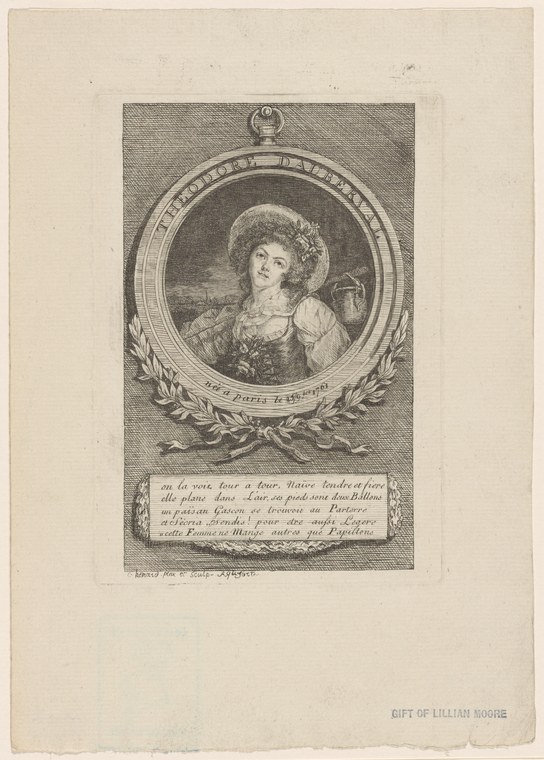
Theodore Dauberval née a Paris le 25/9bre 1761
Unknown artist
- Collection:
- Prints depicting dance
- Source:
- New York Public Library
- Rights:
- Public domain — free to use, share and adapt.
- Recorded as:
- Public Domain
This print documents the 18th-century convention of portraying performers—likely theatrical dancers, singers, or actors—through formal engraved likenesses rather than action scenes. It is evidence of how celebrities of the stage were visualized and remembered in their own time. However, as a static portrait rather than a dance document, it offers no direct evidence of performance technique, movement vocabulary, or choreographic practice.
What you are looking at
A young woman in late 18th-century dress occupies the center of a circular portrait frame, gazing outward with a serene expression. She wears an elegant white or pale muslin dress with puffed sleeves and a low neckline, her hair dressed in the fashionable style of the 1760s with curled ringlets and what appears to be a ribbon or band. The background is a soft landscape with hints of trees or foliage. The circular frame is ornate, with a double-line border and classical decorative elements—a spherical ornament at the apex and laurel wreaths tied with ribbon at the base—the whole composition mounted on a plain page with French text below. The engraving has the fine hatching and formal finish of an 18th-century portrait print.
The dancing
A single standing figure, three-quarter length, weight evenly distributed, no active dance posture or movement implied. The arms hang naturally; there is no frame, hold, or turn that would suggest she is dancing. The figure is presented frontally in a contemplative pose typical of commemorative or biographical portraiture rather than performance documentation.
The dance depicted
This is not a depiction of dance. The figure is a portrait, likely a theatrical or biographical memorial to an individual (the title suggests it may commemorate someone born in Paris on 25 September 1761). While the subject may have been a dancer, singer, or performer, the image itself shows a posed portrait in formal dress, not a scene of movement or performance. No dance style or genre can be identified from the figure's posture or costume.
How it was made
The work is a finely engraved portrait print, executed with the cross-hatching and tonal gradation typical of 18th-century intaglio engraving. The technique—capable of great delicacy in rendering fabric, skin, and light—allowed rapid reproduction and distribution of images of celebrated performers and public figures. The formal circular frame and inscription indicate this was a commemorative or biographical print, part of a tradition of theatrical celebrity portraiture that flourished in France and across Europe in the second half of the 18th century.
About this work
This is a formal portrait engraving of an individual, dated to the late 18th century, commemorating a person born in Paris in 1761. The subject is presented in fashionable dress of the period within an ornate circular frame, a compositional convention used for theatrical and public figures. Although the title suggests a performer or public personality, the image itself is a static biographical portrait rather than a documentation of dance or performance practice.
The work belongs to the broader tradition of 18th-century theatrical portraiture and print culture. Such engravings served to commemorate and circulate the likenesses of celebrated performers throughout Europe, making them accessible to a wide public. The fine engraving technique and ornamental framing indicate an investment in formal commemoration.
How to look at it
This is a portrait, not an action image, so the composition works by stillness and presence rather than movement. The subject is arranged frontally within the circular frame, a format that isolates and elevates the figure while the ornamental surround—the laurel wreaths especially—anchors her in a tradition of merit and commemoration. The soft modeling of the face and the careful rendering of fabric and jewelry are typical of engravers' efforts to convey elegance and refinement. The work asks the viewer to recognize and remember a face and a name, not to infer dance or performance from the image itself.
The period
In the 1760s and 1770s, the engraved portrait of celebrated theatrical performers became a standard form of public commemoration in France and across Europe. The fashion for such prints coincided with the growth of a star system in ballet and theater, the rise of the ballerina as a public figure, and the expansion of print culture. The formal, commemorative style seen here—the ornate frame, the allegorical laurel wreaths—was borrowed from historical and political portraiture, elevating theatrical figures to a status previously reserved for nobility and statesmen. The inscribed text below the portrait followed the conventions of biographical or genealogical records.
Where it lives
The print is held in the New York Public Library's collection of prints depicting dance, as noted by the gift mark 'GIFT OF LILLIAN MOORE' visible at the lower right of the page. Lillian Moore (1911–1973) was a pioneering historian of American ballet and a major collector of dance-related prints and ephemera. The work was acquired as part of her collection, which is now an essential resource for dance history research.
Questions about this work
Is this a picture of someone dancing?
No. This is a formal portrait in the style of 18th-century commemorative prints. The subject is posed standing, in fashionable dress, looking directly outward. There is no movement, no dance costume, no gesture that suggests performance or choreography. The individual pictured may have been a performer, but the image itself documents their likeness, not their art.
Who is Theodore Dauberval?
The title identifies the subject as 'Theodore Dauberval née a Paris le 25/9bre 1761' (born in Paris on 25 September 1761). Without additional research beyond the image, we cannot establish who this person was or what their profession entailed. The formal engraved portrait suggests they were a public figure of some note in late 18th-century France.
What does the French text say?
The inscription below the portrait is partially legible in the engraving but too small to read with certainty in this reproduction. It appears to be a biographical or genealogical notation in the style typical of such commemorative prints. The record does not provide a full transcription.
Why is this in a dance collection?
The work was donated to the Library's dance collection by Lillian Moore, a major collector of dance-related prints and historical materials. Moore acquired prints of performers, celebrities, and theatrical figures as part of a broad effort to document the visual history of dance and theater. The presence of the subject's name and the formal theatrical context likely indicated to Moore that the work belonged in a dance history collection, even though the image itself is a portrait rather than a performance scene.
More dance artwork





