49 works in this view — arrow keys or swipe to move between them.
Dance in Art
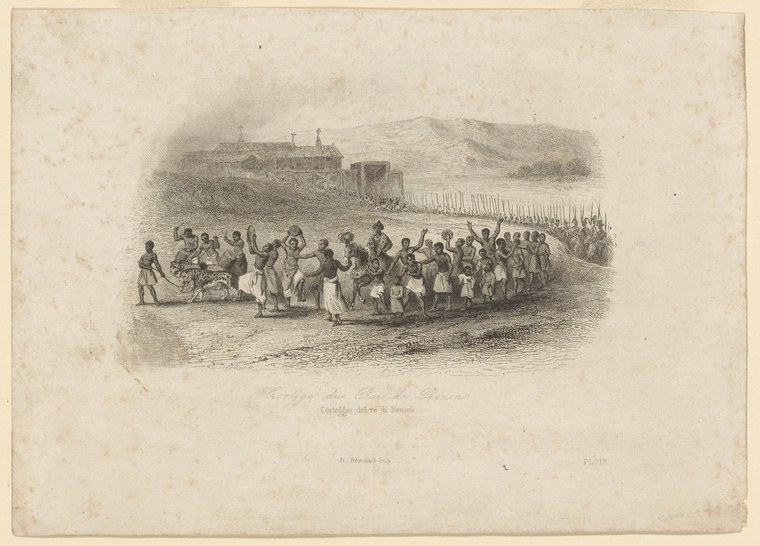
Cortège du roi de Benin
Unknown artist
- Collection:
- Prints depicting dance
- Source:
- New York Public Library
- Rights:
- Public domain — free to use, share and adapt.
- Recorded as:
- Public Domain
This print is a rare 19th-century European visual representation of Benin court ceremony, at a moment when Benin was one of Africa's most powerful and aesthetically sophisticated kingdoms. It offers insight into how European audiences understood African dance and ritual, and possibly into the actual ceremonial and dance practices of the Benin court itself—particularly the role of coordinated movement and procession in royal display.
What you are looking at
A large gathering of figures in what appears to be an open courtyard or ceremonial ground, with a fortress or fortified structure visible on a hilltop in the background. The composition is densely populated, with dozens of figures arranged in loose groups across the foreground. The figures are rendered in the stippled, tonal style characteristic of 19th-century wood engraving or steel engraving. The setting suggests a formal state occasion: the gathering appears ordered yet dynamic, with figures in varied dress and postures. The light is diffuse and atmospheric, created through careful tonal gradation rather than sharp shadow. At the center and middle ground, figures appear to be engaged in coordinated movement or ceremonial action, while others stand in clusters or process across the space. The overall impression is of a grand public spectacle or royal procession, rendered with ethnographic attention to the specifics of dress and formation.
The dancing
The figures vary in dress and stance, suggesting a mixed gathering of court attendants, soldiers, and civilians. Many stand upright in formal posture; others appear to be in motion or transitional positions. Some figures in the center seem to hold objects or move with deliberation, while peripheral figures maintain static positions of observation or attendance. The density and arrangement suggest a procession or ceremonial formation rather than a coordinated dance, though the movement of central figures has a ritualized quality. Bodies are rendered with anatomical attention but without the clarity needed to determine precise dance holds or footwork.
The dance depicted
The image title, 'Cortège du roi de Benin' (Procession of the King of Benin), identifies this as a royal ceremonial occasion from the Kingdom of Benin (in present-day Nigeria). If dance is present, it would be part of a broader state ceremony rather than a staged performance. The gathering could represent a formal court dance or ritual movement, common to Benin's elaborate ceremonial traditions, but the engraving's scale and density make it difficult to isolate specific dance forms or identify the footwork and body mechanics that would confirm a particular dance tradition. The composition prioritizes the spectacle and multitude over the kinetic detail that would clarify the dance.
How it was made
This is a wood engraving or steel engraving, evident from the fine parallel hatching, stippled tones, and precise linear detailing characteristic of 19th-century printmaking. The technique allowed for high circulation and fine detail, but the small scale and dense composition of figures work against clarity of individual gesture. The print was likely produced for a book, newspaper, or illustrated journal aimed at a European audience curious about non-European court life, which explains both the ethnographic framing and the distance from which the ceremony is observed. The medium's reproducibility meant this image circulated widely as a public representation of Benin's royal practices.
About this work
This is a 19th-century engraved print documenting or imagining a royal ceremony at the court of Benin. The work belongs to a broader 19th-century European appetite for images of non-European courts and ritual practices, rendered through the medium of wood or steel engraving for circulation in illustrated periodicals and books. The image frames Benin's ceremonial life as a grand, orderly spectacle—a 'cortège' emphasizing procession, hierarchy, and state formality. For dance history, it is significant as evidence of how European printmakers visualized African royal ceremonies, and potentially as documentation of actual ceremonial movement at the Benin court, though the medium and perspective limit what can be determined about specific dance forms or techniques.
How to look at it
The print is composed as a wide-angle view that sacrifices individual clarity for collective impact—the viewer is positioned as a distant observer of the entire gathering. Focus on the varying postures and dress of the figures to understand the hierarchy and roles within the ceremony. The central figures, who appear more animated or in motion, likely represent the ceremonial focus, while the peripheral figures suggest an assembled audience. Notice how the engraver has used density and tonal variation to create depth and atmosphere, suggesting the scale and formality of the occasion rather than capturing frozen dance steps.
The period
This engraving dates to the 19th century, when European illustrated periodicals and books rapidly expanded their coverage of non-European societies. The Kingdom of Benin was at the height of its artistic and political power during the 19th century until the British military expedition of 1897. European images of Benin from this period often emphasized the court's grandeur, hierarchy, and ceremonial sophistication—partly from actual observation by traders and diplomats, partly from imaginative reconstruction. The rendering as a grand processional ceremony reflects both the reality of Benin's elaborate court protocols and the 19th-century European fascination with 'exotic' spectacle.
Where it lives
The work is held in the New York Public Library's collection of prints depicting dance. It survives as a reproductive print, likely published in a 19th-century illustrated journal or book aimed at a European readership interested in African societies.
Dance in this work
Questions about this work
Is this actually showing dance?
The title describes a royal 'cortège' or procession, which in Benin court practice would have included ceremonial movement and possibly formalized dance. The engraving's distance and scale make it difficult to confirm specific dance forms, but the central figures' postures suggest ritualized coordinated movement rather than static ceremony.
Who made this print?
The catalogue record does not identify the artist. It is a 19th-century engraving, likely produced for European circulation in an illustrated journal or book, but the engraver's name is not recorded.
How reliable is this as a document of Benin ceremony?
The image likely combines observation by European travelers or traders with imaginative reconstruction to suit European expectations of 'exotic' spectacle. It should be read as a European representation of Benin ceremony rather than a direct visual record, though the emphasis on processional order and ceremonial hierarchy aligns with documented Benin court practices.
What can we learn about Benin dance from this?
The print confirms that Benin court ceremony involved large-scale coordinated movement and formal procession, and that such events were visually elaborate and hierarchically organized. The specific techniques, steps, or musical accompaniment cannot be determined from the engraving's resolution and distance.
More dance artwork





