49 works in this view — arrow keys or swipe to move between them.
Dance in Art
El tio Caniyitas
Unknown artist
- Collection:
- Prints depicting dance
- Source:
- New York Public Library
- Rights:
- Public domain — free to use, share and adapt.
- Recorded as:
- Public Domain
This print is one of the few surviving visual records of Spanish popular dance from the early nineteenth century, capturing both the costume and the social performance context of a named dancer or character. For dance historians, it provides concrete evidence of how these dances moved, how they were dressed, and how they functioned in social life—information that would otherwise depend on written description alone. The work also testifies to the commercial value of dance imagery in popular print culture at a moment when lithography was making such imagery widely available.
What you are looking at
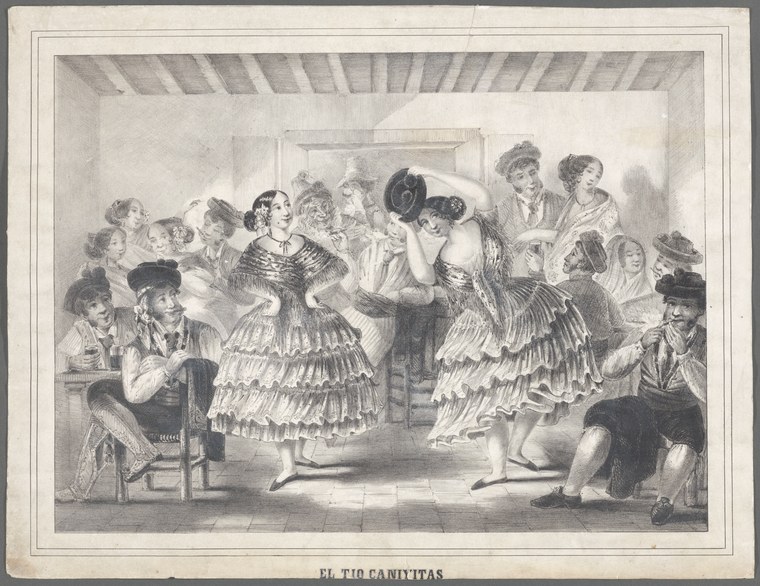
A crowded indoor scene depicts a lively social gathering centered on two women in elaborate tiered skirts performing a dance. The setting appears to be a modest room with exposed ceiling beams, furnished sparsely with chairs occupied by seated onlookers on both left and right. The two dancing women wear voluminous dresses with many horizontal ruffles or flounces that create dramatic silhouettes; one woman wears a darker patterned dress while the other wears a lighter, possibly white garment. Both are actively moving, their skirts in motion. Surrounding them are numerous spectators—men in hats and jackets, women in bonnets and period dress—standing and watching intently. A man on the left plays what appears to be a guitar or similar stringed instrument. The composition is crowded and theatrical, capturing the moment of performance rather than formal instruction. The print's gray wash technique creates soft modeling and suggests gaslight-era documentation.
The dancing
The two central dancers are captured mid-movement with their bodies angled toward each other, their weight shifting as they perform. Their arms are raised and active, contributing to the sense of rhythmic motion. The spectators frame them closely, their postures leaning in with attention. The guitarist on the left provides accompaniment, his body oriented toward the dancers. The overall frame is that of participatory social dance rather than staged ballet—the dancers are embedded among their audience rather than elevated above it. The energy is convivial and informal.
The dance depicted
This is almost certainly a Spanish dance, most likely a cachéra, contradanza, or regional folk dance from the early-to-mid nineteenth century. The title 'El tio Caniyitas' (Uncle Caniyitas) suggests a named performer or character associated with the dance. The elaborate tiered skirts and the energetic arm and hip movement visible in the figures are consistent with Spanish popular and regional dance tradition. The intimate indoor setting and the presence of live guitar accompaniment support this identification. The dance appears to be performed by women for a mixed social audience, characteristic of Spanish salon or tavern dance of this period rather than formal theatrical ballet.
How it was made
This is a lithograph, as evidenced by the tonal wash, the grain of the paper visible in the background, and the characteristic gray monochromatic technique of hand-drawn stone printing. Lithography allowed rapid circulation of such prints and made them affordable for middle-class audiences interested in popular entertainment and street life. The soft modeling and attention to gesture and fabric movement suggest a skilled lithographic draughtsman, likely working from direct observation or a sketch. The print's style and subject matter indicate it was made for commercial distribution—possibly as a broadside or part of a series documenting popular dances and entertainers.
About this work
This is a lithographic print documenting a Spanish popular dance performance, likely from the 1820s–1840s, centered on a named performer or character called 'Caniyitas.' The work captures the social context of dance in early modern Spain—not as a theatrical spectacle but as an intimate, participatory entertainment in a tavern or domestic setting, accompanied by live guitar and witnessed by a diverse crowd. The emphasis on the dancers' voluminous skirts and energetic movement, the presence of the guitarist, and the informal audience arrangement all distinguish this from contemporary theatrical dance imagery. The work belongs in a dance history collection because it documents a living tradition of Spanish popular performance that left few other visual records, and because it shows how such dances were experienced and valued in their own time—as communal entertainment rather than art-historical documents.
How to look at it
Look first at the dancers' skirts—the lithographer has given them extraordinary attention, rendering each flounce and the way the fabric catches light and motion. This level of detail tells you that the skirt itself was a central element of the dance, not merely costume. Notice how the two dancers face each other and how their arms are positioned; this is not the formal frame of a couple dance but something more improvisational and interactive. Watch how the spectators are positioned: they are not seated in orderly rows but crowded closely around the performers, suggesting spontaneous and immediate social engagement. The guitarist's placement on the left keeps him in sight but does not dominate; the emphasis is on the dancers and their relationship to their audience.
The artist
The artist is not recorded in the catalogue. The print's style, subject matter, and technique suggest a professional lithographic shop working in Spain during the 1820s–1840s, producing prints of popular entertainers, dances, and street scenes for a growing urban middle-class market. Such prints were often unsigned or attributed only to a publishing house rather than an individual artist; attribution would require archival research into Spanish lithographic firms of the period.
The period
This print emerges during the period of lithography's explosive growth in Europe and the commercialization of popular culture. In Spain, the early nineteenth century saw increasing interest in documenting regional and popular dance traditions—partly as a response to the Romantic movement's fascination with folk culture, partly because urban audiences were eager to consume images of entertainment and street life. At the same time, European theatrical dance was moving toward codified classical ballet; this print captures a world of dance that was not part of that institutional history and has largely been forgotten by it. The presence of the guitar as the sole accompaniment, the informal social setting, and the energetic femaleperformance align with Spanish contradanza and regional traditions that flourished in taverns and domestic spaces.
Where it lives
This print is held in the New York Public Library's collection of prints depicting dance. It is an example of the commercial lithographic prints that documented popular entertainment in early nineteenth-century Spain and circulated to a middle-class audience interested in scenes of street life and entertainment.
Dance in this work
Questions about this work
What does the title 'El tio Caniyitas' mean?
'Tio' means 'uncle' in Spanish; 'Caniyitas' is likely a diminutive or nickname, possibly referring to the dancer's profession or a character type. Without archival records, it is impossible to know whether this was a real performer, a character associated with a particular dance, or a generic type. The nickname suggests a figure known to the print's original audience.
What is the instrument the man on the left is playing?
It appears to be a guitar or possibly a bandurria (a Spanish plucked-string instrument). The presence of a string instrument was standard for Spanish popular and folk dances of this period. The guitarist's role was to provide rhythm and melody for the dancers, as he does here.
Is this a theatrical performance or a social dance?
It is neither theatrical in the sense of a staged production, nor purely social in the sense of a dance for participation by the audience. It is a performance of a popular dance by a named entertainer for a paying or invited audience in a domestic or tavern setting. The distinction is important: this kind of entertainment occupied a middle ground between family social dancing and formal theatrical production.
How do we know this is Spanish?
The title is in Spanish; the style of dress, particularly the tiered ruffled skirts and the way the women's hair is arranged, is consistent with Spanish fashion of the 1820s–1840s; and the instrument and movement style are characteristic of Spanish regional traditions. The overall aesthetic aligns with Spanish popular culture of the period.
More dance artwork





