49 works in this view — arrow keys or swipe to move between them.
Dance in Art
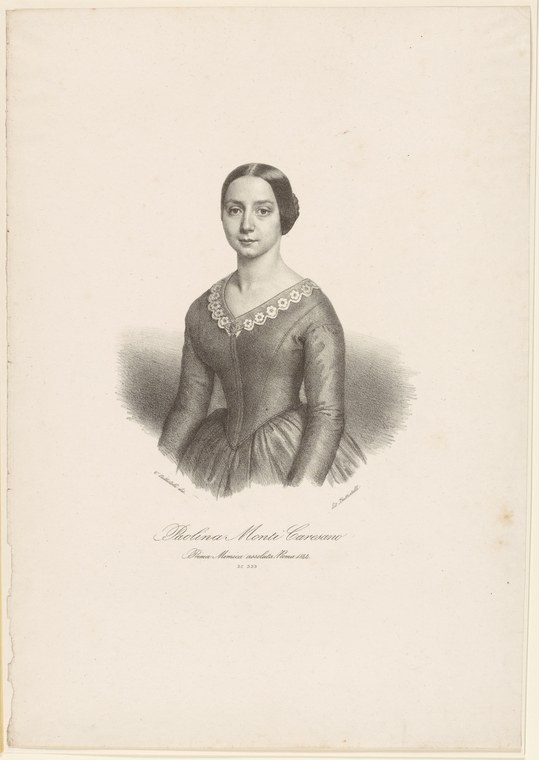
Paolina Monti Caresano, prima mimica assoluta, Roma 1844
Unknown artist
- Collection:
- Prints depicting dance
- Source:
- New York Public Library
- Rights:
- Public domain — free to use, share and adapt.
- Recorded as:
- Public Domain
Pantomime was a major European dance form in the nineteenth century, requiring virtuosic control of the body and face, yet it has left few visual records beyond such portraits. This image preserves the name and rank of a dancer whose performances have otherwise vanished; it shows us that women held the highest titles in this profession, and how their fame was commodified and distributed. The formal portrait style also reveals the tension at the heart of nineteenth-century performance: the dancer's body was the instrument of art, yet promotional images typically froze it into stillness.
What you are looking at
A bust-length portrait of a woman in three-quarter view, presented against a plain cream background. She wears a dark (likely black or deep brown) dress with long sleeves and a decorative neckline trimmed with a band of small circular ornaments or embroidery, possibly pearls or metal studs. Her dark hair is parted and swept back in the fashion of the 1840s. The image is rendered as an engraving or lithograph with soft tonal modeling created through fine parallel lines; the background is worked more heavily around the figure to throw her forward, while her face and shoulders are rendered with careful attention to surface texture and subtle shading. The portrait style—formal, three-quarter length, anonymous setting—follows the convention of theatre publicity prints of the period.
The dancing
The figure is posed in a standard portrait attitude, with the upper body turned slightly toward the viewer's left and the head tilted with a calm, direct expression. There is no visible movement or dance position; this is a study of the person rather than the dancer in motion. The formal frontal address and stillness are consistent with commemorative portraits of performers meant for circulation.
The dance depicted
The inscription names Paolina Monti Caresano as 'prima mimica assoluta' (prima mime absolute)—a distinction given to the foremost pantomime dancer of the day. This was a specific and prestigious rank within the hierarchy of nineteenth-century Italian theatre. Pantomime in this era was a virtuosic dance form emphasizing narrative gesture, facial expression, and whole-body articulation to convey plot and character without speech. The image itself does not depict dance, but rather the performer in street dress, a standard format for theatrical publicity. The designation 'Roma 1844' suggests this was made to commemorate her position or performances in Rome in that year.
How it was made
This is an engraving or possibly a lithograph, executed with fine linear work and tonal shading to create volume and surface detail. The technique allowed for mass production and circulation—these prints were sold as theatrical souvenirs and publicity materials, affordable to a broad audience and collectible. The careful finish and formal presentation indicate this was a serious professional document rather than a quick sketch, intended to circulate among theatre-goers and in collection albums.
About this work
This is a promotional portrait print of a celebrated Italian pantomime dancer, rendered as an engraving and inscribed to preserve her name and rank. Paolina Monti Caresano held the distinguished title 'prima mimica assoluta,' placing her at the apex of the pantomime profession in 1840s Italy. Though the portrait itself shows no dance—only a solemn, formally posed bust—it is a document of nineteenth-century theatrical celebrity and the high status of mime performance in European dance practice. The print exemplifies how theatrical personalities were circulated and commemorated: through affordable, reproducible images designed for fans and collectors.
How to look at it
Look at the title and inscription: the term 'prima mimica assoluta' is the essential information here, and tells you this was a dancer of the highest professional rank. The formal, still pose is typical of theatre celebrity prints—designed to preserve identity and prestige rather than capture performance. Note the care taken with the dress: it is not a performance costume but contemporary street wear of the 1840s, which emphasizes that this is a portrait of the person, not a dance scene. The medium (engraving or lithograph) is significant: this is a reproducible image, meaning Monti Caresano's image could be bought, collected, and displayed in the homes of theatre enthusiasts.
The artist
The artist is not recorded. Portraits of theatrical performers were a major commercial enterprise in nineteenth-century Europe, and prints like this were often made by specialists in theatre portraiture working for publishing houses or theatre management. The quality of execution here suggests a competent professional engraver, but not necessarily a named artist of wide fame.
The period
Pantomime—the art of conveying narrative and emotion through gesture alone—was at the height of its prestige in early nineteenth-century Europe. It was a rigorous discipline, often trained in Italy and performed across Europe. The 1840s saw pantomime still thriving as a major form before the rise of ballet pantomime and the shift toward pure dance spectacle. Italian dancers, particularly those trained in pantomime, held high international status. The system of 'prima ballerina assoluta' and equivalent ranks had recently become formalized, and 'prima mimica assoluta' was its counterpart in pantomime. Rome was a major theatrical center, and such a distinction would have carried considerable weight.
Where it lives
The print is held in the New York Public Library's collection of prints depicting dance. It is a single sheet, likely one of many such portraits produced for theatrical circulation and sale in the 1840s.
Questions about this work
What is a 'prima mimica assoluta'?
It is the highest rank given to a pantomime dancer—equivalent to 'prima ballerina assoluta' in ballet. It designated the foremost performer in the discipline of pantomime, which was a major virtuosic art form in nineteenth-century European theatre. Pantomime dancers conveyed narrative and emotion through gesture, facial expression, and bodily articulation, without speech.
Why does this portrait show no dancing?
This is a publicity portrait, not a performance record. Theatre prints of this era typically showed performers in street dress or formal pose, designed for circulation among fans and collectors. They preserved the performer's identity and rank, not a moment of movement. Dance scenes in art were rarer and served different purposes.
Was pantomime important in the 1840s?
Yes. Pantomime was a respected, formalized discipline with rigorous training, high prestige, and international circulation. It was particularly strong in Italy. The 1840s represent a high point before ballet began to absorb and transform pantomime conventions in the later nineteenth century.
Who was Paolina Monti Caresano?
The record preserves only this inscription, which documents her rank and her presence in Rome in 1844. Beyond that, her biography is not recorded here. She was significant enough to merit a formal portrait print—evidence of celebrity status—but her performances and career details remain to be researched in Italian theatre archives.
More dance artwork





