49 works in this view — arrow keys or swipe to move between them.
Dance in Art
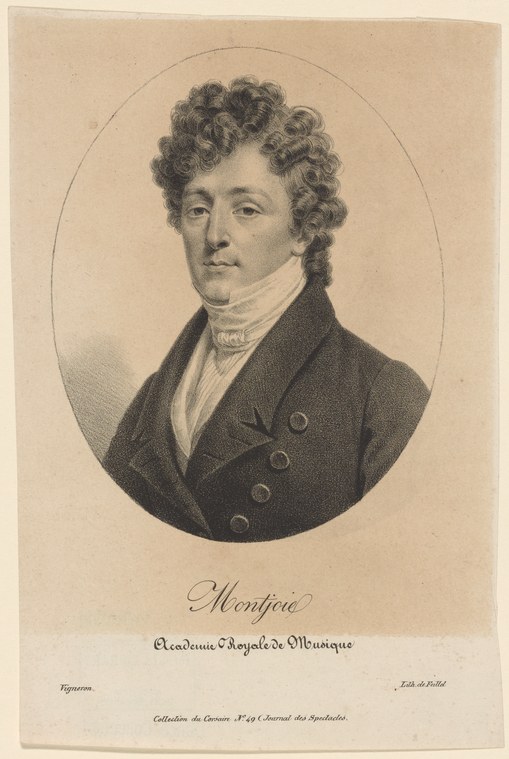
Montjoie, Academie royale de musique
Unknown artist
- Collection:
- Prints depicting dance
- Source:
- New York Public Library
- Rights:
- Public domain — free to use, share and adapt.
- Recorded as:
- Public Domain
The work documents an individual connected to the Paris Opera during a significant period in European dance history, though it captures administration or patronage rather than choreography or performance itself.
What you are looking at
This is a portrait engraving of a young man in early 19th-century dress, presented in oval format. He wears a dark double-breasted coat with visible buttons over a white cravat or neck cloth, and his hair is styled in the fashionable curled arrangement of the period. The figure is shown from the shoulders up, gazing slightly to the viewer's left with a composed, formal expression. The background is plain and neutral, allowing the subject to dominate the composition. The engraving technique creates subtle modeling through fine parallel lines, giving dimension to the face and fabric while maintaining the formal clarity expected of a commemorative portrait.
The dancing
The subject is motionless and posed, not engaged in dance. The shoulders are square and level, the head held in neutral alignment, the arms not visible. This is a formal seated or standing portrait pose of the kind used for official commemoration, not a study of movement or embodiment.
The dance depicted
This work does not depict dance. It is a portrait of an individual identified in the inscription as Montjoie, given as "Academie royale de musique" (Royal Academy of Music). While the subject is associated with a musical institution, the portrait itself shows no dancing, choreography, or performance activity. The figure is posed for formal commemoration rather than captured in movement.
How it was made
This is an engraving, likely stipple or fine-line engraving given the delicate tonal modeling visible in the face and hair. The oval format framing and the formal presentation suggest this is a commemorative print, possibly from a series of notable figures associated with the Paris Opera or musical institutions. The technique allowed for mass reproduction and circulation among educated audiences interested in music and theater.
About this work
This is a commemorative engraving of a man named Montjoie, identified with the Académie Royale de Musique in Paris. It belongs in the dance collection as a historical document of the institutions that employed and trained dancers in the early 19th century, but the work itself is a portrait rather than a depiction of dance. The figure and inscription provide evidence of professional musical and theatrical life in Restoration-era Paris, even though the portrait captures no movement or performance.
How to look at it
Note the inscription below the portrait, which names the subject and his institution. The formal oval frame and refined engraving technique signal that this is a work of commemoration rather than entertainment—the kind of image that would have appeared in institutional records, theater journals, or collections assembled by scholars and administrators. The neutral pose and composed expression reflect the conventions of official portraiture of the period.
The artist
The engraver is not named in the record. The inscription attributes the work to a print collection: "Collection du Conserv. d'Ég Jouraux des Spectacles" (Collection of the Conservatory of Illustrated Theater Journals). This suggests the print was part of a systematic documentation of theatrical and musical figures, possibly compiled for institutional or scholarly purposes.
The period
This engraving dates to the early 19th century (likely 1810s–1830s), a period when the Paris Opera (Académie Royale de Musique) was establishing itself as the preeminent institution of French theatrical dance and music. During this era, Romantic ballet was emerging, and the ballet d'action was becoming the dominant form. Formal portraiture of theatrical administrators and musicians was common as part of the growing documentation and celebration of cultural life.
Where it lives
This engraving is held in the New York Public Library's collection of prints depicting dance. It is part of a larger documented collection relating to theatrical subjects and the visual culture of European performance institutions.
Questions about this work
Does this engraving show a dancer?
No. This is a portrait of an individual associated with the Académie Royale de Musique (Paris Opera), but the figure is posed formally and is not shown performing or dancing. The work documents institutional history rather than choreography or performance.
Why is a portrait included in a dance collection?
Because it documents a person connected to a major dance institution during a formative period in ballet history. Such portraits provide evidence of the people, administration, and cultural networks that shaped dance in the early 19th century, even when they do not depict dance itself.
What does the inscription tell us?
The inscription identifies the subject as Montjoie and associates him with the Académie Royale de Musique (the Paris Opera). It also credits a theater journal collection, suggesting this was part of systematic documentation of theatrical figures.
More dance artwork





