49 works in this view — arrow keys or swipe to move between them.
Dance in Art
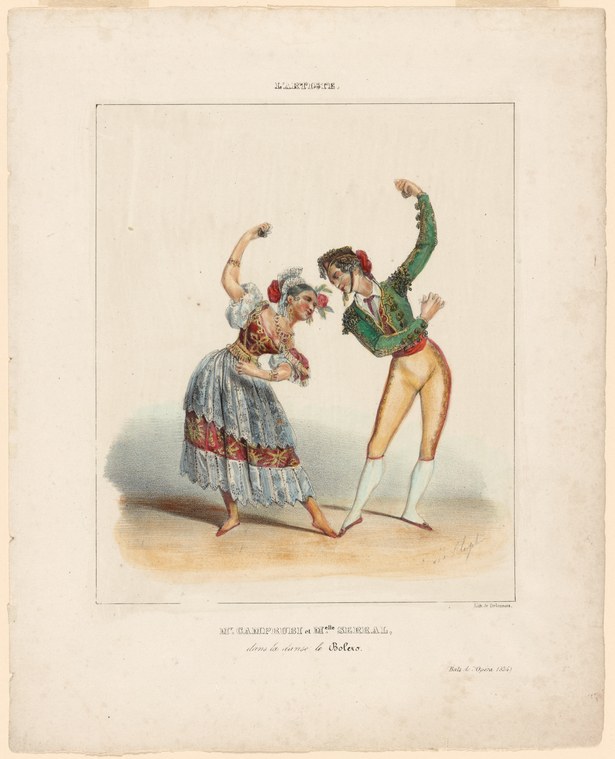
Mr. Camprubi et Melle Serral, dans la danse le Bolero
Unknown artist
- Collection:
- Prints depicting dance
- Source:
- New York Public Library
- Rights:
- Public domain — free to use, share and adapt.
- Recorded as:
- Public Domain
This print is one of the few surviving visual records of how the bolero was actually performed by professional dancers of the period, preserving the specific arm work and partnering style that written descriptions alone cannot convey. The identification of the performers by name offers a rare bridge between historical dance documentation and the individual practitioners whose careers shaped early nineteenth-century ballroom culture.
What you are looking at
A hand-colored theatrical print depicting two dancers in an intimate moment mid-performance. The male dancer, dressed in close-fitting green breeches, white stockings, and a brown fitted jacket with red detail at the waist, leans backward with his right arm raised high and bent. The female dancer, in a flowing pale blue gown with red trim and white lace cap, mirrors his pose with her left arm raised. Both figures are caught mid-turn, their bodies arched away from each other in a symmetrical, coordinated movement. The composition is set against a plain, neutral background with subtle shading that grounds the figures. The print exhibits the refined hand-coloring characteristic of early nineteenth-century theatrical portraiture, with careful attention to the textures of fabric and the delicate modeling of skin tones.
The dancing
Both dancers display a pronounced backward lean with their bodies forming mirror-image curves. Their raised arms stretch upward and outward in a synchronized arch, suggesting a synchronized turning movement. The male dancer's forward-facing stance and the female's perpendicular angle create dynamic asymmetry despite their mirrored gesture. The footwork is obscured by costume, but the weight distribution and spinal extension suggest a rotational movement executed in close spatial proximity, typical of partner dances of this era. The positioning indicates trained performers with ballroom dance technique.
The dance depicted
The title explicitly identifies this as a bolero, a Spanish-origin partner dance that experienced significant popularity in European ballrooms during the nineteenth century. The bolero was characterized by a moderate three-four time and a Cuban habanera-influenced rhythm, danced by couples in close proximity with turning movements and elaborate arm work. This print documents the theatrical performance style of the bolero as executed by named professional dancers—Camprubi and Serral—suggesting these were known performers of the period. The synchronized backward lean and raised-arm positioning matches contemporary descriptions of bolero choreography, which emphasized elegant, languid movements and partnering.
How it was made
This is a hand-colored lithographic print, identifiable by the characteristic crayon-on-stone linework and the precision of the color application. The technique allowed for rapid production and wide distribution of theatrical images, making this a form of popular entertainment advertising. The quality of hand-coloring—the careful gradation of the male dancer's stockings, the translucency of the female's skirt fabric, and the subtle modeling of faces—indicates a professional coloring workshop rather than simple tinting. Lithography became the dominant medium for theatrical portraiture after 1820, enabling artists to capture the specificity of costume and moment while reaching both print collectors and theater-going audiences.
About this work
This print documents the bolero as it was performed in early nineteenth-century European ballrooms and stages, capturing the partnership and technique of two named professional dancers. The bolero, imported from Spain and adapted through Cuban influences, was a fashionable dance among the upper classes during the 1820s–1840s. The work belongs to a substantial tradition of theatrical dance portraiture, where named performers were commemorated in hand-colored prints that served simultaneously as souvenirs, advertisements, and records of dance practice. The specificity of the dancers' names and the care lavished on costume detail suggest this was a commercially significant performance, marketed to audiences who would recognize Camprubi and Serral as established practitioners.
How to look at it
Attend to the mirror-image symmetry of the pose—this is not a snapshot of movement but a formalized, composed moment that the dancers would hold briefly as a high point of the choreography. The deliberate synchronization of the arm gestures and the carefully managed spatial relationship between the partners illustrate what early nineteenth-century ballroom dance valued: coordination, elegance, and the visual unity of the couple. The print captures the moment of greatest extension and visual impact, the practice of theatrical dance documentation itself.
The artist
The artist is not recorded. The print bears the credit line 'Lith. de Chachean' or similar (the manuscript inscription is unclear), suggesting a Parisian lithographic workshop. The style and execution indicate a professional theatrical illustrator working within the conventions of early nineteenth-century French dance portraiture, where such prints were produced to order for performers and sold to the public.
The period
The bolero emerged in Spain in the late eighteenth century and was enthusiastically adopted by Parisian and London ballroom society in the 1820s and 1830s, coinciding with the broader Romantic-era fascination with Spanish and exotic culture. This was the era of Romantic ballet's ascendancy, yet social dance remained a central form of public entertainment and social performance. Professional dancers regularly performed set dances in theaters and at public balls, and their reputations were built through repeated signature performances of particular pieces. The hand-colored theatrical print was the primary medium through which these performances were documented and circulated beyond the venue itself.
Where it lives
The work is held in the New York Public Library's Prints depicting dance collection. It is one of hundreds of theatrical dance portraits produced in Paris and London during the 1820s–1840s, now dispersed among institutional collections.
Dance in this work
Questions about this work
Was the bolero a Spanish dance or a ballroom invention?
The bolero originated in Spain in the late eighteenth century as a three-four time partner dance. By the early nineteenth century it had been adopted and adapted by European ballroom society, especially in Paris, where it acquired the languid, arm-emphasis style visible in this print. It was performed both socially and theatrically, often by professional dancers in public venues.
Who were Camprubi and Serral?
They were professional dancers active in European ballroom and theatrical performance in the early nineteenth century. The fact that they are named in the print title indicates they had sufficient fame or commercial draw to warrant a commemorative portrait, a practice reserved for established performers. No detailed biographical record of them survives.
How was this print used?
Hand-colored lithographic prints of this type served multiple purposes: as souvenirs purchased by attendees of performances, as advertisements for upcoming shows, as reference material for dance students, and as collectibles. They circulated both through theaters and through print shops, reaching audiences beyond those who attended live performances.
More dance artwork





