49 works in this view — arrow keys or swipe to move between them.
Dance in Art
Folk and ethnic dancing in wood engravings
Unknown artist
- Collection:
- Prints depicting dance
- Source:
- New York Public Library
- Rights:
- Public domain — free to use, share and adapt.
- Recorded as:
- Public Domain
For historians of dance and visual culture, this engraving is a primary document of how 19th-century European periodicals represented non-Western dance to mass audiences. It shows both genuine observational detail—the posture, gesture, and social context of the dancers—and the interpretive framework through which that dance was presented to viewers unfamiliar with it. Understanding such images requires attention to both what the artist chose to show and the editorial and commercial purposes the image served.
What you are looking at
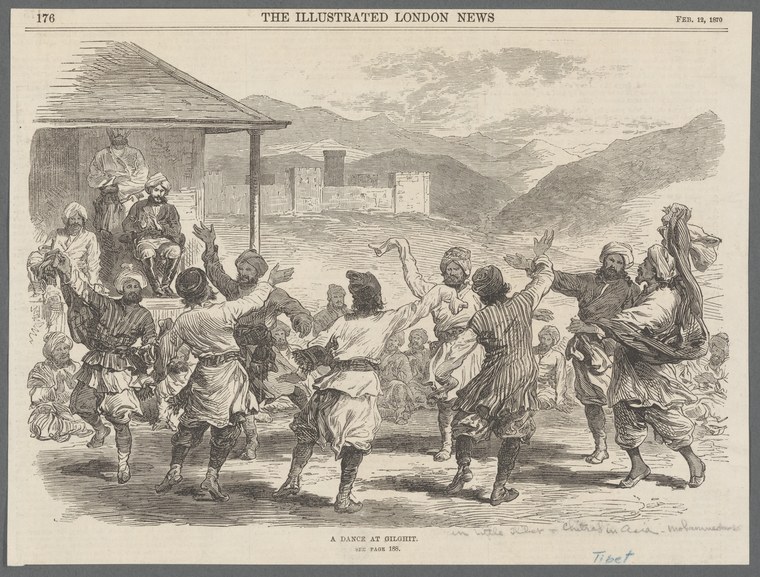
A wood engraving depicts a lively outdoor gathering in what appears to be a village or settlement, with mountains visible in the distant background. A group of figures—men, women, and children—are arranged in an open space before a simple structure with a pitched roof at left. The figures are in motion, many with arms raised or extended, suggesting active participation in a communal event. The dress is varied: some wear long dresses or robes, others simpler garments; several figures sport hats or head coverings. The composition is animated and crowded, with overlapping bodies creating depth and a sense of spontaneous, joyful movement. The engraving technique renders the scene in fine lines and cross-hatching, with strong contrasts between light and shadow that emphasize the energy of the gathering.
The dancing
The dancers display a range of postures and arm positions consistent with folk or social dancing. Several figures have both arms raised or one arm extended outward; others appear to be in the process of turning or stepping. The poses suggest unstructured, improvisational movement rather than formal choreography. Bodies are upright and active, with visible weight shifts and changes in level. The grouping is loose and informal—dancers appear to be engaging with one another across the open space rather than in strict paired formations, though some figures seem to face one another.
The dance depicted
This is a depiction of folk or ethnic social dancing, most likely from a non-Western context given the architectural setting, dress, and the title's reference to "a dance at Edigert." The exact style cannot be determined from visual evidence alone, but the composition suggests a communal celebration or gathering where dancing serves a social or ceremonial function. The informal arrangement, raised arms, and mixed participation of men, women, and children are consistent with many African, Middle Eastern, or South Asian folk traditions. Without inscription or clear cultural markers in costume, the precise dance tradition remains open.
How it was made
This is a wood engraving, a relief printing technique in which an image is carved into the end grain of a hardwood block, inked, and impressed onto paper. The fine parallel lines and cross-hatching visible throughout are characteristic of wood engraving, which allows for high detail and was widely used for newspaper and periodical illustration in the 19th century. The technique's economy and reproducibility made it ideal for circulation in publications like The Illustrated London News, where this image appeared. The precision of the line work and the tonal range achieved through density of marks indicate a skilled engraver working from a drawing or sketch.
About this work
This wood engraving from The Illustrated London News documents a moment of social dancing in what the caption identifies as Edigert, likely a colonial-era ethnographic illustration intended to present the customs of a distant place to a British readership. The print captures the energy and informality of communal dancing—the raised arms, varied postures, and mixed participation suggest a ritual or celebratory occasion rather than formal entertainment. As both a visual record and a cultural artifact of Victorian-era journalism, it reflects how European audiences encountered and interpreted non-Western dance practices through illustrated media. The engraving belongs to a long tradition of travel and ethnographic documentation in which dance became a marker of cultural difference and exotic spectacle.
How to look at it
Attend first to the composition: the scattered, overlapping arrangement of figures and the absence of a formal line or prescribed pattern distinguish this from European ballroom or theatrical dance. Note the prevalence of raised arms and the variety of body positions—the artist is capturing movement in process, not a frozen pose. The architectural and environmental context—the simple structure, the landscape, the dress—anchors the dance in a specific place outside European urban society. Finally, consider the visual language itself: the wood-engraved line has a particular texture and weight that was familiar to Victorian readers of periodicals, positioning this image within a specific mode of seeing and knowing the world.
The period
This engraving dates to the era when The Illustrated London News (founded 1842) was establishing the visual culture of journalism and mass communication. In the mid-to-late 19th century, illustrated periodicals served as primary vehicles for knowledge about distant places, and dance figured prominently in ethnographic reportage. Such images blended documentary impulse with exoticizing aesthetics: dances were presented as evidence of cultural character and often framed to emphasize difference from European norms. The informal, celebratory quality of this scene—with its emphasis on joy, community, and uninhibited movement—reflected both genuine observation and Victorian-era assumptions about non-industrial societies. Wood engraving was the dominant reproductive technology of the period, capable of rendering fine detail at speed and in high volume for newspaper distribution.
Where it lives
This wood engraving was published in The Illustrated London News, a weekly periodical that circulated among British readers of the 19th century. The print belongs to a collection of dance imagery held by the New York Public Library. As part of illustrated periodical journalism, it was designed for mass circulation and viewing, making it a public document of its moment.
Dance in this work
Questions about this work
Where is Edigert?
The caption identifies the location as Edigert, but without additional research into The Illustrated London News archives and historical geography, it is difficult to pinpoint with certainty. The name may refer to a settlement in a region of colonial interest—possibly in Africa, Asia, or the Middle East—but the engraving alone does not clarify the location.
How reliable is this as a record of actual dance?
Wood engravings for periodicals were often based on sketches or reports from correspondents or travelers, and while they aimed at visual accuracy, they were also subject to the conventions and biases of the engraver and the editorial context. This image likely captures genuine observational details—the informal grouping, the raised arms, the mixed participation—but it is also shaped by Victorian aesthetics and the agenda of presenting the exotic to a British audience. It should be read as both document and interpretation.
What was the purpose of publishing this image?
The Illustrated London News published such images to satisfy readers' curiosity about distant places and peoples, and to position Britain's periodical press as a purveyor of knowledge and spectacle. Ethnographic scenes, including dance, were standard fare and served both informational and entertainment functions. The image brought the world to British readers' drawing rooms.
More dance artwork





