49 works in this view — arrow keys or swipe to move between them.
Dance in Art
La belle savoyarde polka: arrangée pour le piano forte [one piano] et dediée aux demoiselles Dora A. Mumford et Clara S. Jackson
Unknown artist
- Collection:
- Prints depicting dance
- Source:
- New York Public Library
- Rights:
- Public domain — free to use, share and adapt.
- Recorded as:
- Public Domain
The polka represented a radical shift in social dance: faster, more turning, more democratic in access than the quadrille, and driven by commercial mass production rather than aristocratic gatekeeping. This image shows how dance was sold, taught, and imagined in the age of industrialised leisure, and how a single composition could circulate across Europe in dozens of arrangements, versions, and illustrated editions.
What you are looking at
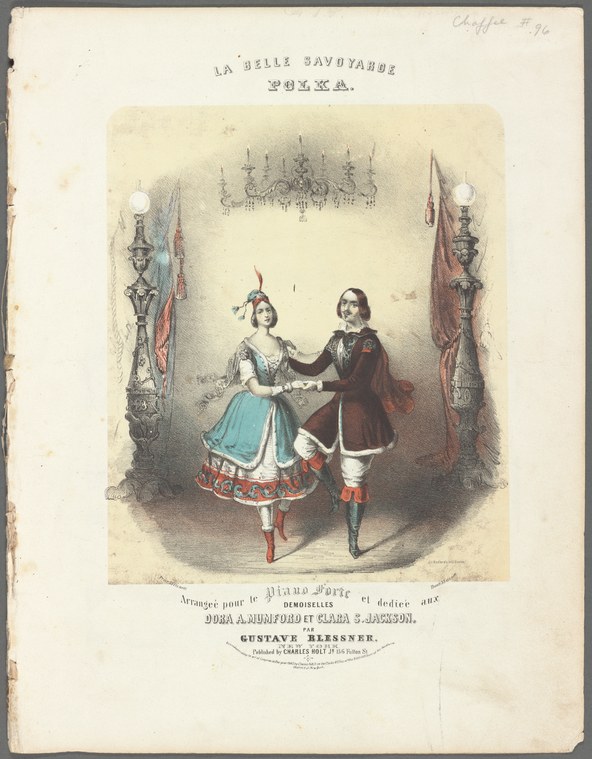
A couple dances in an ornate interior space defined by decorative pillars draped with fabric and surmounted by elaborate torches or candelabra. The woman wears a pale blue skirt with white underskirts and a fitted bodice; the man is dressed in a dark formal coat with a high collar and military styling, his posture upright and commanding. They stand close together in the centre of the composition, the woman's body angled toward the man in a posture of engagement. Above them hangs a chandelier. The engraving is hand-coloured, with soft washes of blue, flesh tones, and red accents on military trim. The setting suggests an aristocratic ballroom or palace interior—formal, intimate, and designed to showcase fashionable social dance. The couple's positioning and the woman's skirt suggest a turning or pivoting moment in the dance.
The dancing
The man's right arm is extended to hold the woman's left hand or arm in a formal ballroom grip; his left arm appears positioned at the woman's waist or back. The woman's posture is upright but slightly inclined toward her partner, her weight appearing to be in motion. Both figures are shown mid-step or mid-turn, with the woman's skirts billowing slightly, suggesting rotational movement. The distance and frame of the hold is consistent with early 19th-century ballroom partnering—close but not intimate by modern standards, formal and codified.
The dance depicted
The title identifies this as a polka, specifically arranged as a piano piece and dedicated to two women. The polka emerged as a fashionable dance in the 1840s, combining Czech folk origins with Parisian salon culture, and became one of the dominant social dances of the mid-19th century. The image shows the characteristic closed ballroom position and the suggestion of rapid, turning movement that defined the polka's appeal. The military dress of the male partner and the formal interior setting suggest this represents polka as danced in aristocratic or upper-middle-class ballrooms rather than folk or café contexts. The arrangement for piano and the dedication to named women (likely amateur musicians or society dancers) confirms this was a commercial, fashionable piece aimed at the home music market.
How it was made
This is a hand-coloured engraving, a technique that dominated commercial dance imagery in the early-to-mid 19th century. The combination of engraved line work (fine detail in the architecture, fabric textures, and facial features) with hand-applied watercolour washes allowed mass production at relatively low cost while retaining the prestige of art-world materials. Such prints were typically sold as sheet-music covers or standalone illustrations, reaching parlour musicians, dance teachers, and fashionable households. The colouration and style suggest French or Anglo-French production, consistent with Paris's dominance in polka imagery during this period.
About this work
This is a commercial illustration for a piano arrangement of 'La Belle Savoyarde Polka,' a fashionable dance composition of the mid-19th century. The image presents the polka as an elite social practice—a couple in formal dress executing the characteristic rotational movement in a richly appointed ballroom. The work belongs to a vast printed culture of polka imagery, sheet-music covers, and dance instruction materials that circulated among urban bourgeois households in the 1840s–1860s. It documents both the polka's ascendancy as the dominant social dance of the era and the role of commercial engraving in making dance visual and teachable to a mass amateur market.
How to look at it
Attend to the woman's skirts and the tilt of her body—the artist has caught the moment of a turn or rotation, the defining feature of the polka's appeal and challenge. The formal closed hold and the upright posture of both figures illustrate the ballroom discipline required even in a dance celebrated for its speed and apparent spontaneity. The ornate architectural setting—the pillars, torches, chandelier—places this dance in elite space, not the café or public hall where the polka also flourished. The hand-colouration adds materiality and prestige to what is fundamentally a mass-produced commercial image, reflecting the polka's position at the intersection of folk culture, aristocratic fashion, and industrial capitalism.
The period
The polka emerged in Bohemia in the 1830s and reached Paris around 1840, where it was instantly fashionable and commercially exploited. By the 1850s, the polka dominated European ballrooms and generated an enormous printed industry: sheet music, dance manuals, pictorial broadsheets, and satirical prints. The dedication to 'Demoiselles Dora A. Mumford et Clara S. Jackson' suggests an Anglo-American context (possibly British or American), indicating the polka's rapid transatlantic circulation. The military styling of the male dancer and the formal ballroom setting reflect the polka's adoption by the upper-middle and aristocratic classes, despite its folk origins. Simultaneously, the polka was satirised in high art and periodicals as shallow, frenetic, and symptomatic of modern commercial culture.
Where it lives
This is a sheet-music cover or standalone dance illustration from the NYPL's collection of prints depicting dance. It is one of thousands of similar hand-coloured engraved images produced in the mid-19th century to accompany polka arrangements, dance instruction books, and fashionable entertainment. The current holding reflects the NYPL's role in preserving the material culture of dance as commercial, visual, and pedagogical practice.
Dance in this work
Questions about this work
What is a polka and why was it so popular?
The polka is a fast, turning dance that originated in Bohemia and became the dominant social dance across Europe and North America in the 1840s–1860s. It was faster, more exhilarating, and easier to learn than the quadrille, and it appealed across social classes. Its popularity was driven by sheet-music publication, dance manuals, and images like this one, which made it teachable and fashionable in parlours and ballrooms.
Who were Dora A. Mumford and Clara S. Jackson?
The catalogue record does not identify these women. The dedication suggests they were amateur pianists or dancers of some social standing. Such dedications were common commercial practice—a way to honour patrons or to suggest the composition was suitable for refined amateur performance.
How was this image made and circulated?
This is a hand-coloured engraving, a technique that combined mechanical line-work (engraving) with manual colour application. This allowed thousands of copies to be produced relatively cheaply and sold as sheet-music covers, broadsheets, or standalone prints. Such images reached the homes of musicians, dancers, and fashionable households across the English-speaking world.
Is this a dance instruction image or a decoration?
It is both. The image provides a visual model of correct ballroom posture and partnering for the polka, while also serving as an attractive, prestige-conferring cover for a commercial sheet-music product. The formal setting and fashionable dress suggest aspiration as well as instruction.
More dance artwork





