49 works in this view — arrow keys or swipe to move between them.
Dance in Art
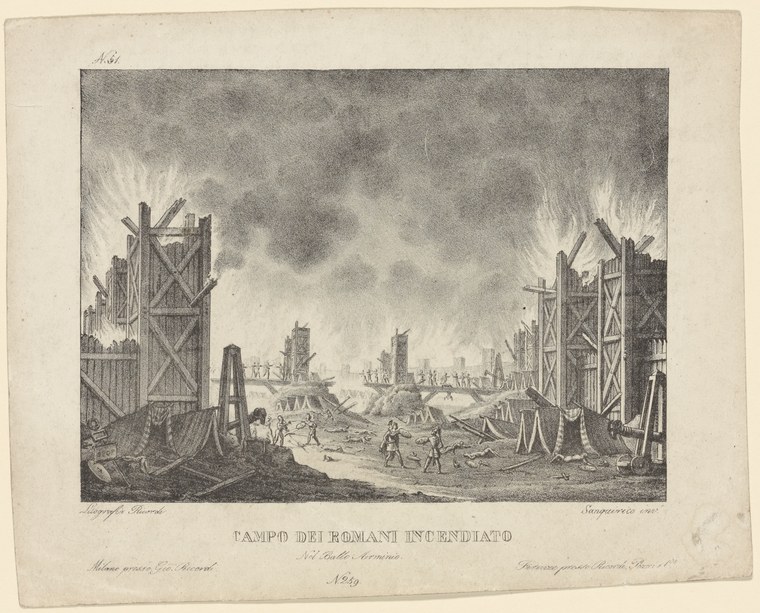
Campo dei Romani incendiato nel ballo Arminio
Unknown artist
- Collection:
- Prints depicting dance
- Source:
- New York Public Library
- Rights:
- Public domain — free to use, share and adapt.
- Recorded as:
- Public Domain
This work is catalogued as a dance-related image but does not depict dance itself. It is important as a test case: the title references performance ('ballo') but the content is narrative violence, showing how easily theatrical and operatic imagery can be misclassified. It reminds us that not every theatrical image, and not every image with a performance title, documents actual dance.
What you are looking at
A dramatic engraving depicting a scene of destruction and chaos, likely a military encampment or fortified position in ruins. Two massive wooden siege structures or fortification gates flank the composition, both engulfed in flames and smoke that billows into a turbulent sky. Between them stretches a devastated landscape: collapsed buildings, toppled timbers, and scattered debris. Small figures move through this ruined terrain—some appear to be soldiers or combatants, others fleeing or regrouping. The scale of the structures emphasizes the catastrophe; the human figures are dwarfed by the architectural destruction. The entire scene is rendered in grey and black tones with dramatic shading that conveys heat, smoke, and chaos. This is a scene of violence and military conflict, not a dance.
The dancing
The human figures scattered across the composition are too small and distant to discern specific gesture or choreography. Some appear to be in postures of flight or combat—raised arms, bent postures—but individual bodies cannot be clearly read. The figures are distributed across the scene without any formation, alignment, or coordinated spacing that would suggest dance.
The dance depicted
This engraving does not depict dance. The title references 'ballo Arminio' (the ball or dance of Arminio), which suggests it may illustrate a dramatic or operatic moment nominally connected to performance or festival, but the visual content shows military destruction, not dancers or a ballroom scene. If this is a theatrical context, it depicts the narrative content (a battle or siege) rather than the dance itself.
How it was made
This is an engraving, established from the fine line work, tonal hatching, and overall formal aesthetic typical of 18th-century print production. The signature at bottom left suggests it is a documented print by a known artist, and the inscription identifies it as from an Italian collection or publication context ('Scenografia'). Engravings of this scale and finish were expensive to produce and circulated among educated collectors, libraries, and theatres, suggesting this documented a significant theatrical production or historical scene.
About this work
This is an engraving of a scene of military destruction—a fortified position or camp consumed by fire and chaos. Although the title invokes 'ballo Arminio,' the image itself shows warfare, not dance. It may represent a theatrical set design or a dramatic moment from an opera or play centered on the historical figure Arminius, rendered as a narrative spectacle of destruction rather than as choreography. The work belongs in a historical archive of theatrical imagery or military illustration rather than in a dance collection.
How to look at it
The composition is built on symmetry and scale: the two burning structures frame a central zone of ruin and activity. The eye is drawn upward by the plumes of smoke and down again by the scattered figures, which give a sense of ongoing action and emergency. The artist has frozen a moment of maximum dramatic intensity—not the beginning of the fire or its aftermath, but the catastrophic present. The formal, balanced composition contrasts sharply with the chaos depicted, a tension typical of theatrical imagery designed to be both credible and aesthetically controlled.
The artist
The artist is not recorded in the catalogue. The signature visible at bottom left ('Scenografia Incisa') indicates a professional engraver working in theatrical or architectural scenography tradition, likely Italian or Italian-trained, working in the 18th century. The inscription suggests publication in an Italian context, possibly Venice or Rome.
The period
This engraving belongs to the 18th-century tradition of theatrical scenography prints—elaborate documentation of stage sets and dramatic tableaux, often commissioned to record famous productions or to circulate designs. The period saw intense development of illusionistic stagecraft, architectural spectacle, and the visual drama of opera and drama. Engravings like this were valued as records of theatrical innovation and as models for other productions.
Where it lives
The work is held in the New York Public Library's collection of prints depicting dance. It is catalogued with minimal metadata; the medium is not formally recorded, though the technique is clearly engraving. The Italian language and iconography suggest a European source and production.
Questions about this work
Is this actually a dance image?
No. Although the title 'Campo dei Romani incendiato nel ballo Arminio' references a ball or performance ('ballo'), the engraving depicts a scene of military siege and destruction, not choreography or dancers. It may illustrate a dramatic moment from an opera or theatrical work, but the image itself shows narrative action, not dance.
What is the historical subject?
The inscription references Arminio, the historical Germanic leader also known as Hermann, who famously defeated Roman legions in 9 CE. The title suggests a theatrical or operatic treatment of this conflict, rendered as a dramatic spectacle of destruction. Without additional documentation, we cannot determine which specific opera or play this represents.
Why is this in a dance collection?
The title contains the word 'ballo' (ball/dance), which likely triggered its classification in theatrical and dance-related collections. However, the image itself does not depict dance and may represent a cataloguing error or an over-inclusive definition of 'dance-related imagery.'
More dance artwork





