49 works in this view — arrow keys or swipe to move between them.
Dance in Art
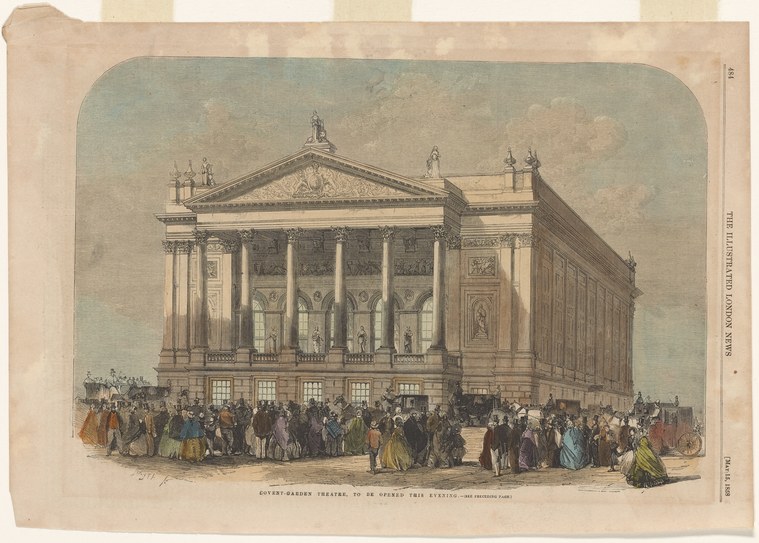
Covent Garden Theatre: to be opened this evening
Unknown artist
- Collection:
- Prints depicting dance
- Source:
- New York Public Library
- Rights:
- Public domain — free to use, share and adapt.
- Recorded as:
- Public Domain
Covent Garden Theatre was central to the history of ballet in Britain, particularly Romantic ballet, and this print is a rare documentary view of the building's architectural identity and the social context of theater-going at a crucial historical moment. For dance historians, the image reveals how the theater was positioned within urban London and what the audience and occasion looked like—essential context for understanding who watched dance and how it was framed culturally.
What you are looking at
A hand-colored engraving depicting the opening night of Covent Garden Theatre, with a monumental neoclassical building as the focal point. The theater's façade dominates the composition: a grand portico with tall Corinthian columns, a triangular pediment, and ornamental detail across the entablature. The ground level features large arched windows. Before the building stands a substantial crowd of Londoners in early 19th-century dress—men in top hats and dark coats, women in high-waisted Empire silhouettes and bonnets, children mixed throughout. The crowd is animated but organized, gathered for the ceremonial opening. The sky above is rendered in soft blue-grey tones, with white highlights suggesting overcast London weather. The engraving's palette is restrained: ochres and taupes for the stone, muted blues and greens in the sky, touches of color in the crowd's clothing (yellows, blues, reds in scattered figures' dress).
The dancing
The figures in the crowd are not engaged in dance; they stand, walk, and gesture in social conversation. Postures are upright and dignified, typical of formal public occasions. Some figures gesture toward the building or each other in conversation; several women's skirts display the high waistlines and columnar silhouettes characteristic of the Regency period, with long trails on the ground. A few children are visible in the crowd, and the density of figures creates a sense of gathered assembly rather than choreographed movement. No dancing couples, formation, or bodily alignment suggesting dance is visible.
The dance depicted
This is a documentary engraving of a public ceremonial event, not a representation of dance itself. While Covent Garden Theatre was intimately associated with dance performance—particularly ballet—the image captures the inaugural gathering outside the building, focused on architecture and civic ceremony rather than theatrical performance. The crowd's composition and dress are consistent with Regency-era theater-going society, and opening nights would have featured both plays and possibly ballet, but no dancers or choreography are shown here. The image is valuable as a historical record of theatergoing culture and dress rather than as evidence of specific dance practices.
How it was made
This is a hand-colored engraving, likely steel or copper plate, in which the fine linear work has been incised into the plate and inked to create the print. The architectural detail and crowd figures are rendered through cross-hatching and line work characteristic of early 19th-century commercial engraving. Hand coloring was applied afterward with watercolor or oil-based pigments, a labor-intensive process that made such prints valuable and relatively costly. The technique allowed for mass distribution while retaining the prestige of fine printmaking; such prints typically served as commemorative records of significant public events and were sold to middle- and upper-class audiences as souvenirs and documentation. The hand-coloring gives each impression individual character and suggests this was a premium product.
About this work
This engraving documents the opening of the Theatre Royal, Covent Garden, one of London's principal theaters, famous historically as a venue for both dramatic and dance performances. The print captures not the performance itself but the public ceremony and social gathering surrounding the event, showing the architectural ambition of the theater and the composition of London's theater-going public in the Regency era. It belongs in a dance archive not because it depicts dance, but because it documents the theatrical infrastructure and audience culture within which Romantic ballet and other staged dance developed and was consumed. The building itself became synonymous with British ballet and dance history.
How to look at it
Attend first to the architectural dominance of the building—the print's purpose was to celebrate and document the theater structure itself as a permanent civic monument. The crowd should be read as evidence of occasion and social composition rather than action; note the formality and stillness compared to scenes of actual dance or carnival. The hand-coloring, while restrained, directs the eye: the pale stone of the building is set off by the darker figures and the muted sky, and touches of bright color in the crowd's dress create focal points and human interest. The engraver's choice to show the building full-face, symmetrical and frontal, emphasizes its grandeur and permanence.
The artist
The artist is not recorded in the catalogue. The work is a commercial print, likely produced by a London printshop in the early 19th century. Such commemorative architectural engravings were standard products of the London print trade, documenting significant civic, royal, or cultural events. The quality of the line work and composition suggests a competent professional engraver, though not one of the era's most celebrated printmakers.
The period
The engraving dates to the period of the Regency (c. 1811–1820) or early Georgian era, when London's theater culture was flourishing and neoclassical architecture was at its height. This was the era immediately preceding the arrival of Romantic ballet in London in the 1830s—works like *La Sylphide* and *Giselle*—so the print documents the very stages and institutions on which that revolution would unfold. The Covent Garden Theatre and the Theatre Royal Drury Lane were the dominant London venues, and their architectural grandeur signaled the cultural importance placed on theater. The crowd's dress and composition show the cross-class nature of theater attendance, though weighted toward the educated and prosperous.
Where it lives
The print is held in the New York Public Library's collection of prints depicting dance. It was catalogued in that collection despite its documentary rather than narrative focus, likely because of Covent Garden's historical centrality to British dance performance. The entry in the record has minimal descriptive information, suggesting the work is documented primarily by its image rather than by external scholarship.
Questions about this work
Why is a picture of a theater building in a gallery of dance in art?
Covent Garden Theatre was one of the two principal theaters in London where ballet, pantomime, and other staged dances were performed, especially during the Romantic ballet period from the 1830s onward. This print documents the building itself and the social context of theater-going, which is integral to understanding how and where dance was experienced as a public art form. The architectural monument and the crowd are inseparable from the performances that took place within.
Is there any dancing happening in this image?
No. This is a commemorative print of the opening ceremony and gathering outside the theater, not a representation of performance or dancers. The crowd is assembled for a civic occasion, not for dance. However, the image reveals the scale, location, and audience context of one of the principal venues where dance was staged in Regency England.
When was Covent Garden Theatre built?
The Theatre Royal, Covent Garden (also known as the Royal Opera House) was built on this site in 1732. The neoclassical building shown in this print was completed in 1809, after the earlier theater burned in 1808. This engraving likely documents the reopening in 1809 or a subsequent major public occasion at the theater.
What does the crowd's dress tell us?
The high-waisted Empire silhouettes on the women, top hats on the men, and bonnets throughout date the scene to the Regency period (c. 1811–1820). The presence of well-dressed families, children, and the overall formality suggests that theater-going was a major social event for London's middle and upper classes, not a marginal entertainment. The crowd's size and composition evidence the cultural prestige of the theater and dance performances within it.
More dance artwork





