49 works in this view — arrow keys or swipe to move between them.
Dance in Art
Head of a woman
Unknown artist
- Collection:
- Prints depicting dance
- Source:
- New York Public Library
- Rights:
- Public domain — free to use, share and adapt.
- Recorded as:
- Public Domain
This work documents the visual culture around dance in the early modernist period, when dancers and their portraits became subjects of artistic interest alongside the dance itself. The refined, economical line style represents how visual artists of the time translated the elegance associated with dance into non-representational form.
What you are looking at
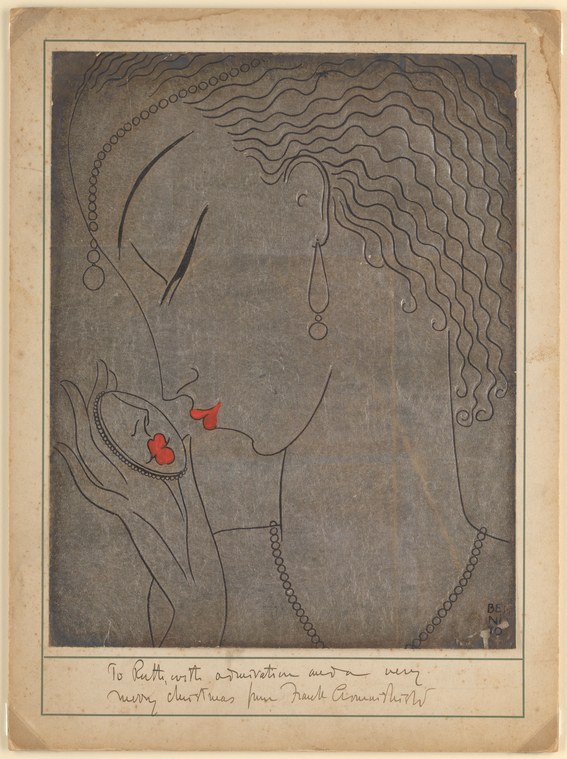
A profile portrait of a woman's head and shoulders rendered in fine pen line against a dark ground. The woman faces left, her features delicately outlined: a small mouth, defined cheekbone, and eye suggested by minimal marks. Her hair is the dominant visual element—a cascade of long, wavy strands that fall past her shoulders in rhythmic parallel lines, suggesting movement and considerable length. She wears pendant earrings and what appears to be a beaded or knotted necklace that hangs to her chest. Two small red shapes—possibly flowers or decorative elements—appear near her neckline or collar. The composition is spare and linear, with the figure occupying roughly the central third of the rectangular frame. Below the image, handwritten text in cursive script runs across the lower margin, though it is not fully legible in reproduction.
The dancing
A single figure shown from the shoulders up, in profile. The neck is elongated and curves gracefully; the posture suggests ease and repose rather than active movement. The hair is rendered with particular attention to flow and wave, implying either natural waves or the aftermath of motion—the kind of loose, animated hair one might see after dancing or vigorous movement. The minimal facial features and elegant line work suggest this is a portrait study rather than action depiction, though the emphasis on the hair's movement creates an impression of dynamism.
The dance depicted
This is a portrait rather than a dance scene, and therefore does not depict dancing in progress. However, the emphasis on the woman's flowing hair and the graceful curve of her neck suggest a context of elegance and feminine beauty associated with dance culture of the early 20th century. The style and inscription suggest this may be a study of a dancer or a figure from dance circles, but the image itself shows a still portrait, not a body in motion or a choreographic moment.
How it was made
Pen and ink on paper, with the figure rendered in fine, economical line work over a dark ground (possibly applied wash or the paper's natural tone). The technique is characteristic of modernist portraiture of the early 20th century—linear, reductive, and emphasizing contour and form over modeling. The handwritten inscription below suggests this is a finished work or artist's proof, likely circulated among a small audience. The delicacy of the line work and the refined execution indicate this was made for a cultivated viewer.
About this work
This is a portrait study in modernist style, not a representation of dance itself. The work belongs to the genre of early 20th-century figure studies, where artists distilled the human form into essential line. The emphasis on flowing hair and graceful bearing suggests an interest in beauty and movement, but the figure is static—a head study rather than a kinetic work. Its inclusion in a collection of prints depicting dance likely reflects its context of creation (possibly a portrait of a dancer or figure in dance circles) or an aesthetic association with the values of the dance world of its era.
How to look at it
Attend to the contrast between the minimal, refined face and the elaborate, animated rendering of the hair. The artist has chosen to suggest movement and vitality primarily through the hair's cascading waves, a convention that conflates beauty with motion. The profile view, the elongated neck, and the graceful bearing all reference classical portraiture while the modern line work and the dark ground root it in contemporary practice. Notice how much visual energy the hair contains despite—or because of—its linear simplicity.
The period
Early 20th-century modernism saw a turn toward simplification of form and emphasis on essential line—a movement running through Cubism, Expressionism, and various schools of modernist drawing. Dancers and dance culture held special prestige in avant-garde circles of this period, from the Ballets Russes onward. Portrait studies in this idiom often became vehicles for exploring abstraction and the reduction of the figure to pure form.
Where it lives
From the New York Public Library's collection of prints depicting dance. The handwritten inscription suggests this may be a signed or annotated work, though the signature and text are not fully legible in the reproduction provided.
Questions about this work
Is this a dancer?
The work is a portrait study, not a representation of dance in progress. However, it may depict a dancer or be from dance circles, based on its inclusion in a dance-print collection. The flowing hair and graceful bearing suggest an aesthetic context associated with dance culture.
Who is the artist?
The artist is not recorded in the catalogue. The style is consistent with early 20th-century modernist portraiture, and the refined execution suggests a trained artist working in the avant-garde idiom of the period, but attribution cannot be confirmed from the image alone.
What do the red marks represent?
The two red elements near the neckline are unclear from the reproduction. They may be flowers, decorative elements of dress, or marks applied by the artist for emphasis or meaning specific to the work's context.
More dance artwork





