49 works in this view — arrow keys or swipe to move between them.
Dance in Art
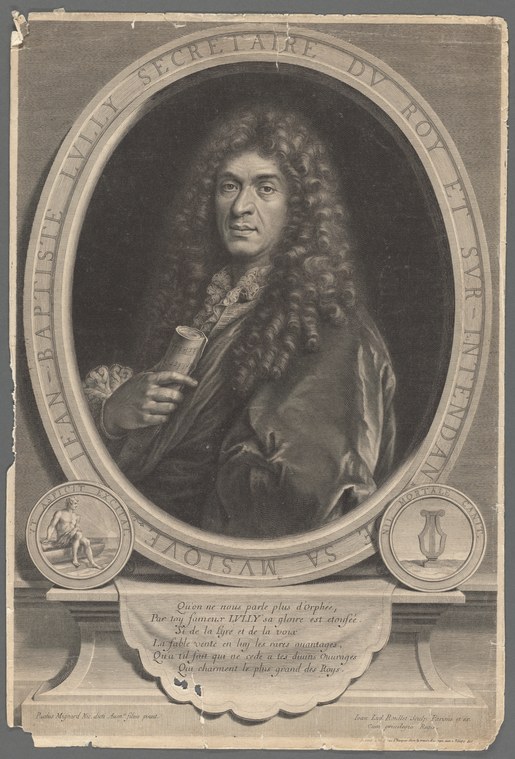
Jean-Baptiste Lully, secretaire du roy et sur-intendant de sa musique
Unknown artist
- Collection:
- Prints depicting dance
- Source:
- New York Public Library
- Rights:
- Public domain — free to use, share and adapt.
- Recorded as:
- Public Domain
Lully was arguably the most influential figure in the codification and dissemination of French Baroque dance, both through his musical compositions and through his direction of court ballet spectacles. His role in creating the institutional framework and aesthetic standards of court dancing makes him essential to understanding how Baroque dance developed and was transmitted. This portrait is a record of his authority and celebrity within the court system that produced and preserved dance culture.
What you are looking at
A three-quarter-length portrait of a man in Baroque dress, shown within an oval frame set against a plain background. The figure wears a long coat of rich fabric with elaborate buttons, a white collar and cuffs, and his long curled hair falls past his shoulders in the fashion of the late 17th century. He holds what appears to be a conductor's baton or similar implement in his right hand. Below the portrait oval, a cartouche contains a French inscription. Small circular emblems flank the bottom of the oval frame—on the left what appears to be a musical or theatrical scene, on the right a lyre or similar musical symbol. The engraving is executed in fine parallel lines typical of copper-plate work, creating subtle modeling and texture throughout.
The dancing
A single standing figure shown in a contemplative three-quarter pose, weight distributed evenly. The right arm is raised and bent at the elbow, the hand holding an object (baton or conductor's tool) that extends outward at roughly shoulder height. The left arm hangs at the side. The posture is formal and dignified, with the head turned slightly toward the viewer's left. There is no active dancing gesture here; the figure is presented as a statesman or conductor of music, not as a dancer in motion.
The dance depicted
This is a portrait of a musician and court official, not a depiction of dance in action. The inscription identifies the subject as Jean-Baptiste Lully, secretary of the king and superintendent of his music. Lully was a central figure in the development of French Baroque dance and music, and a designer of court ballet spectacles (*ballet de cour*), but the print shows him in his official capacity rather than dancing. The image records his identity and status; any dance content is implicit in his role as choreographer and organizer of the court's dancing rather than demonstrated through bodily movement.
How it was made
This is an engraving, likely copper-plate engraving given the fine linear hatching and the precision of the lines. The technique allows for the creation of multiple impressions from a single plate, making it ideal for distributing portraits of important figures throughout the court and beyond. The formal oval frame, the heraldic emblems, and the cartouche with inscription are all characteristic of official portraiture prints intended for display and circulation. The quality of the engraving suggests a professional workshop and a figure of sufficient prominence to warrant such an investment.
About this work
This is an official engraved portrait of Jean-Baptiste Lully, the dominant figure in French court music and dance during the reign of Louis XIV. Lully did not appear as a dancer himself in this image; rather, the print records his status as the king's music superintendent and the architect of the ballet spectacles that defined French Baroque court culture. The portrait is one of many such prints that circulated in the 17th century to commemorate important courtiers and cultural figures. Its inclusion in a collection of dance imagery reflects Lully's foundational role in organizing, choreographing, and promoting the dances of the court—even though he is shown here in official dress rather than in the act of dancing.
How to look at it
Look at the insignia flanking the oval portrait—the left emblem suggests a theatrical or musical scene, the right shows a lyre, the instrument of Apollo and thus of music and harmony. These small details reinforce Lully's identity as a musician and organizer of the arts rather than as a performer. The baton or stick in his hand is a conductor's tool, not a dancer's prop. The formal, still pose and official dress are the conventions of portraiture used to confer dignity and authority on a figure of state; this is not a moment of action or improvisation, but a permanent record of rank and identity.
The artist
The artist of the engraving is not recorded, but the quality and formality of the work suggest it was produced in a professional court workshop, possibly in Paris. Official portraits of high-ranking courtiers were typically engraved by skilled specialists and distributed in limited but significant editions. The style and technique are consistent with mid-to-late 17th-century French engraving practices.
The period
This portrait dates to the era of Louis XIV's court at Versailles, when French Baroque dance was at its cultural apex. Lully's tenure coincided with the professionalization of dance through the establishment of the Académie Royale de Danse (1661) and the consolidation of ballet technique and notation. The elaborate court spectacles that mixed music, dance, poetry, and machinery were central to Louis's political and cultural power. Engraved portraits of courtiers and artists circulated as markers of prestige and as records of the cultural establishment; this print belongs to that tradition.
Where it lives
The print is held by the New York Public Library in the Prints collection under the category 'Prints depicting dance.' It is an example of official court portraiture from the 17th century, circulated to establish and commemorate Lully's prominence in the French cultural establishment.
Questions about this work
Why is a portrait of a musician in a collection of dance imagery?
Lully was central to the creation and direction of French Baroque court ballet (*ballet de cour*). Although he is not shown dancing here, his role as superintendent of the king's music and as the designer of court spectacles makes him foundational to the history of that dance form. The portrait records his authority and status within the system that produced and preserved dance.
What does the baton in Lully's hand indicate?
The implement he holds is a conductor's or director's baton, a tool of his office rather than a dance prop. It signals his role as an organizer and leader of musical and choreographic performances, not as a performer in them.
Is Lully known to have danced himself?
Lully was trained as a dancer and early in his career performed in court ballets, but by the time of this portrait he had established himself primarily as a composer, conductor, and director. He was central to the codification of French dance technique through his musical compositions and his direction of elaborate court spectacles, rather than through his own performance as a dancer.
More dance artwork





