49 works in this view — arrow keys or swipe to move between them.
Dance in Art
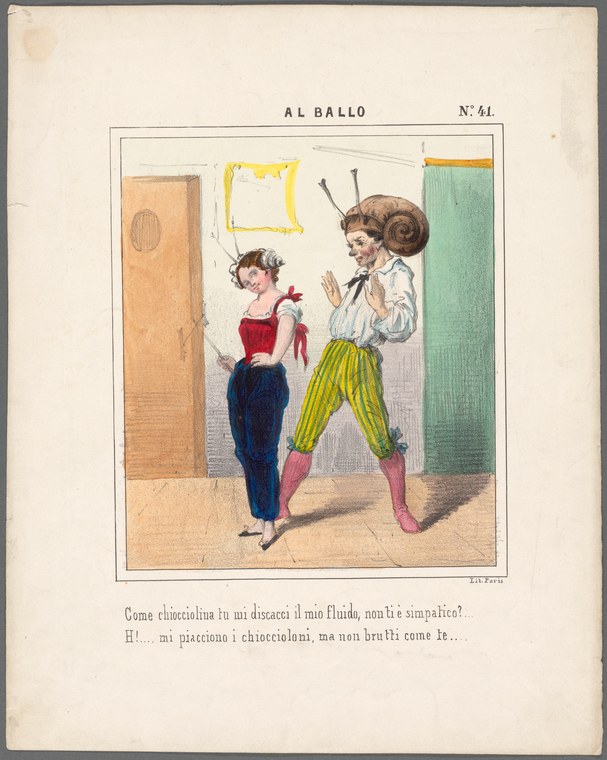
Al ballo, no. 41
Unknown artist
- Collection:
- Prints depicting dance
- Source:
- New York Public Library
- Rights:
- Public domain — free to use, share and adapt.
- Recorded as:
- Public Domain
This print preserves a moment from a tradition of popular theatrical entertainment now largely lost—the sight gags, costume comedy, and mime dialogue of 19th-century Italian farce and pantomime. For historians of performance and carnival, it offers evidence of how bodies were used for comedy and how costume and caricature functioned in live theater before cinema.
What you are looking at
A young woman in theatrical costume stands in an interior space, gesturing in surprise or alarm toward a grotesquely costumed figure. The woman wears a red corset with blue tights and a white blouse; her hair is styled in ringlets. Facing her is a figure in yellow-green striped tight breeches and a white shirt, with an enormous snail-shell coiffure and exaggerated facial features suggesting a commedia dell'arte or pantomime character—possibly meant to evoke an insect or creature. Behind them are simple architectural elements: a doorway in tan, a picture frame in yellow, and a green panel, all rendered in flat washes. The lighting is gentle and diffuse, typical of hand-colored theatrical prints. The Italian caption below reads: "Come chiacchierina tu mi discacci il mio fluido, non ti è simpatico?... Hì!... mi piacciono i chiocciulani, ma non brutti come te..." ("How you chatter—you drove away my fluid; don't you like me?... Hi!... I like snails, but not ugly ones like you..."), establishing this as a satirical or comedic dialogue scene.
The dancing
The woman stands in profile with one arm raised in a gesture of rejection or amazement, her body angled away from her companion, weight forward on her legs in a posture suggesting active recoil. The snail-creature leans toward her with arms outstretched in a supplicating or theatrical pose, the torso twisted and the oversized shell-head dominating the composition. Neither figure is in a balletic frame; both occupy the gestural vocabulary of pantomime and comedic theater, with exaggeration and narrative mime rather than dance technique.
The dance depicted
This is not a dance scene in the classical or ballroom sense, but rather a theatrical tableau from pantomime or commedia dell'arte tradition, likely a scene from a popular theatrical entertainment or farce. The interaction between the woman and the snail-creature suggests a comedic encounter or courtship scene common to 19th-century popular theater. The title 'Al ballo' (To the Ball) may be ironic or may suggest this scene occurs within or relates to a ball setting, but the action depicted is dialogue-based mime rather than dancing.
How it was made
This is a hand-colored engraving or lithograph, a process that allowed mass production and wide circulation of theatrical scenes. The coloring is applied in flat, bright washes—reds, blues, yellows, greens—characteristic of 19th-century popular theatrical prints. This technique enabled affordable distribution to a broad audience fascinated by theater, carnival, and comic spectacle, and the style suggests publication sometime in the mid-to-late 1800s, possibly Italian.
About this work
This theatrical print depicts a moment of comedic mime or pantomime rather than dance proper. A young woman gestures in astonishment at a grotesquely costumed snail-creature in an interior space, their dialogue rendered in Italian caption as a playful exchange. The work is a hand-colored theatrical print likely documenting a scene from a popular farce, carnival tradition, or improvised theater of 19th-century Italy. It belongs in a gallery about dance as documentation of theatrical spectacle, carnival costume, and the performative practices of the era—the broader culture of embodied entertainment within which dance existed.
How to look at it
Notice the exaggeration in the snail-creature's costume and pose—the shell-head, the striped breeches, the outstretched arms—which reads as burlesque rather than naturalistic. The woman's gesture of recoil is the counterpoint: a moment of feigned shock or coquetry typical of the dialogue-based comedy of the era. The caption is essential to the meaning; without it, the image is decorative. The flatness of the setting and the bright hand-coloring were deliberate choices that prioritized legibility and impact over illusionistic depth.
The artist
The work is attributed only as 'Al Ballo, no. 41,' indicating it is part of a numbered series, likely from a publisher's catalog of theatrical or satirical prints. The artist remains unidentified in the catalogue record. The style and subject suggest a mid-to-late 19th-century Italian theatrical print tradition, possibly produced by a Neapolitan or Roman publisher specializing in images of carnival, theater, and social satire.
The period
This print dates from an era when theatrical performance, carnival, and popular spectacle were at the height of their social and cultural importance in urban Italy. Pantomime and commedia dell'arte traditions were undergoing revival and adaptation in the 19th century, coexisting with the rise of ballet and operatic spectacle. Satirical theater and costume comedy appealed to a broad public across social classes, and prints such as this circulated as affordable souvenirs and entertainment.
Where it lives
This print is part of the New York Public Library's 'Prints depicting dance' collection, catalogued as 'Al Ballo, no. 41,' suggesting it was originally part of a numbered series or portfolio of theatrical prints. It is held as a primary source document for the visual history of performance.
Questions about this work
Is this actually a dance scene?
Not in the technical sense. It is a comedic theatrical tableau from pantomime or farce tradition. The bodies are engaged in mime and dialogue, not in choreographed movement. It belongs in a dance collection as documentation of the broader performative culture in which dance existed.
What does 'Al Ballo' mean?
'Al Ballo' means 'To the Ball' or 'At the Ball' in Italian. The title may be ironic or suggest the scene is part of a ball setting, but the action shown is comedic theater rather than dancing.
Who is the snail-creature supposed to be?
The figure appears to be a commedia dell'arte character, possibly a variant of a stock character type exaggerated through costume. The enormous shell-head and striped breeches suggest deliberate visual satire or jest, likely part of a specific farce or theatrical tradition now lost to us.
How was this print made and distributed?
It is a hand-colored engraving or lithograph, a process that allowed mass production and affordable circulation. Such prints were popular souvenirs of theatrical performances and carnival events, distributed to theatergoers and the general public throughout the 19th century.
More dance artwork





