49 works in this view — arrow keys or swipe to move between them.
Dance in Art
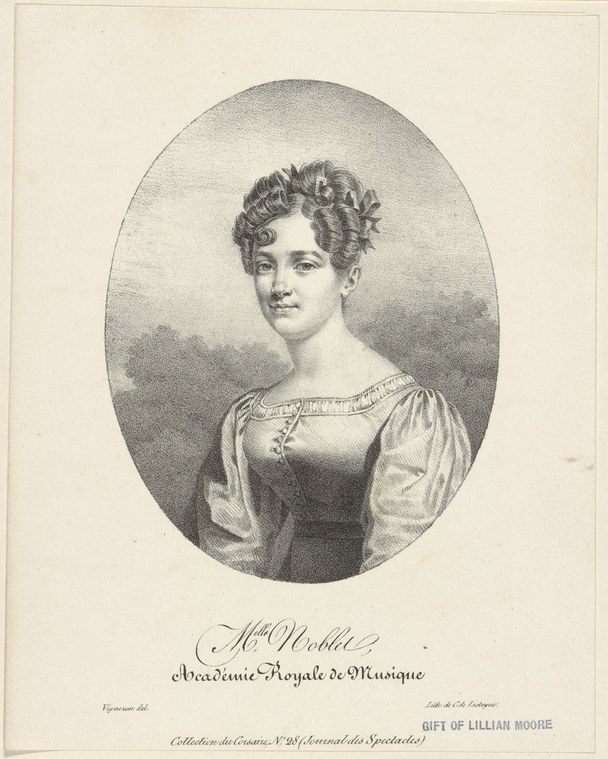
Melle. Noblet, Académie royale de musique
Unknown artist
- Collection:
- Prints depicting dance
- Source:
- New York Public Library
- Rights:
- Public domain — free to use, share and adapt.
- Recorded as:
- Public Domain
This engraving is a rare survival of an actual performer from the Romantic ballet era—not a fictional idealized dancer, but a real woman whose name was recorded and whose image was considered valuable enough to reproduce and sell. It offers insight into how the dance world marketed itself and how dancers (or at least, dancers important enough to be immortalized in print) were expected to present themselves: refined, classically educated, dignified, and accessible to a genteel audience.
What you are looking at
A three-quarter-length portrait of a young woman, shown from approximately waist up, set within a delicate oval frame against a subtly shaded background. She wears a high-waisted classical dress with short, puffed sleeves and an empire silhouette typical of early 19th-century fashion. Her dark hair is arranged in carefully styled ringlets piled atop her head in the Regency manner. Her posture is upright and composed, her gaze directed slightly past the viewer. The engraving is finely executed with careful attention to the fall of fabric, the soft modeling of her face, and the refined simplicity of her costume. Below the portrait, an inscription identifies her as "Melle. Noblet" of the "Académie Royale de Musique."
The dancing
A single standing figure, frontal and at rest. The woman's shoulders are level and relaxed; her arms are not depicted, likely hidden within the frame of the oval. Her neck is elongated and graceful, her head held with the composed dignity expected of a trained performer. There is no active dance pose—the figure is presented as a formal portrait rather than captured mid-movement, though the refined carriage suggests training.
The dance depicted
This is a portrait of a dancer or performer associated with the Paris Opéra (the Académie Royale de Musique) during the Romantic era, most likely the 1820s–1840s. The inscription identifies her only as "Melle. Noblet," a common stage surname. The portrait does not depict her dancing but rather presents her in formal dress as a celebrated performer. The costume suggests she may have danced in classical ballet, and the refined, classical styling of both her dress and her presentation aligns with the aesthetics of Romantic ballet, though the image itself offers no specific evidence of her repertory or technique.
How it was made
This is a finely executed steel or copper engraving, a reproductive print likely made for circulation and sale to the public. The delicate cross-hatching visible in the background and the subtle tonal gradations indicate skilled hand-engraving or possibly steel-engraving, a technique that allowed for sharper lines and larger print runs than traditional copper. The oval frame and neoclassical styling of the composition suggest this was one of a series of celebrity portraits—a common format for promoting opera and ballet stars to an increasingly bourgeois audience in early 19th-century Paris.
About this work
This is a formal portrait engraving of a performer at the Paris Opéra during the early Romantic period, printed and sold as a popular celebrity image. The work documents both the aesthetics of early 19th-century theatrical dance—refined, classically trained, female-centered—and the growing commercialization of performance through mass-produced portraiture. The inscription alone tells us this woman was notable enough to be publicly celebrated, yet her individual identity and career remain largely obscured by time and the generic conventions of the genre.
The portrait belongs in a collection of dance imagery not because it captures movement or technique, but because it preserves evidence of who was considered worthy of celebration in the dance world of its era, and how performers were presented to the public. It is a document of theatrical celebrity and the visual culture surrounding dance at a transformative moment in the art form's history.
How to look at it
Look first at the posture and carriage: the way she holds her head, the line from neck to shoulder, the composed stillness. These convey training and discipline. Notice the costume—the high waistline, the short puffed sleeves, the refined simplicity—which is contemporary fashionable dress but also signals her status as a woman of culture and education. Observe the engraver's technique in the face: the soft modeling of her features, the catch of light in her eyes, the delicacy of the line work. The oval frame and the neoclassical restraint of the composition place her within a tradition of portraiture that presents theatrical performers not as exotics or fantasies, but as educated members of society worthy of formal commemoration.
The artist
The artist and engraver are not recorded in the catalogue. The print's refined technique and professional format suggest it was produced by a commercial printmaking shop in Paris, likely one of the many studios producing celebrity portraiture during the 1820s–1840s. The style and finish are consistent with the output of Parisian print publishers who specialized in theatrical subjects.
The period
This portrait dates to the flowering of Romantic ballet in Europe, when ballet achieved new prominence as a theatrical and cultural form. The 1820s and 1830s saw the rise of the ballerina as a public figure—celebrated, idealized, and widely reproduced in prints, lithographs, and engravings. The Paris Opéra was the premier ballet institution in Europe, and dancers who performed there achieved international renown. At the same time, theatrical portraiture was becoming a major commercial enterprise; prints of celebrated performers sold to the public as collectibles and as documents of fashion and taste. This print participates in that economy of celebrity.
Where it lives
The print is held in the New York Public Library's collection of prints depicting dance. It is catalogued as a gift from Lillian Moore, a major twentieth-century historian and collector of dance imagery, whose archive formed the core of the Library's dance holdings. The inscription at the bottom indicates it was part of the "Collection des Estampes. N° 281. Journal des Spectacles," suggesting it was originally part of a periodical or organized collection of theatrical prints.
Questions about this work
Who was Melle. Noblet?
The print does not specify her first name or provide biographical details; such information would require archival research in Opéra records. "Melle." (Mademoiselle) was a common stage designation for unmarried female performers. The surname Noblet is associated with the Paris Opéra during the Romantic era, and there were several dancers with that name performing in the 1820s–1840s, but this engraving alone does not establish which individual is portrayed.
Is this a photograph?
No. This is a hand-engraved print, likely made in the 1820s–1840s, well before photography became the dominant medium for portraiture. The technique is reproductive engraving—a skilled engraver copied a drawing or painting onto a metal plate and hand-incised the lines that would hold ink.
What was the Académie Royale de Musique?
The institution now known as the Opéra de Paris. During the period this print was made, it was the official royal opera house, the premier venue for ballet and opera in France, and the most prestigious training ground for dancers in Europe. Dancers who performed there achieved international celebrity.
Why does she look so formal and still?
This is a formal portrait, not a capture of her in performance. The conventions of portraiture in this era required composed, dignified poses. The engraver was not attempting to show her dancing, but rather to present her as a cultured, refined woman—which was part of how the theatrical world marketed its stars to a bourgeois audience.
More dance artwork





