49 works in this view — arrow keys or swipe to move between them.
Dance in Art
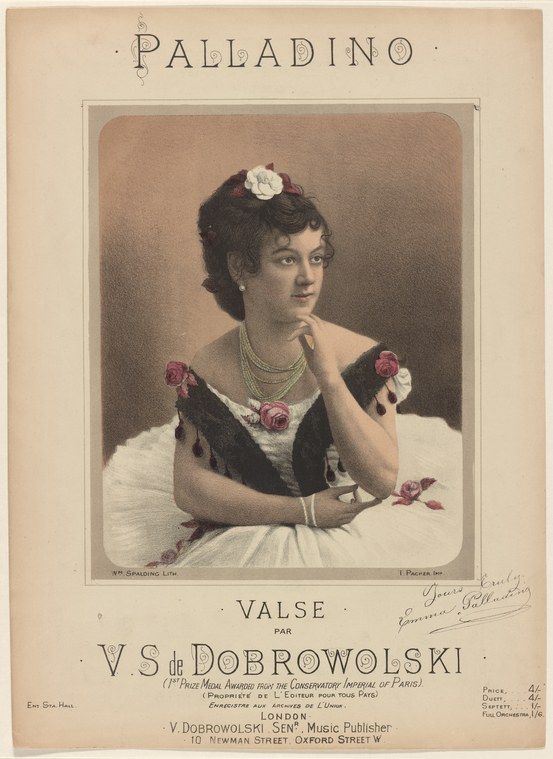
Palladino valse par V. S. de Dobrowolski
Unknown artist
- Collection:
- Prints depicting dance
- Source:
- New York Public Library
- Rights:
- Public domain — free to use, share and adapt.
- Recorded as:
- Public Domain
This work documents how waltz music was marketed and consumed in the Anglo-American home market at the turn of the 20th century. It shows the aesthetic distance between the public, virtuosic waltz performances of earlier decades and the privatized, sentimental domestic genre that the form had become—a shift reflected not in choreography but in imagery, typography, and the identity of the consumer.
What you are looking at
A young woman in an elegant late-Victorian or Edwardian gown is depicted in a three-quarter seated pose against a warm, soft background. She wears a pale dress with a high neckline and fitted bodice, topped with a black velvet shawl or cape that drapes across her shoulders and upper arms. Her dark hair is styled in the fashion of the period, adorned with a white flower. She holds sprigs of small red roses in both hands—one cluster near her right shoulder, another at her lap—and gazes downward with a gentle, introspective expression. The composition emphasizes grace and refinement, with warm peachy-brown tones creating an intimate, theatrical atmosphere. This is a chromolithograph or hand-colored print, likely a cover or promotional image for a published musical work.
The dancing
The figure is seated or semi-reclined rather than standing in an active dance posture. Her upper body is relaxed and turned slightly, her arms soft and naturally positioned to display the flowers. There is no visible footwork or partner, and no indication of active movement or a closed ballroom hold. The gesture is contemplative and posed for portraiture rather than choreographic—this is a single stationary figure in an attitude of repose.
The dance depicted
The title identifies this as a valse (waltz) by V.S. de Dobrowolski, a composer published by V. Dobrowolski, Sen. in London. The image itself contains no direct evidence of waltz choreography or technique—no couples, no characteristic three-quarter-time posture, no floor work. This appears to be a cover illustration or promotional portrait for a published piano work or vocal score, in the tradition of late-19th-century sheet music decoration. The subject and mood are romantic and lyrical, consistent with the sentimentality of salon waltzes of the period, but the image represents the work's aesthetic appeal rather than a scene of actual dancing.
How it was made
This is a chromolithograph or color lithograph print, a process that allowed for rich, multi-color reproductions of artwork at moderate cost. The credited printer appears to be listed as Raoul Duval (discernible in small print at lower left). The technique enabled wide distribution of sheet music covers to a middle-class audience, and the soft, painterly quality of the coloring—particularly the warm background and subtle modeling of the figure—was characteristic of art-nouveau-influenced commercial graphics of the 1890s–1910s. The print was professionally hand-finished or color-separated to achieve the refined tonal palette.
About this work
This is a sheet music cover illustration for a salon waltz by a London-based composer active in the late 19th or early 20th century. It represents a common publishing practice: the marriage of a musical composition with a refined, atmospheric portrait designed to appeal to amateur pianists and domestic music-makers. The image captures the romantic, introspective mood the composer intended, rather than depicting an actual ballroom scene or dance performance. The young woman with roses embodies the lyrical, sentimental character of the salon waltz tradition—a dance form that by this period had moved from the ballroom into the parlor, from spectacle to intimate, domestic consumption.
How to look at it
The viewer should note that this is not a dance scene but a portrait in service of musical sentiment. Attend to the pose: the seated, graceful repose; the downward gaze; the strategic placement of flowers. These elements communicate the emotional tone the composer wished the listener to feel—reverie, delicacy, romantic yearning—rather than showing how the waltz was actually performed. The chromolithographic technique allows the artist to use soft, warm coloring to evoke an atmosphere of intimacy and tasteful elegance, qualities central to the marketing of salon music to the Victorian and Edwardian middle classes.
The artist
The artist of the illustration is not identified in the catalogue record. The printer Raoul Duval was active in London during the 1890s–1910s, specializing in commercial chromolithographic work. The composer V.S. de Dobrowolski is listed as having been published by V. Dobrowolski, Sen., Music Publisher, 10 Newman Street, Oxford Street, London—a publisher active in the late Victorian and Edwardian eras, suggesting this work dates to approximately 1890–1920.
The period
The waltz had dominated European ballroom culture for nearly a century by the time this cover was created, but by the 1890s–1900s it had become a standard fixture of domestic music-making. The rise of chromolithographic sheet music covers in the 1880s–1910s created a new genre of decorative art aimed at middle-class drawing rooms. This period saw the waltz shift from a dance of spectacle and fashion statement to a symbol of refined, sentimental domesticity—particularly appealing to amateur musicians and young women learning piano. The aesthetic here—the soft romanticism, the single meditative female figure, the studio lighting—reflects the values of fin-de-siècle parlor culture rather than active ballroom practice.
Where it lives
This work is held in the Prints depicting dance collection at the New York Public Library. It is a chromolithographic sheet music cover by or for the London-based publisher V. Dobrowolski, Sen., dating to the late 19th or early 20th century.
Questions about this work
Is this a picture of someone actually dancing?
No. This is a cover illustration for a published sheet music score. The seated, contemplative pose is designed to evoke the mood and character of the musical composition rather than to depict ballroom choreography. It represents the shift in waltz culture toward domestic, parlor-based performance.
Who composed the Palladino Valse?
V.S. de Dobrowolski, whose work was published by V. Dobrowolski, Sen. in London. Little else is known about this composer from the available record, though the publication details suggest activity in the late Victorian or Edwardian era.
What is chromolithography and why was it used for sheet music?
Chromolithography is a color printing process that allowed multiple colors to be printed in layers, creating richly detailed and colored images at relatively low cost. It revolutionized sheet music production in the 1880s–1910s, enabling publishers to include attractive, atmospheric cover illustrations that helped sell works to amateur musicians and appealed to consumers' aesthetic tastes.
What is a salon waltz?
A salon waltz is a composition in three-quarter time designed for amateur piano performance in the home, rather than for ballroom dancing or concert performance. By the late 19th century, waltzes had become primarily a domestic musical genre associated with sentiment, romance, and refined taste.
More dance artwork





