49 works in this view — arrow keys or swipe to move between them.
Dance in Art
L'Opéra au XIXème siècle, no. 53
Unknown artist
- Collection:
- Prints depicting dance
- Source:
- New York Public Library
- Rights:
- Public domain — free to use, share and adapt.
- Recorded as:
- Public Domain
This print is one of very few surviving images that document the private, day-to-day reality of nineteenth-century ballet training and preparation, showing the mirror-work and pedagogical practices that were central to dance-making but rarely depicted in formal portraiture. It reveals attitudes toward child performers and the gendered labor of theatrical preparation during a period when ballet was at the height of its cultural prestige.
What you are looking at
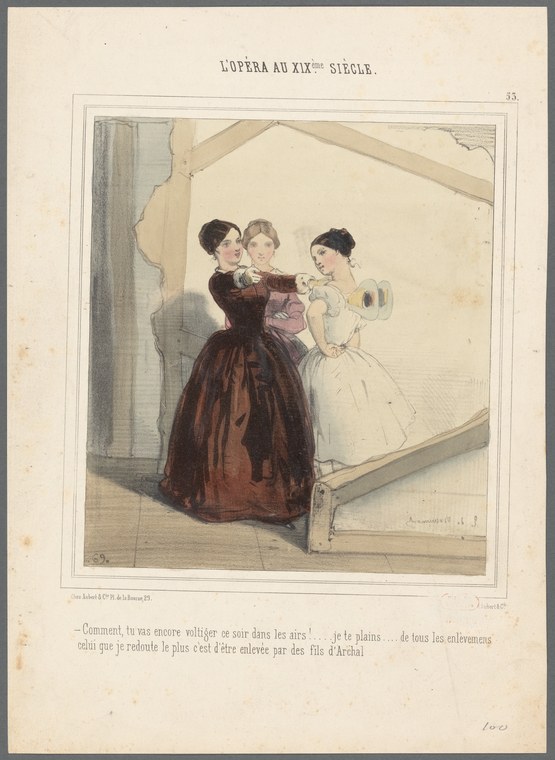
A woman in a burgundy dress holds a young child while gesturing toward a large mirror mounted on the wall of what appears to be a dressing room or studio. A second woman in a pale white dress stands beside them, also looking toward the mirror. The setting is intimate and domestic, lit from the front, with the mirror creating a sense of depth and doubling of the figures. The composition suggests a moment of instruction or presentation—the child is being shown or prepared for something, possibly a dance performance or lesson. The print is hand-colored, with careful attention to the textures of fabric and the play of light on the surfaces.
The dancing
The woman in burgundy holds the child at her hip with one arm while her other arm extends upward in a pointing or directing gesture toward the mirror. Her body is turned three-quarter to the viewer. The child, dressed in a light-colored outfit, appears attentive but passive. The woman in white stands in profile to the right, her posture graceful and her gaze directed at either the child or the mirror. None of the figures are in a dance position or hold; the interaction is observational rather than performative.
The dance depicted
This print appears to depict a behind-the-scenes moment in nineteenth-century theatrical life, most likely related to ballet training or preparation. The child's age, dress, and the pedagogical gesture of the woman in burgundy suggest a young dancer being readied for a role or being shown their appearance before performance. The mirror is the focal point—a tool for self-observation essential to dance training. However, no actual dancing is taking place in this image; it documents the ritual of preparation and self-regard that surrounded theatrical dance.
How it was made
This is a hand-colored engraving or lithograph, characteristic of mid-nineteenth-century French popular illustration. The print belongs to a series titled *L'Opéra au XIXème siècle* (Opera in the Nineteenth Century), indicating it was mass-produced for a wide audience interested in theatrical culture. The technique allowed for nuanced tonal work in the drapery and subtle modulation of color, while the series format suggests these were collected or bound as a visual chronicle of opera house life.
About this work
This is one of a series of prints documenting life at the Paris Opéra during the nineteenth century, depicting the private moment of a young dancer's preparation before performance. The image captures not the dance itself but the theatrical infrastructure that surrounded it—the dressing room, the mirror, the adults shepherding a child performer through the rituals of transformation. The print reveals how integral the mirror was to dance practice and self-presentation, and it documents the intimate, often informal relationship between adult professionals and child performers in the nineteenth-century ballet world.
The work belongs to a broader nineteenth-century genre of theater-life imagery popular in France, where prints, newspapers, and journals documented the opera house as a site of fascination. For dancers and historians, this image offers evidence of training methods, studio practice, costume, and the social structures that sustained ballet performance.
How to look at it
Note the gesture of the woman in burgundy: she is not demonstrating a position or movement, but pointing the child toward the mirror—inviting observation rather than imitation. The mirror itself is the teaching instrument here. Observe also the distinction between the active adult (reaching, directing) and the passive child (being held, shown), which reflects nineteenth-century ideas about the child performer as material to be shaped. The pale dress of the child against the darker tones of the adults and the interior creates visual focus on the moment of presentation.
The period
This print was produced during the height of the Paris Opéra's dominance in European ballet, in an era when Romantic ballet—with its emphasis on ethereal, weightless movement—was the dominant aesthetic. The 1850s–1880s saw the rise of illustrated journalism and series documentation of contemporary life; this series belongs to that context. The image reflects a moment when ballet training had become increasingly formalized and systematized, with the mirror becoming an essential pedagogical tool for dancers to self-monitor their positions and movements.
Where it lives
This print is from the New York Public Library's collection of prints depicting dance. It is part of a numbered series, *L'Opéra au XIXème siècle*, indicating it was one of a set of popular illustrations documenting opera house life for a French audience.
Questions about this work
Is this actually showing a dance lesson?
Not directly. The image shows a moment of preparation or presentation rather than active instruction. However, the mirror and the pedagogical framing suggest this is part of the training and preparation infrastructure of nineteenth-century ballet. What we see is the ritual of looking at oneself—a foundational practice in ballet technique.
Why is the child so young?
Child performers were standard in nineteenth-century ballet, and training often began in early childhood. This image may depict a child being prepared for a role in a corps de ballet or in a children's part within a larger work. The adult's protective gesture and attentive gaze suggest careful shepherding of the young performer.
What does the series title tell us?
*L'Opéra au XIXème siècle* (Opera in the Nineteenth Century) indicates this was one of a set of prints documenting contemporary opera house life for a popular French audience. The series documents not just performances but the social and professional world surrounding them.
More dance artwork





