49 works in this view — arrow keys or swipe to move between them.
Dance in Art
Oeuvres nouvelles de Gavarni. Baliverneries parisiennes, no. 16?
Unknown artist
- Collection:
- Prints depicting dance
- Source:
- New York Public Library
- Rights:
- Public domain — free to use, share and adapt.
- Recorded as:
- Public Domain
The image documents the ballroom not as a space of choreographed movement but as a site of social performance and hidden narratives. For historians of nineteenth-century Paris, Gavarni's work is invaluable evidence of how ballroom dancing was integrated into a larger economy of courtship, gossip, and social climbing—and of how women's bodies in formal dress were objects of both display and vulnerability.
What you are looking at
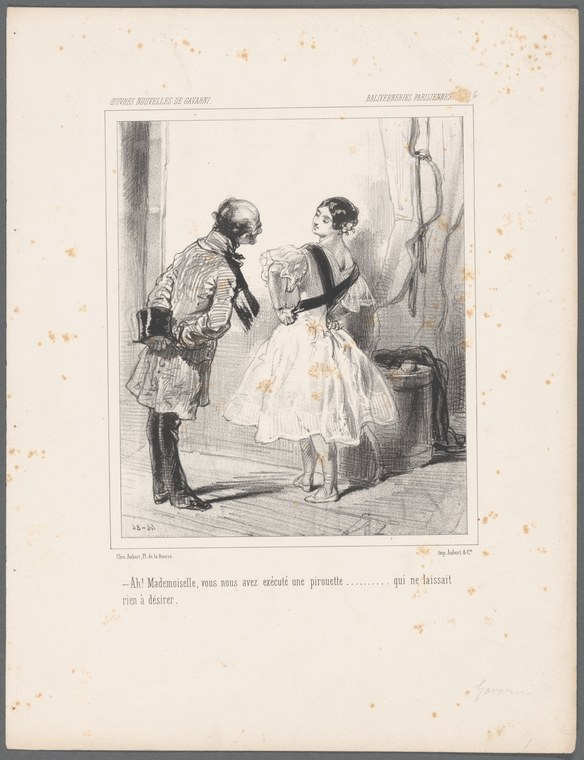
A man in military dress uniform confronts a woman in a white ball gown in an interior setting, likely a parlor or backstage space. The woman holds a small framed portrait or miniature toward him in a gesture of offering or revelation. The composition is intimate and charged: the man leans forward with evident interest or concern, while the woman's posture is poised but urgent. The setting is suggested by spare furnishings—a chair visible at right, drapery at left—rendered in the light, sketchy manner typical of mid-nineteenth-century social satire. The drawing style is loose and economical, with heavy pencil shading creating volume and shadow; the artist captures a moment of private drama within a public or formal context. The title references "Baliverneries parisiennes" (Parisian trifles), suggesting this depicts a fashionable or theatrical world.
The dancing
The man stands in a sharp, almost military posture, his torso angled toward the woman with his head slightly raised. The woman faces him directly, her arm extended to present the miniature; her white gown is full and formal, with visible skirts suggesting a dance-ready ensemble. Both figures are upright and engaged in direct eye contact, suggesting a moment of confession, proposal, or confrontation rather than movement through space. There is no closed ballroom hold, no active footwork: this is a moment of pause between dances or before them.
The dance depicted
This is not a depiction of dance in action, but rather a scene from the social world in which dance occurred—the ballroom, the backstage, the moment of courtship or intrigue that framed the ball. The woman's white gown and the formal setting indicate an evening dance or theatrical event, likely from the 1840s–1850s Parisian social scene. The gesture of presenting the miniature portrait suggests a narrative moment—perhaps a revelation, a memory, or an object of sentimental or political weight—that interrupts or precedes the dance. The work captures the social drama surrounding dance rather than dance itself.
How it was made
This is a lithograph or engraving, identifiable from the tonal shading, the handling of line, and the character of the printing surface. The technique is that of mid-nineteenth-century social satire printing: economical, gestural, with emphasis on psychological expression rather than anatomical detail. The loose, almost caricatural style is suited to rapid production and wide circulation; this appears to be a page from a serialized or collected work of satirical prints. The monochromatic medium allowed for cheap reproduction and broad distribution, suggesting an audience of educated Parisians familiar with ballroom culture and its foibles.
About this work
This is a satirical print from a series documenting Parisian ballroom society and its hypocrisies, rendered as a moment of social tension frozen mid-gesture. The woman's formal white gown marks her as a dancer or ballroom participant, and the man's military dress suggests the intersection of state, military, and civilian elite worlds that characterized mid-nineteenth-century Paris. The work belongs in a gallery of dance not because it shows dancing, but because it captures the social and emotional texture of the ballroom world—the intrigue, courtship, and drama that surrounded the formal dances of the period. It is a record of how dance functioned as a theater for class, gender, and power relations.
How to look at it
Attend to the woman's gesture: the extension of the miniature portrait is the crux of the scene, and her body language—poised but insistent—suggests this is a moment of revelation or emotional stakes. Note the military precision of the man's dress and carriage; the contrast between his rigid formality and the intimacy of the moment creates the satiric tension. The artist has chosen not a moment of movement but of pause—the breath before speech, the instant of recognition or confrontation. This is the ballroom world frozen at its moment of psychological truth.
The artist
The work belongs to the Gavarni (Sulpice-Guillaume Chevalier, 1804–1866) tradition, though attribution is not recorded here. Gavarni was the master of Parisian social satire and lithographic serialization in the 1840s–1850s. He specialized in scenes of fashionable life—balls, promenades, theaters, salons—depicted with psychological acuity and mordant wit. His prints were widely circulated in newspapers and collected volumes, making him the visual chronicler of bourgeois Parisian life. The series *Baliverneries parisiennes* (Parisian Trifles) exemplifies his practice of capturing the small dramas and pretensions of ballroom society.
The period
This print dates to the reign of Louis-Philippe (1830–1848) or the Second Empire (1852–1870), when the Parisian ballroom was at its social and cultural peak. The ball was the primary venue for courtship, alliance-building, and the display of fashionable identity; white ball gowns like the one shown here were standardized formal wear for unmarried women. Lithographic satire was the dominant medium for social commentary during this period, distributed through newspapers like *La Caricature* and *Le Charivari*. The formal, almost militaristic posture of the man and the precision of the woman's gown reflect the rigid gender codes and social hierarchies of the period, which the satirist was trained to expose.
Where it lives
The work is held in the New York Public Library as part of a collection of prints depicting dance. It is identified as belonging to a series titled *Oeuvres nouvelles de Gavarni. Baliverneries parisiennes*, though the specific print number and publication details are uncertain.
Questions about this work
Is this actually a dance image?
Not in the sense of depicting choreography or footwork. But it is a document of ballroom culture—the social world in which dance happened. The woman's formal white gown and the ballroom setting make clear this is a scene from the evening dance world. For social historians of dance, these satirical prints are invaluable evidence of how dancing was embedded in courtship, intrigue, and gender performance.
What is the miniature portrait for?
The image does not tell us. It could be a memento of a rival, a lover, a family member, or a political figure. The ambiguity is the point: Gavarni's satire lies in capturing a moment of social or emotional intensity without fully explaining it. The viewer is invited to imagine the backstory—gossip, jealousy, ambition—that surrounds the formal ritual of the ball.
Who is Gavarni?
Sulpice-Guillaume Chevalier (1804–1866), who worked under the pseudonym Gavarni, was the preeminent lithographic satirist of Parisian life in the 1840s–1850s. His prints of fashionable society, theater, and ballroom life were distributed widely and collected avidly. He had an unparalleled eye for the psychological and social dimensions of everyday elite life.
More dance artwork





