49 works in this view — arrow keys or swipe to move between them.
Dance in Art
The harvest dance of the Viennoise children
Unknown artist
- Collection:
- Prints depicting dance
- Source:
- New York Public Library
- Rights:
- Public domain — free to use, share and adapt.
- Recorded as:
- Public Domain
The work documents the formalization and performance of children's movement in the 19th century, showing how even play and seasonal celebration were choreographed and staged for observation. It provides visual evidence of children's dance training, costume, and movement vocabulary from this period, valuable for understanding the history of children's physical education and dance pedagogy.
What you are looking at
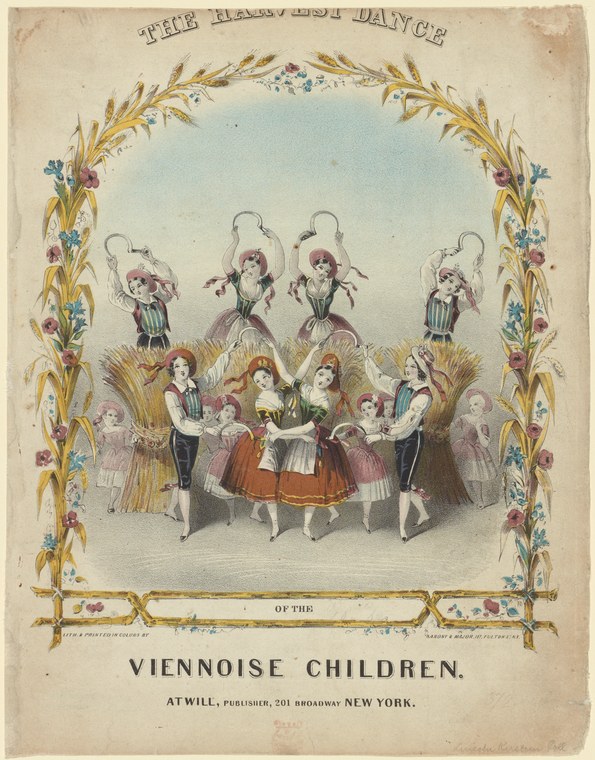
A colored lithograph presents a lively children's dance scene framed by an ornamental border of golden wheat sheaves interspersed with small flowers. The composition shows ten children arranged in two groups within a shallow interior space. In the center, four children stand elevated on what appears to be a low platform or stage, executing a synchronized jumping or skipping movement with arms raised in unison—their bodies caught mid-leap. Below and around them, six seated or standing children observe and participate, wearing period dress including striped jackets, full skirts, and bonnets typical of early 19th-century children's clothing. The color palette is soft: pale blues, pinks, ochres, and browns. The title banner at top reads "THE HARVEST DANCE" and at bottom "OF THE VIENNOISE CHILDREN."
The dancing
The four elevated children display synchronized vertical impulses with both arms raised symmetrically overhead, suggesting a rhythmic jumping or springing motion. Their bodies are aligned, torsos upright, legs extended or in flight. The seated children below maintain engaged postures, their attention directed toward the performers. All figures are rendered with relatively naturalistic proportions appropriate to young dancers. The grouping suggests a performance or demonstration rather than a spontaneous game—the elevated platform and the watched-and-watcher dynamic establish clear roles.
The dance depicted
This is identified in the title as a harvest dance performed by Viennese children. The synchronized jumping and raised-arm gesture could suggest a folk celebration or children's version of a harvest festival dance, though the term "harvest dance" is not a specific named style. The wheat-sheaf border reinforces the harvest theme. The formalized arrangement and the theatrical presentation (children on display to an audience of peers) suggests this may depict a staged performance or pedagogical demonstration of children's movement rather than an actual harvest celebration. The specific movement vocabulary is difficult to determine from the static image alone.
How it was made
This is a hand-colored lithograph, evident from the characteristic soft color application, the tonal variation typical of lithographic printing, and the decorative border design. The technique allowed for mass production with hand-coloring, making it affordable for domestic circulation. The publisher A. Wilk of 201 Broadway, New York, is identified at the bottom, indicating this was a commercially produced print intended for the American market in the 19th century. The delicate coloring and decorative framing suggest it was marketed as a parlor print suitable for families with children.
About this work
This is a hand-colored lithograph depicting a organized children's dance performance titled as a Viennese harvest dance. The image captures a moment of synchronized movement set within an ornate decorative frame, presenting the dance as both a visual spectacle and a record of children's choreography or movement instruction. Published in New York in the 19th century, it belongs to a tradition of prints documenting both children's activities and the staging of dance for entertainment and educational purposes.
As a print for domestic consumption, it represents how dance—particularly children's participation in formal movement sequences—was circulated, valued, and visually represented in 19th-century American homes. The harvest theme and Viennese attribution suggest an interest in European cultural practices adapted for American children's education and amusement.
How to look at it
Note the moment the artist chose: the upward leap of the four elevated children, frozen at the apex of the jump with arms raised. This vertical emphasis communicates energy and joy, a common choice in depicting children's movement. The border framing the dance within a harvest motif directs the viewer to read the movement as connected to seasonal labor and celebration, even though the formalized staging suggests something more controlled than an actual harvest festival. The contrast between the active jumping children and the watching children below establishes a theatrical frame: this is a performance for observation, not participation.
The period
This print dates from the era of the popular lithographic trade in America (1830s–1850s likely), when such prints were affordable entertainment and educational tools for middle-class families. The Viennese attribution reflects the period's cultural fascination with European sophistication and the assumption that Continental practices were worth imitating. In dance, this was the Romantic era, though children's movement was typically segregated from theatrical dance practice; the formality of this staged harvest dance suggests a pedagogical or entertainment context rather than participatory folk practice. The wheat-sheaf border and harvest subject align with early 19th-century nostalgia for agrarian or folk traditions even as urbanization advanced.
Where it lives
The print is held by the New York Public Library in the Prints depicting dance collection. It was published by A. Wilk at 201 Broadway, New York, and exists as a commercial print from the 19th-century lithographic trade. The hand coloring and domestic scale indicate it was made for parlor display or inclusion in printed collections of children's scenes.
Dance in this work
Questions about this work
What is a Viennese harvest dance?
The specific term appears unique to this print. It likely refers to a stylized or choreographed version of a European harvest celebration, adapted for children's performance in America. The title may reflect a fashion for importing and renaming European cultural practices rather than documenting an actual Viennese tradition.
Was this a real performance or an imagined scene?
The print may document an actual pedagogical demonstration or children's performance that toured or was staged, or it may represent an idealized version of children's harvest dance. The publisher's location in New York and the polished presentation suggest it was marketed to American families, whether depicting a real event or a fanciful composition.
What can this tell us about children's dance training in the 19th century?
The formal arrangement, synchronized movement, and staged presentation indicate that even children's recreation was subject to choreography and observation. The costuming and careful grouping suggest organized instruction or performance, not spontaneous play, pointing to emerging systems of physical education and children's cultural training.
More dance artwork





