49 works in this view — arrow keys or swipe to move between them.
Dance in Art
Nine vignettes of animals dressed as humans
Unknown artist
- Collection:
- Prints depicting dance
- Source:
- New York Public Library
- Rights:
- Public domain — free to use, share and adapt.
- Recorded as:
- Public Domain
Satirical animal prints offer a form of evidence about how a society understood dance: the dances worth mocking are those that mattered most socially. The recurrence of ballroom dancing among these vignettes confirms that couple dancing was central to fashionable life and courtship. Beyond that, the tradition of depicting dance through animal mime shows how artists could use formal distance and humor to observe human behavior with a freedom that straight portraiture might not permit.
What you are looking at
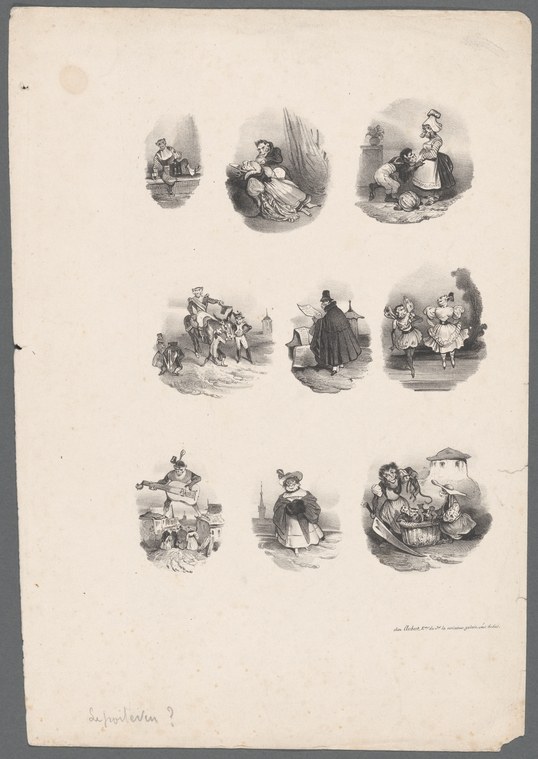
A set of nine engraved vignettes arranged in a three-by-three grid, each depicting anthropomorphic animals engaged in human social activities. The animals—appearing to include dogs, cats, bears, and other creatures—are dressed in human clothing of what appears to be the nineteenth century: women in long dresses, bonnets, and shawls; men in coats and hats. The scenes show domestic and social interactions: courtship, dancing, eating, socializing indoors and out. The engravings are executed in a fine, delicate line with careful cross-hatching for shadow and depth. Each vignette is roughly oval or circular in composition, isolated within its own frame on the page. The overall tone is whimsical and satirical, anthropomorphizing animal behavior to comment on human manners and morality. The paper is aged cream, with visible foxing.
The dancing
The bodies throughout are rendered with naturalistic proportions adapted to animal anatomy—the creatures retain their animal forms while adopting human posture and dress. In the dancing vignettes (particularly the center and lower-right scenes), pairs are shown in close proximity with what appears to be partnered hold, arms raised or extended in the manner of social dance. The figures display weight-shift and directional orientation suggesting movement through space. All figures are positioned with animated, engaged gestures appropriate to social interaction rather than static display.
The dance depicted
Two or more of the nine vignettes appear to depict social ballroom dancing, most clearly in the center composition where a pair is shown in apparent waltz or similar couple dance position. The style and dress suggest early-to-mid nineteenth-century ballroom practice. These are not studies of specific technical steps but rather genre scenes capturing the social fact of dancing as an activity of courtship and entertainment among the fashionable classes. The satirical intent—using animals to mock human vanity and behavior—is consistent with European humorous prints of the 1830s–1850s.
How it was made
This is a steel or copper engraving, executed in the fine-line tradition typical of printed illustration of the nineteenth century. The technique allowed for high resolution and considerable detail in costume and expression, and for the production of multiple impressions suitable for circulation in periodicals, collections of prints, or bound volumes of satirical illustrations. The precision of the line work and the sophisticated use of cross-hatching to model form suggest a skilled professional engraver, though the designer or originating artist is not recorded. The engraving would have been affordable to a middle-class audience and widely distributed.
About this work
This is a sheet of nine comic engravings in the tradition of European satirical animal prints, in which anthropomorphized creatures conduct human social life—including dancing—to comic or moralizing effect. Such prints were popular vehicles for social commentary in the nineteenth century, allowing artists to criticize human behavior by removing it once from reality through the lens of animal mime. The inclusion of ballroom dancing among the vignettes reflects the centrality of dance to fashionable social life in the period; dance was a frequent subject for both serious and comic illustration. The work sits within a long European tradition of animal satire descending from Aesop and active in the prints of Hogarth, Gillray, and Grandville, but the specific artist and date remain unknown. The piece belongs in a gallery of dance in art because it documents both the practice and the cultural meaning of ballroom dance in the nineteenth century: not merely steps, but a marker of civility, courtship, and social standing—even when performed by dogs.
How to look at it
Attend to the specific body positions in the dancing vignettes: the arm placement, the proximity of the partners, and the orientation of their bodies relative to one another will reveal what form of dance is being depicted. Note also the costume details—the cuts of the dresses, the style of the men's coats and hats—which anchor the print in a particular moment and place. The comic effect arises from the juxtaposition of animal faces and forms with the formality and pretension of human ballroom dress and decorum; the artist chose moments of social interaction that would be immediately recognizable to the print's audience as markers of fashionable life. The fineness of the line work and the careful modeling of form reward close looking.
The period
This print belongs to the tradition of European satirical animal prints that flourished in the early nineteenth century, exemplified by J. J. Grandville's *Scenes from the Life and Conduct of the Animals* (1842) and other collections. These works coincided with the height of ballroom culture in Europe and America: the waltz, quadrille, and cotillion were dominant social forms for the middle and upper classes, especially in urban centers. Dance was a frequent subject of illustration because it embodied both the aspirations and the absurdities of refined society. The medium of the engraved print allowed such works to circulate widely and to appeal to audiences who enjoyed both the technical virtuosity of the engraving and the humor of the social commentary.
Where it lives
The work is held in the New York Public Library's collection of prints depicting dance. The print is catalogued as part of that collection but lacks full attribution and dating information; it is described as a nineteenth-century engraving of unknown artist and date.
Dance in this work
Questions about this work
Is this a real dance that the animals are doing?
The gestures and positioning suggest ballroom forms of the nineteenth century—waltz, quadrille, or similar couple dances—but the artist's primary intent was comic rather than technical instruction. The dancing is recognizable as social ballroom dancing in order to make the satire work; the audience would have known these dances and appreciated the humor of seeing them performed by animals in fashionable dress. So yes, a real dance form is depicted, but not in order to teach or document its steps.
Why use animals instead of people?
Animal satire was a convention of European popular prints, descended from Aesop's fables and used by artists like Hogarth and Gillray. It allowed commentators to mock human behavior with a degree of distance and safety—the absurdity is easier to laugh at when it is attributed to foolish animals rather than to named individuals. In this case, the animals acting out human social rituals like ballroom dancing emphasize the artificiality and pretension of such behavior.
When was this made?
The style of dress, the technique of the engraving, and the conventions of animal satire all point to the 1830s–1850s, but the print is not dated and the artist is not recorded. A stylistic analysis might narrow the date further, but it cannot be certain without additional documentation.
More dance artwork





