49 works in this view — arrow keys or swipe to move between them.
Dance in Art
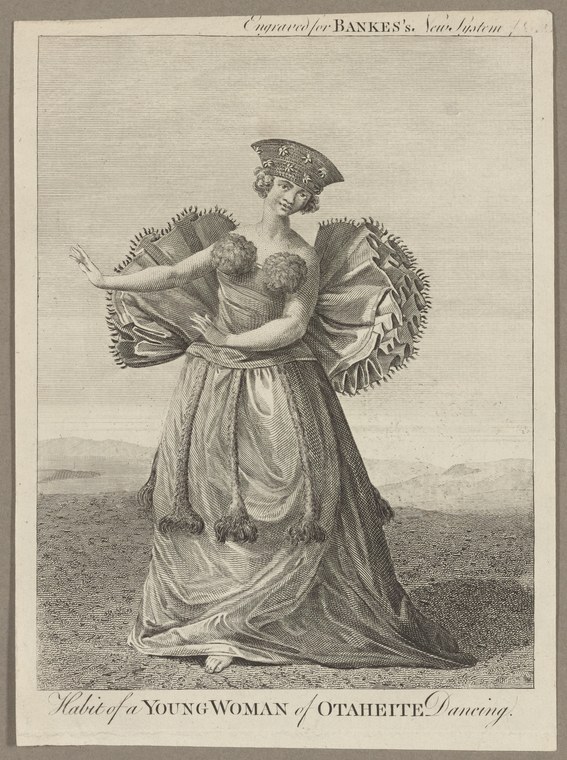
Habit of a young woman of Otaheite dancing
Unknown artist
- Collection:
- Prints depicting dance
- Source:
- New York Public Library
- Rights:
- Public domain — free to use, share and adapt.
- Recorded as:
- Public Domain
This work exemplifies the dangers and distortions inherent in early European documentation of non-Western dance. It asks viewers to consider the gap between claimed subject matter and actual visual content, and to recognize that costume prints marketed as anthropological records were often commercial fantasies shaped by European neoclassical taste. For historians of dance and representation, it is a key example of how 'exotic' dance was mediated, translated, and fundamentally altered in circulation through print.
What you are looking at
A single female figure dominates the composition, posed against a distant, hazy landscape. She wears an elaborate neoclassical dress with a high waistline, rendered in fine linear detail. The dress features a full skirt with deep, ornate folds and sweeping drapery that pools at her feet. Most striking are her massive draped sleeves—constructed of layered, feathered or fringed fabric that extends far beyond her shoulders, creating enormous wing-like projections on both sides. She wears a decorative headdress with what appears to be a tall ornamental crest or plume. Her pose is frontal and statuesque, with her body upright and her arms positioned to display the costume. One arm is extended slightly outward; the other is bent across her body. Her expression is serene and her gaze directed outward. The entire composition is executed in fine engraving technique, with delicate cross-hatching creating tone and shadow across the fabrics and landscape.
The dancing
The figure stands in a relatively static, presentational pose rather than one suggesting active movement or specific dance technique. Her weight appears evenly distributed. The arm positions are controlled and graceful but not engaged in the kind of partnering, precise footwork, or dynamic weight transfer characteristic of any recognizable dance form. She is a single dancer, alone in the frame. The pose reads as a display of costume and bearing rather than a captured moment of kinetic action.
The dance depicted
The title identifies this as a depiction of a young Tahitian woman's dancing costume and manner. However, the image itself shows a figure in neoclassical European dress—not Indigenous Pacific costume—posed in a static, formal manner that does not clearly demonstrate actual Tahitian dance movement. The elaborate European-style sleeves, high waistline, and formal presentation are entirely consistent with late 18th-century European fashion and artistic convention, not with documented Tahitian dress or movement practices. The work appears to be a European artist's imagined or stylized interpretation of 'Otaheite (Tahiti) filtered through the aesthetic codes of neoclassical engraving, rather than a documentary record of actual dance.
How it was made
This is a finely executed copper-plate engraving, identified by its linear hatching, tonal gradation through parallel lines, and the characteristic precision of the medium. The inscription at the top—'Engrav'd for Bankes's New Assist in'—indicates commercial publication as part of a printed series. Engraving of this quality required substantial skill and was an expensive process, suggesting the work was aimed at a literate, affluent audience interested in costume, travel, and the exotic. The technique's precision and tonal control made it ideal for circulating images of distant places and peoples throughout Europe during the age of exploration and Enlightenment collecting.
About this work
This is a late 18th-century engraving presenting a European imagining of Pacific Island femininity and dance costume. The figure herself—her neoclassical pose, European high-waisted dress, and elaborate artificial sleeves—reveals more about European aesthetic ideals and commercial print conventions than about actual Tahitian dress or movement practice. It belongs in a dance art gallery as an example of how dance imagery, travel imagery, and exoticizing European fantasy intersect; the work documents not Tahitian dance but the European gaze upon it, mediated through engraving, fashion, and the language of neoclassical form.
The inscription links it to a specific publication series ('Bankes's New Assist'), suggesting it was one of many such images circulating in educated European households as curiosities or fashion inspiration. It is both a document of 18th-century global commerce and representation, and a record of how European artists and publishers imagined and commodified distant dance traditions without direct ethnographic knowledge.
How to look at it
Observe the tension between the title's claim (this is how a Tahitian woman dances) and what the image actually shows (a woman in European neoclassical dress). Notice how the enormous draped sleeves—which would be impossible to move in during actual dance—are deployed as the primary visual attraction. The static pose, formal frontality, and pristine presentation suggest this is a costume display or fashion plate rather than a moment of actual movement. The fine linear technique of the engraving mimics precision and documentary authority, but serves here to render a fantasy as if it were fact. Ask yourself what the artist actually knew about Tahitian dance, and what a European print buyer of the 1780s would have understood this image to represent.
The artist
The artist is not recorded. The engraving bears only a publication credit to 'Bankes's New Assist in' (likely *Bankes's New Assist in* or a similar publication series), suggesting it was a commercial product issued by a London or European print publisher rather than the work of a named, independent artist. This anonymity was common for costume and travel prints of the period, which were often produced in workshops or by journeyman engravers working from designs, sketches, or descriptions rather than from life.
The period
This engraving dates to the late 18th century, a moment when European enthusiasm for the Pacific and its peoples was intensifying following accounts of exploration voyages. Captain James Cook's voyages (1768–1779) generated enormous public appetite for images of newly 'discovered' islands and their inhabitants. Simultaneously, neoclassicism was the dominant aesthetic in European visual culture, and all exotic subjects—including Pacific Island peoples—were filtered through neoclassical ideals of form, drapery, and pose. The fashion for 'Otaheite' imagery was partly genuine curiosity, partly commercial opportunism, and entirely shaped by European artistic convention. Dance documentation in this period was rare and almost never firsthand; costume prints served as a primary means of circulating ideas about distant dance practices.
Where it lives
The work is held in the New York Public Library as part of its collection of prints depicting dance. It was issued as a commercial engraving within a titled publication series ('Bankes's New Assist'), indicating it circulated as a retail print in the late 18th-century European print market.
Dance in this work
Questions about this work
Is this actually based on Tahitian dance?
The title claims it depicts a Tahitian dancing costume, but the figure wears European neoclassical dress with no correspondence to documented Tahitian clothing or body presentation. The work is better understood as a European artist's fantasy interpretation of 'the exotic' than as ethnographic documentation. It reveals what Europeans *imagined* the Pacific to look like, not what was actually there.
Why are the sleeves so enormous?
The oversized draped sleeves are a feature of late 18th-century European neoclassical fashion, not Tahitian dress. They serve as the image's visual centerpiece and primary marker of exoticism. In reality, such unwieldy sleeves would make dance movement impossible, but the print values display and visual spectacle over functional accuracy.
Who was Bankes and what is this 'New Assist'?
The publication credit suggests this was issued as part of a commercial print series, likely from a London publisher. 'Bankes's New Assist in' appears to be a costume or curiosity series aimed at educated, affluent households. Without further research into the publisher's catalog, the precise scope and date of the series cannot be determined from the image alone.
Why is there no artist's name?
Anonymous publication was standard for commercial costume and travel prints in this period. Such works were often workshop products, reproduced from designs or descriptions rather than original artistic vision, and publishers did not credit individual engravers. The omission reflects the print's status as commercial commodity rather than high art.
More dance artwork





