49 works in this view — arrow keys or swipe to move between them.
Dance in Art
Masquerades and fancy-dress balls in prints
Unknown artist
- Collection:
- Prints depicting dance
- Source:
- New York Public Library
- Rights:
- Public domain — free to use, share and adapt.
- Recorded as:
- Public Domain
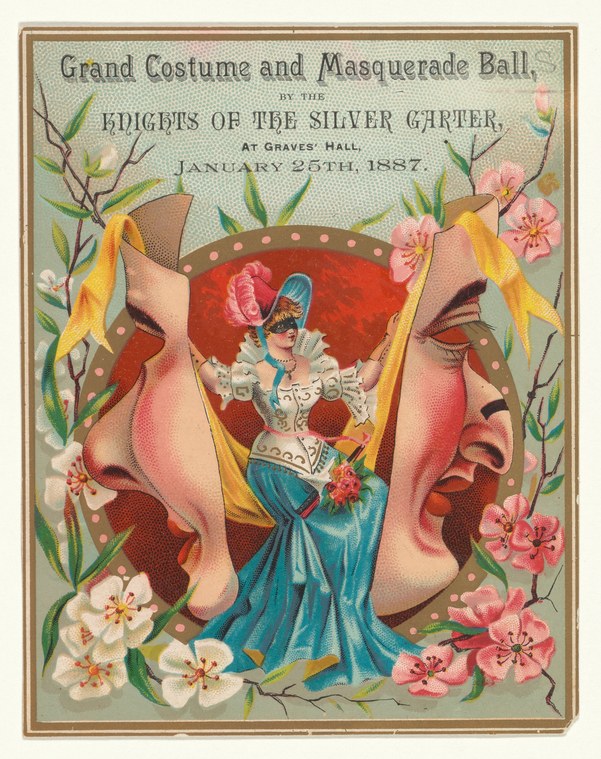
This work is a rare surviving artifact of the material culture of Victorian masquerade—a social form that was deeply tied to dance but is now largely understood through literary and theatrical representations rather than visual evidence. For dance historians, it documents the aesthetic expectations and costume conventions of late 19th-century ballroom culture and the role of fancy dress in creating social space for formalized, choreographed social interaction. The image also reveals how masquerade was marketed and understood: as a spectacle, a display, and a moment of controlled transformation.
What you are looking at
This is a chromolithographed invitation or poster for a masquerade ball held by the Edgetts of the Silver Garter at Graves' Hall on January 25th, 1887. The composition is dominated by two large profile faces in pink and cream, facing outward from the center of the image. Between them stands a single female figure in an elaborate costume: she wears a bright blue gown with a fitted bodice, white lace collar and cuffs, and holds a red umbrella or parasol overhead. Her face is covered by a black mask. The entire scene is framed and decorated with flowering plants—carnations and other blooms in pink and white—and golden-yellow ribbons or fabric swags that curve organically around the composition. The background is a soft gray dotted pattern. The overall effect is one of festive theatricality: the scale of the faces emphasizes the visual spectacle and anonymity of masquerade, while the central figure in her jeweled costume embodies the elegant fancy dress that guests would have worn to such an event.
The dancing
The central figure is posed formally, standing upright in a three-quarter view with one arm raised to hold the parasol overhead and the other hand positioned near her body. Her posture is elegant and self-conscious—she is not moving but rather displaying herself as a costume, which is the point of a fancy-dress ball. The two large heads flanking her are stylized and symbolic rather than realistic portraiture; they frame the action without participating in it. There is no actual dance movement depicted, though the figure's formal stance suggests the kind of stationary presentation required at a masquerade gathering.
The dance depicted
This is not a depiction of active dance, but rather of the fancy-dress culture surrounding masquerade balls and costume events of the 1880s. Masquerade balls were social events structured around music and dancing, but this image captures the moment of display and presentation rather than the kinetic act of dancing itself. The masked costume and formal dress indicate the theatrical and social conventions of Victorian-era ballroom culture, where costume, spectacle, and controlled deportment were central to the experience. The anonymity afforded by the mask—here literally facing away from the viewer—was a key element of masquerade tradition, allowing dancers and attendees to inhabit alternative identities within the formal ballroom setting.
How it was made
This is a chromolithograph, a color printing process that became standard for theatrical posters, invitations, and entertainment advertisements in the 1880s and 1890s. The technique allowed for the bright, saturated colors visible here—the vivid blue of the gown, the pink flowers, the golden ribbons—and the smooth gradations of tone in the faces and background. Chromolithography required multiple stone plates (one for each color), making it expensive enough to suggest this was a formal invitation from a notable family or organization. The process was ideal for publicity and social announcements, and this particular object would have circulated among invited guests and perhaps been posted in public spaces to advertise the event.
About this work
This chromolithographed invitation announces a masquerade ball held on January 25, 1887, by the Edgetts of the Silver Garter—possibly a social club or organization—at Graves' Hall. The image is a visual essay on masquerade culture: the large faces emphasize the theme of hidden identity and spectacle, while the figure in the center displays the kind of elaborate, jeweled costume that guests were expected to wear. The work belongs in a gallery of dance art because masquerade balls were central events in ballroom culture, blending formal dancing with theatrical costume and controlled social transgression. The image documents not the moment of dancing itself but the visual and social machinery that made such dancing possible—the costume, the mask, the formal presentation that characterized Victorian high society's most elaborate entertainments.
How to look at it
Attend first to the composition's symmetry: the two large faces create a theatrical proscenium arch, with the costumed figure positioned as if on a stage. The faces are not meant as realistic portraiture but as symbolic representations of the masquerade theme—the duplication, the slight stylization, the way they frame rather than engage with the central figure. Notice the costume itself: the blue silk gown, the white lace collar, the black mask, and especially the red parasol, which is both practical and ornamental. These are the markers of 1880s fancy dress—specific enough that a contemporary viewer would have understood the reference. The floral border is not accidental decoration but part of the work's claim to elegance and beauty; flowers and ribbons were standard ornaments of theatrical and social announcements in this period.
The period
The masquerade ball had a long history in European courtly culture, but experienced a significant revival in the Victorian era as an elite social entertainment. In the 1880s, masquerade events were among the most elaborate and expensive entertainments available to upper-class society, often organized by wealthy families or exclusive clubs. The formal ballroom dances of the period—waltzes, quadrilles, and cotillions—were typically performed at such events, and the masquerade format allowed for a measure of social role-playing within strict codes of decorum. Chromolithography, which came into widespread use in the 1870s and 1880s, made it possible to create visually striking announcements and invitations for such events, turning ephemeral social occasions into collectible artifacts. The artistic language here—the symbolic faces, the theatrical framing, the floral abundance—reflects both the Pre-Raphaelite influence on decorative arts and the growing sophistication of commercial graphic design.
Where it lives
The work is held as part of the New York Public Library's collection of prints on the subject of masquerades and fancy-dress balls. It is catalogued as an example of masquerade imagery in historical prints, a category that includes both documentary evidence of actual events and more generalized promotional material. As an invitation or announcement, it would have been produced in multiple copies and distributed to prospective guests.
Dance in this work
Questions about this work
What was a masquerade ball in the Victorian era?
A masquerade ball was an elaborate, formal entertainment held by wealthy families or exclusive social clubs, typically featuring orchestral music, formal dances (waltzes, quadrilles, and cotillions), and mandatory fancy dress and masks. The mask granted temporary anonymity and allowed guests to adopt alternative identities within strict social boundaries. Such events were expensive to attend and were among the most prestigious social occasions of the era.
Why are the faces so large and stylized?
The large faces are symbolic rather than realistic—they represent the theme of masquerade by emphasizing the duality of masked identity and the theatrical nature of the event. They also serve a practical design purpose: framing the central costumed figure and drawing the eye to the announcement's central information. In chromolithographic design, bold, simplified forms were both aesthetically striking and practical for color printing.
What does the blue dress tell us about 1880s fancy-dress fashion?
The vivid blue silk gown, ornate white lace collar, and jeweled accessories represent the height of fancy-dress costume in the 1880s. Such costumes were expensive to acquire or commission and were often elaborate historical or theatrical references. The parasol, though ornamental rather than functional, was a standard accessory for formal dress and costume in this period.
Is this an actual record of a specific ball, or a generic invitation?
The specific date (January 25, 1887), location (Graves' Hall), and organization name (Edgetts of the Silver Garter) suggest this was a real, planned event. However, it is unclear whether the Edgetts were a family, a social club, or an organization. The image is a promotional announcement rather than a documentary record of the event itself.
More dance artwork





