49 works in this view — arrow keys or swipe to move between them.
Dance in Art
Caricature
Unknown artist
- Collection:
- Prints depicting dance
- Source:
- New York Public Library
- Rights:
- Public domain — free to use, share and adapt.
- Recorded as:
- Public Domain
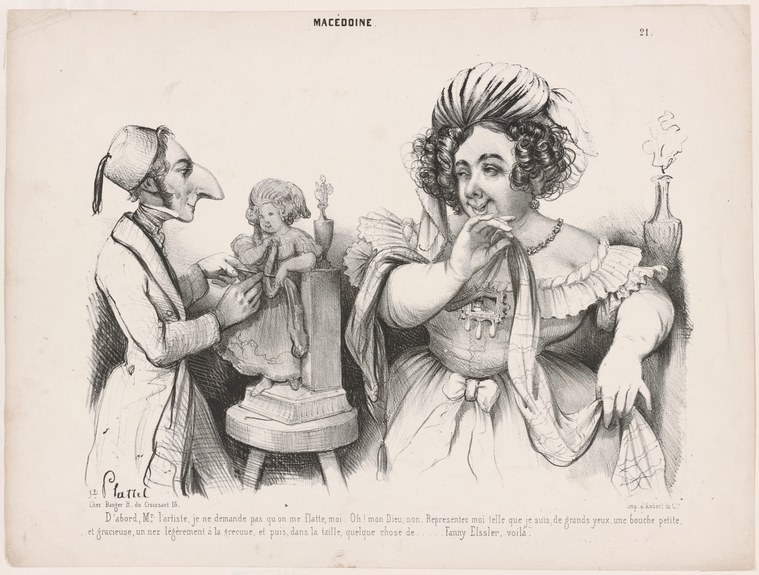
This print illuminates the historical connection between courtship ritual, social performance, and choreography—how the vocabulary of dance was applied metaphorically to everyday social behavior. For historians of 19th-century visual culture, it documents the satirical tradition's use of exaggerated pose to comment on gender, desire, and social convention. For dance scholars, it reveals how gestures of seduction and flirtation were understood as performative 'dances' worthy of artistic representation and ridicule.
What you are looking at
A caricature in the style of 19th-century French satirical prints, showing three figures in an interior setting. On the left, a thin, hunched man with an exaggerated profile leans toward the center of the composition, his body angled in toward the action. At center stands a small cherub or putto figurine on a pedestal, serving as a focus point. On the right, a woman with elaborate upswept hair and dressed in fashionable garments of the period—a low-cut bodice with puffed sleeves and what appears to be a shawl or wrap—sits or reclines, one hand raised near her face in a gesture suggesting amusement or coquetry. Her posture is relaxed and theatrical. A small decorative object, possibly a perfume bottle or vial, stands on a surface to her right. The line work is fluid and expressive, typical of mid-19th-century lithographic or engraved caricature, with particular attention to the exaggerated features of the male figure's nose and the woman's fashionable coiffure. The setting suggests an intimate domestic or boudoir space, and the overall tone is one of social satire, likely commenting on courtship, seduction, or the vanities of fashionable society.
The dancing
The male figure exhibits a posture of animated attention, his body bent forward and his gaze fixed on the woman. His gesture reads as intrusive or fawning—the posture of pursuit or plea. The female figure, by contrast, maintains a composed, almost languid bearing; she reclines slightly, her raised hand positioned near her mouth in a gesture that reads as both receptive and performative—neither fleeing nor fully engaging. Neither figure appears to be in actual motion or dance; instead, their bodies express social relationship and psychological state through theatrical stillness.
The dance depicted
This is not a depiction of dance in the formal sense. The figures' postures are too static and their relationship too clearly psychological—one pursuing, one withholding—to represent actual movement. However, the image belongs to a visual tradition of social satire that used exaggerated gesture and theatrical pose to comment on courtship ritual and the social 'performance' of attraction. In 19th-century salon culture, such rituals were often compared to dance, and the visual language here—the elaborate costume, the posed bodies, the intimate interior—draws on that metaphor. This is satire of the social 'dance' of flirtation rather than depiction of choreographed movement.
How it was made
The work is a lithograph or engraved print, evident from the delicate line work, the tonal gradations achieved through cross-hatching, and the characteristic handling of light and shade. The technique allowed rapid production and wide circulation; such satirical prints were distributed as single sheets and collected in bound volumes, making them a primary medium for social commentary in 19th-century France. The image bears the signature 'Paul' (likely Paul Gavarni or a contemporary caricaturist working in his manner), and text in French at the base, indicating this was part of a numbered or serialized publication. The style of dress and the hand-lettered caption suggest a date in the 1840s–1860s.
About this work
This is a satirical print from the mid-19th-century French tradition of caricature and social commentary. It uses exaggerated gesture and theatrical pose to ridicule courtship behavior and the performative aspects of fashionable society—the social 'dance' of attraction. The work belongs to the broader visual culture of humor prints that circulated widely in Paris and were avidly collected by middle-class readers. While not a depiction of actual choreographed dance, it employs the visual language of theatrical pose and bodily performance to make its satirical point, and thus occupies a liminal position between social satire and dance imagery. The work is valuable as evidence of how 19th-century artists understood gesture, posture, and social movement as forms of expression comparable to dance.
How to look at it
Attend first to the postures and spatial relationship: the man's forward lean and the woman's reclined ease establish a social dynamic without movement. Notice the hands—the man's are empty and reaching toward the object of his attention; the woman's is raised, a gesture of withholding or amusement. The artist has frozen a moment of social tension, not a moment in a dance, but the theatrical pose recalls stage gesture. The exaggeration of features—the man's nose, the woman's hair—is the tool of satire; by distorting the body, the artist comments on social behavior. The presence of the decorative objects (the cherub, the perfume bottle) reminds us that this is a world of surfaces, appearances, and performed desire.
The artist
The signature 'Paul' suggests this is the work of a mid-19th-century French caricaturist, possibly Paul Gavarni (1804–1866), one of the most prolific and celebrated satirical artists of the period, or another artist working in the same tradition. Such prints were published in illustrated journals like *La Caricature*, *Le Charivari*, and *Le Journal pour rire*, which employed caricaturists to produce social and political satire. The style—elegant line work, psychological subtlety, and focus on salon behavior—is consistent with the more sophisticated end of the French caricature tradition, aimed at educated, urban viewers.
The period
In the 1840s–1860s, when this print was likely made, French caricature had reached a high point of artistic sophistication and social influence. Artists like Gavarni, Honoré Daumier, and others used exaggerated gesture and pose to satirize the pretensions of bourgeois society, particularly around courtship, fashion, and gender relations. This was also the era of Romantic ballet, when theaters were filled with images of sylphs and odalisques, and when the female body on stage became a focus of artistic and social fascination. The satirical print tradition ran in parallel, offering a sharply critical counterpoint to the idealized bodies of theatrical dance—mocking the affectations of real-world courtship while dancers on stage embodied fantasies of grace and unreality.
Where it lives
The work is held by the New York Public Library in its collection of prints depicting dance. The catalogue record is sparse and offers no date, artist name, or medium confirmation, but the image itself is a clear example of mid-19th-century French lithographic or engraved caricature, likely from a serialized publication or journal. The French-language caption and the style of dress and printing are consistent with Parisian print production of the 1840s–1860s.
Questions about this work
Is this actually a dance?
Not in the formal sense—the figures are posed rather than moving. But it is a satire on courtship as a kind of social 'dance,' using exaggerated theatrical gesture to mock the performance of attraction. In 19th-century usage, the rituals of flirtation were often called 'dances,' and this image plays on that metaphor. It belongs in a dance collection because it documents how gesture and pose were understood as forms of bodily expression akin to choreography.
Who is the artist?
The signature reads 'Paul,' which most likely identifies the artist as Paul Gavarni (1804–1866), a prolific French caricaturist, though the catalogue record does not confirm this. Other artists of the same era and tradition also signed their work 'Paul.' Without additional documentation, the identification remains tentative.
What is the French text saying?
The caption is partly legible in the image and appears to be a witty commentary on the scene—typical of the kind of brief, punchy captions that accompanied such prints in satirical journals. A full transcription and translation would require a higher-resolution image or access to the original publication.
When was this made?
The style of dress, the printing technique, and the artistic manner all point to the 1840s–1860s, the heyday of French satirical caricature. The catalogue record offers no date, but the visual evidence is consistent with mid-19th-century French production.
More dance artwork





