49 works in this view — arrow keys or swipe to move between them.
Dance in Art
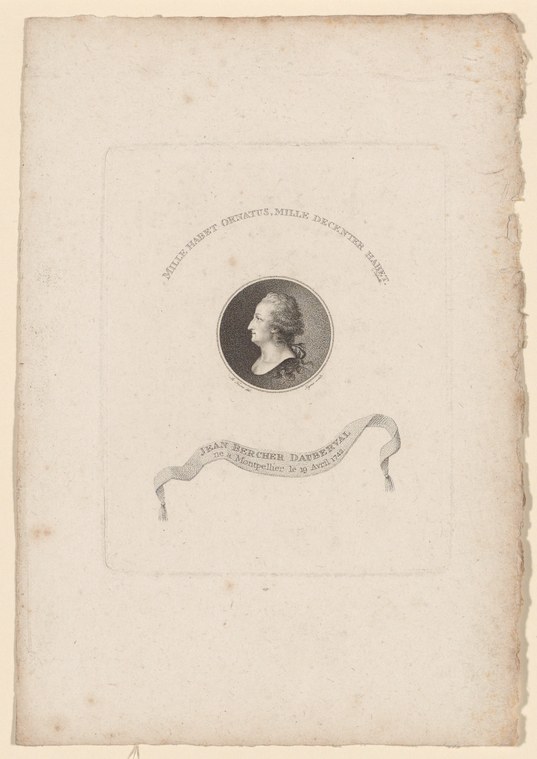
Jean Bercher Dauberval, ne à Montpellier le 19 avril 1742
Unknown artist
- Collection:
- Prints depicting dance
- Source:
- New York Public Library
- Rights:
- Public domain — free to use, share and adapt.
- Recorded as:
- Public Domain
Dauberval revolutionized 18th-century ballet by introducing greater realism, character development, and narrative pantomime into the form—moving away from pure spectacle toward dramatic storytelling. This portrait, though not a dance image, documents how his contemporaries saw and remembered him and indicates the professional status he achieved. For anyone studying the history of ballet reform, the physiognomy of theatrical celebrity, or the uses of engraving in 18th-century theater culture, this work is evidence.
What you are looking at
A circular profile portrait in the neoclassical mode dominates the composition, centered on the page within a ruled rectangular border. The sitter is shown in left profile, head and shoulders only, rendered in fine stippled engraving against a plain background. Below the portrait runs a curved decorative ribbon or cartouche bearing an inscription. The entire composition is spare and formal, typical of 18th-century commemoration. The profile itself is delicately modeled with attention to the line of the nose, lips, and chin; the hair is dressed in the fashion of the 1740s, swept back and gathered. No dance is depicted in the image itself—this is a portrait memorial, not a scene of movement.
The dancing
A single human head in profile. No gesture, pose, or body movement is represented. This is an image of commemoration through physiognomy alone, not a depiction of dance practice or performance.
The dance depicted
The image does not depict dance. It is a commemorative portrait of Jean Bercher Dauberval, a figure historically significant to the history of ballet (he was a dancer, choreographer, and reformer of the 18th century), but the artwork itself shows no dancing body and tells us nothing about how he danced or choreographed.
How it was made
This is an engraving, executed in the stippled or dotted manner typical of fine portraiture of the later 18th century. The technique allowed for subtle modeling of light and shadow across the face and created a surface suitable for mass reproduction and circulation as a print. The fineness of execution suggests a work aimed at an educated audience—collectors, dancers, or patrons of the theater who might have known Dauberval's name.
About this work
This is a commemorative engraved portrait of Jean Bercher Dauberval (1742–1806), the influential French ballet reformer and choreographer. Although Dauberval was a pivotal figure in theatrical dance—he was the creator of *La Fille Mal Gardée* and an advocate for naturalism and pantomimic expression in ballet—this image is not a dance picture. It serves instead as a record of his likeness and reputation within the circuits of 18th-century theatrical culture. The work belongs in a dance collection as a document of how the profession commemorated and recognized its innovators, even when the commemoration itself is purely portraiture.
The inscription on the cartouche (which reads "Jean Bercher Dauberval, né à Montpellier le 19 avril 1742") anchors the image to a specific person and birthdate. For historians of dance, such portraits functioned as certificates of identity and achievement within the world of theater. This print circulated among dancers, choreographers, and theater-goers as a form of celebrity portraiture.
How to look at it
Study the proportions and character expressed in the profile: the refinement of line, the attention to physiognomy, and the careful rendering of contemporary dress. The formal conventions of commemorative portraiture—the ruled frame, the cartouche, the centered placement—tell you this is a work of record, not a moment of action. Note how the engraver has used stippling to create volume and depth in the face, creating an illusion of three-dimensionality from millions of tiny dots. This technical accomplishment was the selling point: it proved the engraver's skill and the subject's worthiness of such labor.
The artist
The engraver is not named in the catalogue record. Based on the style, this is likely the work of a specialized portrait engraver working in the Paris theater circles of the later 18th century, possibly in the 1770s or 1780s. Such prints were produced by workshops that created commemorative likenesses of celebrated dancers and performers for sale to the public and for use in theatrical publications.
The period
This portrait dates to the era of Dauberval's artistic maturity and fame. In the 1760s and 1770s, ballet was undergoing significant reform, driven by thinkers like Jean-Georges Noverre (whose *Lettres sur la danse* appeared in 1760) and by dancers and choreographers like Dauberval who sought to elevate the art form by introducing coherent narrative, character psychology, and expressive mime. The circulation of engraved portraits of celebrated dancers became a common practice, as the profession gained cultural prestige and a wider public following. Such prints were sold in theaters and printshops, making the faces of celebrated artists recognizable to urban audiences.
Where it lives
Held in the New York Public Library as part of a collection of prints depicting dance. The work is a loose print, likely part of a broader assemblage of theater and dance portraiture accumulated by collectors of 18th-century visual culture.
Questions about this work
Who was Jean Bercher Dauberval?
Dauberval (1742–1806) was a French dancer, choreographer, and major reformer of late 18th-century ballet. He is best known for creating *La Fille Mal Gardée* (1789), one of the earliest surviving ballets still performed today. He championed naturalism and pantomimic storytelling in an art form that had often emphasized pure spectacle and technical display.
Why is a portrait included in a dance collection?
Although this image does not show dance in action, it documents how the profession was represented and valued. Engraved portraits of celebrated dancers circulated widely in the 18th century, making them visible to audiences and helping establish dance as a respectable, recognized art form worthy of commemoration.
What is the text beneath the portrait?
The inscription reads "Jean Bercher Dauberval, né à Montpellier le 19 avril 1742" (Jean Bercher Dauberval, born at Montpellier on 19 April 1742). This dates his birth and identifies his birthplace, anchoring the portrait to a specific historical person and moment.
What technique was used to make this print?
This is an engraving, most likely executed in the stippled manner, where tiny dots of varying density create tone and modeling. This technique was labor-intensive but allowed for fine detail and could be reproduced multiple times from a single copper plate, making it an effective medium for circulating celebrity images.
More dance artwork





