49 works in this view — arrow keys or swipe to move between them.
Dance in Art
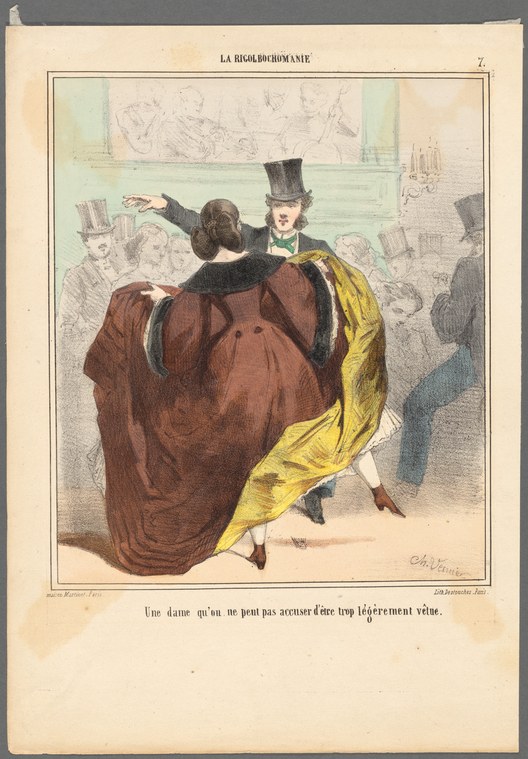
7. Une dame qu'on ne peut pas accuser d'être trop légèrement vêtue
Unknown artist
- Collection:
- Prints depicting dance
- Source:
- New York Public Library
- Rights:
- Public domain — free to use, share and adapt.
- Recorded as:
- Public Domain
This work shows how 19th-century ballroom dance was fundamentally bound up with fashion display and how the female body in motion—particularly in the waltz—became a vehicle for both admiration and satire. The artist captures a tension central to Romantic-era dance: the interplay between control and excess, between the refined movement required by formal dance and the visual exuberance of costume. For scholars of dance history, it documents not technique but the social and material reality of how dance was experienced and understood.
What you are looking at
A fashionably dressed woman in a voluminous brown or rust-colored dress with a full skirt dominates the composition, shown from behind and mid-turn. Her dress features elaborate draping and a striking yellow or golden shawl or train that swings outward, catching light and creating dynamic movement across the page. She wears the formal attire of the mid-19th century, including what appears to be a fitted bodice. Beside her stands a man in dark formal wear with a top hat, shown in profile, gesturing toward the woman with an extended arm. The setting is an elegant ballroom or salon rendered in muted tones in the background, with other figures visible in silhouette wearing top hats, suggesting an evening gathering of the fashionable classes. The composition is rendered as a hand-colored engraving or lithograph, with fine line work creating the architectural and figural details.
The dancing
The woman's body is captured in a swinging, rotating movement—her weight appears to be shifting as she turns, her heavy skirts lifting and spreading with the centrifugal force of the movement. Her posture is upright and formal, arms not clearly visible but the overall frame suggests the controlled elegance expected of a lady at a formal gathering. The man's gesture is animated and theatrical, his arm raised in what could be a greeting, invitation, or response to her movement. The spatial relationship between them suggests social interaction rather than a partnered dance hold, though the woman's dynamic pose creates a clear moment of visual interest.
The dance depicted
This appears to document a moment of social dancing or promenade at a 19th-century ball, most likely during the Romantic era or Gilded Age. The woman's bold, turning movement and the visibility of her dress in motion suggests a waltz or a variation of quadrille dancing, where women's skirts became increasingly voluminous and were displayed as a key element of the spectacle. The title in French—'Une dame qu'on ne peut pas accuser d'être trop légèrement vêtue' (A lady one cannot accuse of being too scantily dressed)—is a satirical remark, suggesting the humor lies precisely in the contrast between her extremely heavy, elaborate clothing and either the man's gesture or the very idea of underdressing. The image records not primarily how the dance was executed technically, but rather the fashion spectacle and social dynamics of ballroom culture.
How it was made
This is a hand-colored lithograph or engraving, identifiable by the fine linear work in the background architecture and figures, combined with selective watercolor or chromolithographic tinting in the dress, shawl, and skin tones. The technique allowed the artist to create satirical social commentary with precision, capturing both the exaggerated silhouette of mid-19th-century fashion and the wit of the caption. Hand-coloring suggests this was created for a middle-class or affluent audience—lithographs of this type were commonly published in fashion journals or satirical periodicals, where they could reach viewers interested in both dance culture and fashion critique.
About this work
This is a satirical social document from the Romantic or Gilded Age, capturing a moment in a fashionable ballroom where the sheer volume and weight of a woman's dress becomes the visual and conceptual center of attention. The work belongs to a genre of fashion and ballroom satire common in 19th-century prints, where the transformation of dress through movement—particularly the waltz and quadrille—was a subject of both artistic celebration and social humor. The image reveals how dance was not simply movement but spectacle: the ballroom stage on which elaborate textiles and social performance converged. For dancers and historians of performance, it documents the material conditions of 19th-century social dance, showing how the dancer's body was inseparable from the costume and how fashion itself became part of the choreography.
How to look at it
Focus on the moment the artist chose: not a static pose but captured motion, with the dress caught mid-swing and the man's gesture registering surprise or appreciation at the visual spectacle. The title instructs us to read the image as satire—the joke is that the woman is so heavily, elaborately dressed that accusations of immodesty would be absurd. Notice how the artist has rendered the fabric itself as the true subject, with the body underneath almost incidental. The background figures in silhouette emphasize that this is a scene of social observation: the ballroom as theater for the display of dress and behavior.
The artist
The work is attributed to a hand in the tradition of mid-19th-century French satirical prints. The style and composition are consistent with the work of artists publishing in *La Vie Parisienne* and similar periodicals of the 1850s–1870s, though without a signature or documented attribution, the specific artist remains unknown. The inclusion of a French caption and the refined execution suggest a trained printmaker working for the Parisian market.
The period
The 1850s–1870s saw the zenith of the waltz and quadrille in European ballroom culture. The expansion of women's skirts—reaching maximum volume in the 1860s through the use of crinolines and later bustles—made the ballroom dress a spectacular object. Simultaneously, satire of fashion became a major mode of social commentary in the press. Lithographic and engraved prints allowed artists to circulate images of ballroom life, fashion excess, and social manners to a broad urban audience. Dance was not marginal to fashion discourse; the ballroom was one of the primary stages on which new silhouettes were displayed and critiqued.
Where it lives
The work is held in the New York Public Library's collection of prints depicting dance. It is one of a large corpus of 19th-century French satirical lithographs and engravings documenting ballroom fashion and social life, circulated through periodicals and as independent prints for framing and collecting.
Dance in this work
Questions about this work
Is this showing an actual dance step or movement?
The image captures a moment of turning or promenade in a ballroom dance—likely a waltz given the woman's swinging pose and the period. However, the artist's primary interest is not in documenting dance technique but in the visual and social spectacle of the dress in motion. The movement is real, but the joke is visual, not technical.
What does the French title mean?
'A lady one cannot accuse of being too scantily dressed.' It is satirical: the woman is dressed in such an enormous, elaborate outfit that she could never be criticized for immodesty. The humor plays on the tension between Romantic-era ideals of refined femininity and the increasingly exaggerated silhouettes of mid-19th-century fashion.
Why is the man's gesture so prominent?
His raised arm and apparent astonishment register as a response to the spectacle of the woman's dress and movement. In satirical prints of the period, masculine appreciation or bewilderment at female fashion excess was a standard motif, reinforcing the idea that the dress itself—not the wearer—was the object of attention.
What does this tell us about how people actually danced in the 1860s?
While the dress was spectacular and movement-constraining, the ballroom dances of the period—particularly the waltz—were designed to accommodate large skirts. Dancers developed a particular upright posture and a turning technique suited to heavy textiles. This print shows the result: elegance expressed through the relationship between the body's controlled rotation and the fabric's generous flow.
More dance artwork





