49 works in this view — arrow keys or swipe to move between them.
Dance in Art
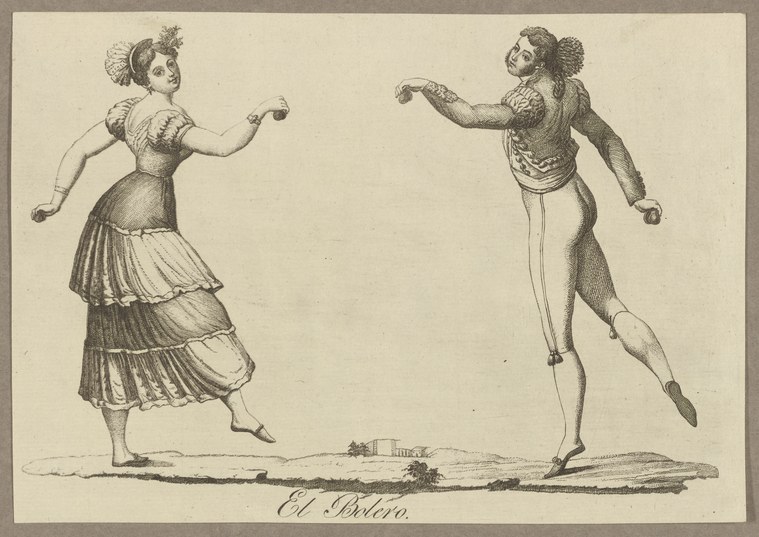
El Bolero
Unknown artist
- Collection:
- Prints depicting dance
- Source:
- New York Public Library
- Rights:
- Public domain — free to use, share and adapt.
- Recorded as:
- Public Domain
The bolero was a pivotal dance in the transition from courtly to modern ballroom technique—it introduced Spanish rhythmic and gestural elements to continental dance while maintaining the balletic posture that defined Romantic-era gentility. This print is rare visual evidence of how that dance was actually taught and understood at the moment of its greatest popularity, preserving a snapshot of technique, costume, and bodily deportment that would otherwise exist only in written dance notation or fragmentary written descriptions.
What you are looking at
Two figures occupy a cream-colored stage against a neutral background marked only by a thin ground line and small landscape elements. On the left stands a woman in fashionable early 19th-century dress: a high-waisted gown with puffed sleeves, fitted bodice, and a voluminous skirt composed of three tiered, flounced layers that fall to mid-calf. Her hair is pinned up with an ornamental headdress, and she wears what appear to be soft slippers. Her right arm is raised at shoulder height with the hand curved, while her left arm hangs lower with the hand similarly curved—a posture suggesting controlled, balletic carriage. On the right stands a male figure, posed on the ball of one foot with the other leg extended behind him in an airborne attitude. He wears tights or fitted breeches, a short tunic or jacket with decorative embroidery or beading across the chest, and his dark hair is styled close to his head. His arms are raised and curved, mirroring the woman's port de bras. Both figures are rendered in fine pen line with cross-hatching for shadow, giving them sculptural definition.
The dancing
The two dancers occupy mirror-image positions across the composition, each with arms held at variable heights in a series of curved, controlled poses. The woman's weight settles firmly on both feet, her stance grounded and stable; the man appears suspended on his right leg with the left leg trailing or airborne behind, suggesting an ascending or traveling action. Both maintain an upright carriage with lifted ribs and lengthened necks—hallmarks of courtly dance technique. The bilateral symmetry of their arm positions, the raised elbows, and the curved wrists suggest a coordinated dance executed in a promenade or processional frame rather than in closed ballroom contact.
The dance depicted
This is a bolero, as stated in the title. The bolero was an early 19th-century social dance of Spanish origin that became fashionable across European ballrooms, particularly in Regency England. The image captures the characteristic posture and decorum of the Romantic era: upright carriage, arm styling derived from ballet technique, and separation between partners rather than embrace. The man's elevated leg and dynamic weight distribution hint at the traveling, turning steps and rhythmic hip action for which the bolero was known, while the woman's composed stance and high carriage reflect the reserved propriety expected of female dancers in this period. The theatrical quality of the pose—the dramatic leg extension, the balletic port de bras—suggests this may be a theatrical or demonstration version of the social dance rather than a snapshot of improvised ballroom movement.
How it was made
This is a fine engraving executed in the linear hatching technique typical of early 19th-century dance instruction prints. The medium allowed crisp definition of costume detail and precise delineation of body position—essential for a work meant to instruct readers in dance posture and technique. The use of line rather than tone or color concentrated attention on form and gesture, making this a didactic rather than decorative print. The scale and composition suggest this originated as an illustration in a dance instruction manual or a broader work on fashionable amusements, and the inscription 'El Bolero' at the bottom serves as a printed label rather than a signature, typical of commercial dance prints circulated across Europe in the 1820s–1830s.
About this work
This engraving documents the bolero, a Spanish-derived social dance that swept through Regency and early Romantic ballrooms in the 1820s–1830s. The two figures demonstrate the characteristic posture and arm styling of the period: balletically composed upper bodies, controlled curvature of the arms and wrists, and a separation of partners that emphasizes individual carriage over contact. The image belongs to a long tradition of dance prints that used precise linear engraving to capture and standardize dance technique, making knowledge of fashionable steps and deportment available to middle-class households and aspiring dancers who could not afford private instruction. As such, it documents both the technique of a specific historical dance and the means by which that technique was transmitted and normalized across European dance culture.
How to look at it
Observe the moment the artist chose: neither partner is in active traveling or turning motion, but rather posed in the characteristic arm and body positions that would recur throughout the dance. The man's airborne leg extension and the woman's gathered, composed stance show the contrast between male and female roles—the man displays elevation and spatial command while the woman embodies restraint and verticality. The bilateral mirroring of the arm positions, unusual in social dance, may indicate this is a demonstration pose meant to teach arm carriage rather than capture a moment of actual dance. Notice how both figures' posture derives from ballet—the turned-out legs, the lifted carriage, the curved arms—indicating how thoroughly ballet technique had infiltrated even Spanish social dancing by this date.
The artist
The artist is not recorded. The print's style and execution are consistent with the commercial engravers and dance masters who produced instructional prints across London and continental Europe in the 1820s–1830s. Such prints were often unsigned or attributed only to the publisher or dance master whose name appeared in the title. The quality of the engraving and the precision of the anatomical drawing suggest a trained hand, likely working from drawings provided by a dancing master or choreographer who had a stake in the work's accuracy.
The period
The bolero emerged in Spain in the late 18th century and became fashionable in Regency England and across Europe in the 1820s and 1830s, a period when Spanish and Portuguese cultural forms were exoticized and adopted into European high society. This coincided with the height of the Romantic ballet movement, during which ballet-derived posture and arm technique became the standard for all 'polite' social dancing. The bolero occupied an ambiguous space: it was fashionable and courtly, yet marked by Spanish rhythmic and hip-action elements that distinguished it from the restraint of English country dances or the geometric patterns of the quadrille. Dance instruction prints like this one proliferated as the dance professions consolidated their authority and as an expanding middle class sought to acquire the bodily knowledge that signaled social status.
Where it lives
The print is held in the New York Public Library's collection of prints depicting dance. It is a commercial engraving, likely from a published dance instruction manual or a broader work on fashionable amusements circulated in England or continental Europe between 1810 and 1840.
Dance in this work
Questions about this work
What is a bolero and where did it come from?
The bolero is a Spanish social dance that emerged in the late 18th century and became fashionable across European ballrooms in the 1820s and 1830s. It was marked by three-beat rhythm, hip action, and traveled figures—elements that distinguished it from the more restrained, balletically correct English dances of the same period. The bolero represented a taste for Spanish and Iberian exoticism among European aristocracy and the emerging middle class.
How do I know this is the bolero and not another dance?
The title 'El Bolero' is printed at the bottom of the engraving, and the composition and posture are consistent with early 19th-century depictions of the bolero in dance manuals and lithographs. The theatrical separation of the partners, the man's leg extension, and the balletic upper-body carriage are all characteristic of how the bolero was presented and taught during this period.
Why are the two dancers not touching?
Early 19th-century social dancing often involved separation between partners, particularly in dances with Spanish origins or theatrical presentation. The bolero sometimes featured traveling passages in which partners moved independently or in promenade positions rather than in the closed frame of a waltz. This print may also be demonstrating arm and body carriage rather than capturing a moment of actual dance contact.
What can I learn about Regency-era dance from this image?
The posture, arm styling, and costume reveal the central role of ballet technique in Romantic-era social dancing. Even a Spanish dance was executed with the turned-out legs, lifted carriage, and curved arm positions derived from ballet. The image also documents fashionable female dress of the period—the high waistline, puffed sleeves, and tiered skirts that allowed for the traveling and turning movements the bolero required.
More dance artwork





