49 works in this view — arrow keys or swipe to move between them.
Dance in Art
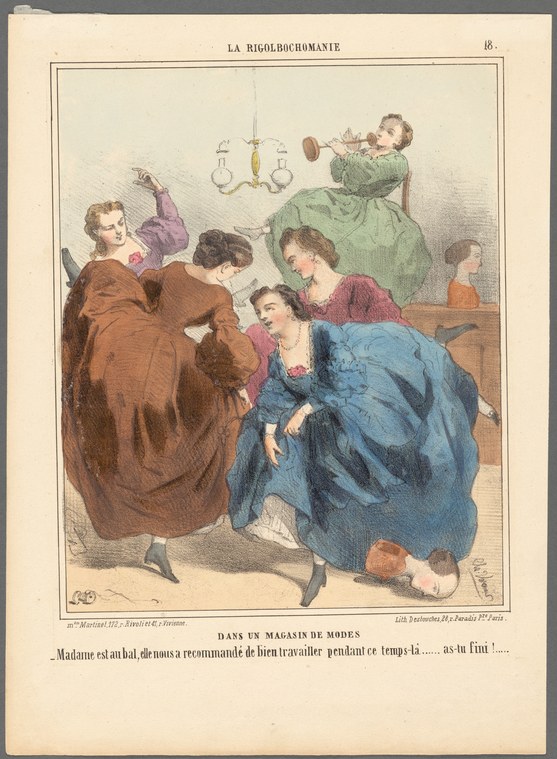
18. Dans un magasin de modes. Madame est au bal, elle nous a recommandé de bien travailler pendant ce temps-là-- as-tu fini!
Unknown artist
- Collection:
- Prints depicting dance
- Source:
- New York Public Library
- Rights:
- Public domain — free to use, share and adapt.
- Recorded as:
- Public Domain
This work documents the intersection of bodily satire and social critique in 19th-century visual culture. For dance historians and artists, it reveals how exaggerated movement and twisted posture were understood as tools of comic commentary and how the fashion industry was imagined as a site of frenetic, feminized labor. The image demonstrates that not all historical depictions of moving bodies constitute 'dance'—here, distortion serves critique rather than aesthetic or technical display.
What you are looking at
A satirical French print depicting a scene in a fashionable millinery shop, titled *Dans un magasin de modes* (In a fashion shop). The proprietor, a stout woman in brown drapery, stands at the center-left examining a large feathered hat while gesturing emphatically. Two younger women in bright silks—one in deep blue, one in maroon—kneel or crouch before her in exaggerated postures of deference and labor, their bodies contorted as if dancing or performing beneath her gaze. Behind them, a third woman in green stands elevated on furniture, holding aloft a swinging mobile or ornament—perhaps a hat form or decorative object—while another figure leans back dramatically. The print's caption reads: "Madame est au bal, elle nous a recommandé de bien travailler pendant ce temps-là—as-tu fini!" (Madame is at the ball; she recommended we work well while she is away—have you finished!). The scene satirizes both the fashion industry's frenetic labor and the social pretensions of its clientele. The composition is crowded and deliberately awkward, with bodies twisted into positions that suggest both frantic work and performative exertion.
The dancing
The women's bodies occupy the space between labor and dance: bent, twisted, and contorted rather than held in any classical dance frame. The two kneeling figures lean sharply forward with arched backs; the standing woman in green holds an arm extended upward in an unbalanced, strained position. Their movements suggest exhaustion and constraint rather than the pleasure of dance, though the exaggeration borders on theatrical burlesque. The composition emphasizes verticality and imbalance—bodies at different levels, none occupying a stable or graceful stance. This is bodily movement under commercial pressure, rendered as visual chaos.
The dance depicted
This is not a depiction of actual dance practice but rather a satirical commentary on labor and bodily exertion disguised as fashion comedy. The print uses the *vocabulary* of caricatural movement to mock both the working conditions of fashion workers and the vanity of their clients. The contorted poses and elevated positions may reference the exaggerated, acrobatic comedy of popular theatrical performance (vaudeville, pantomime, or music-hall burlesque), which often employed twisted bodies and physical impossibility for comic effect. The print belongs to the tradition of social satire through bodily distortion rather than the depiction of actual ballroom or theatrical dance.
How it was made
This is a colored lithograph, recognizable from the hand-colored finish, the characteristic stone-printed line, and the stippled tonal areas typical of 19th-century commercial lithography. The signature "Daumier" (if present) would indicate Honoré Daumier's workshop or circle, though attribution is not confirmed by the record. Lithography allowed rapid production and mass circulation of satirical prints aimed at a middle-class Parisian audience; the technique's fluidity made exaggeration and caricature particularly effective. The bright, flat color application—the vivid silks, the warm browns—enhances the satirical tone by making the scene both visually striking and somewhat absurd.
About this work
This is a French satirical print from the mid-19th century mocking the fashion industry, its workers, and their clientele through deliberately exaggerated bodily contortion. Rather than depicting actual dance, it borrows the visual language of comic bodily distortion—a staple of popular theatre and caricature—to critique social pretension and exploitative labor. The women's twisted poses, extreme flexibility, and inverted orientations serve the satire rather than any dance tradition, though they demonstrate a keen eye for how bodies could be positioned for maximum comedic and critical effect. The print circulated as part of Parisian satirical visual culture, likely published in a periodical or as a standalone broadside for middle-class consumption.
How to look at it
Attend to the deliberate *impossibility* of the poses: these bodies could not move this way in actual labor or actual dance. The artist has twisted each figure to maximize visual discomfort and comedy—the exaggerated curves, the strained reaches, the precarious balances. Notice how the scene offers no moment of rest or stability: everyone is caught in frantic, awkward exertion. The bright colors and busy composition reinforce the satire by making the chaos visually as well as conceptually overwhelming. The caption is essential: it frames the whole scene as a commentary on the gap between the leisure of the wealthy (Madame at the ball) and the exhausting work of those who serve them.
The artist
The style and subject matter are consistent with the Parisian satirical print tradition of the 1830s–1850s, particularly the work of Honoré Daumier and his contemporaries. Daumier was celebrated for his rapid, exaggerated line and his sharp social commentary on fashion, labor, and urban manners. The print's title and composition suggest publication in a satirical periodical such as *La Caricature* or *Le Charivari*, for which Daumier and others produced weekly commentary on Parisian life. However, without a confirmed signature or publication record, attribution remains uncertain.
The period
This print belongs to the 1830s–1850s golden age of French satirical lithography, when Parisian visual culture was sharply divided between official Salon art and the cutting, comedic critique of the press. The fashion industry was a favorite target of satirists, who lampooned both the aspirations of the bourgeoisie and the exploitation of female workers. Simultaneously, theatrical and circus performance—with their emphasis on bodily contortion, elasticity, and comic physicality—were enormously popular. This print sits at the intersection: it uses the visual language of circus and pantomime to expose the human cost of fashion labor.
Where it lives
This print is held in the New York Public Library's collection of prints depicting dance. It likely entered the collection as part of a broader acquisition of 19th-century French satirical prints, though the exact accession history is not recorded.
Questions about this work
Is this actually a dance scene?
No. This is a satirical print using exaggerated bodily contortion as social commentary on the fashion industry. While the twisted poses may evoke the comic physicality of theatrical performance, the print documents labor and exploitation, not dance practice or instruction.
Why are the women's bodies positioned so strangely?
The exaggerated contortion is deliberate satire. By rendering the workers' bodies as twisted and strained, the artist critiques both the conditions of fashion labor and the vanity of the clients who drive it. The impossible poses make the scene visually absurd and therefore comic.
What does the caption mean?
"Madame est au bal, elle nous a recommandé de bien travailler pendant ce temps-là—as-tu fini!" translates to "Madame is at the ball; she recommended we work well while she is away—have you finished!" It sets up the satire: while the wealthy woman enjoys leisure, her workers labor frantically in her shop.
Who made this print?
The artist is not definitively recorded, though the style and subject matter are consistent with the work of Honoré Daumier and other Parisian satirists of the 1830s–1850s. The print likely appeared in a satirical periodical such as *La Caricature* or *Le Charivari*.
More dance artwork





