49 works in this view — arrow keys or swipe to move between them.
Dance in Art
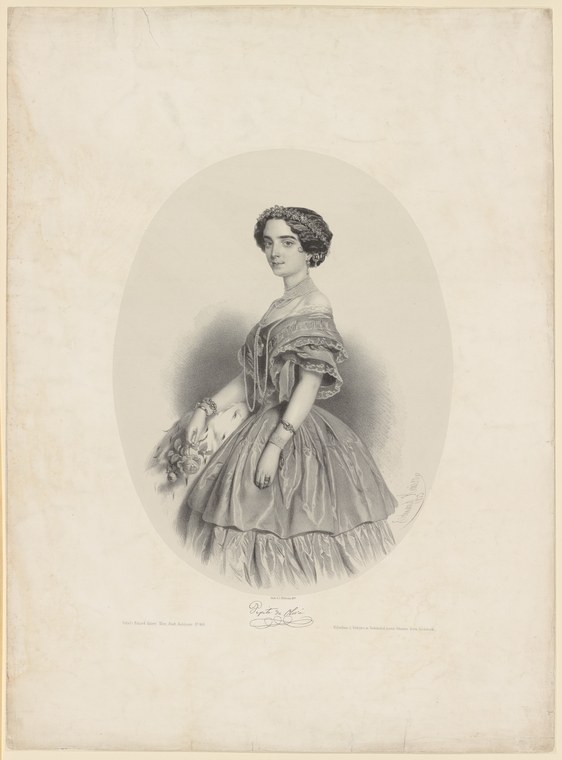
Pepita de Olivá [facsimile signature]
Unknown artist
- Collection:
- Prints depicting dance
- Source:
- New York Public Library
- Rights:
- Public domain — free to use, share and adapt.
- Recorded as:
- Public Domain
This portrait documents the nineteenth-century practice of circulating engravings of celebrated performers as a form of promotion and fan culture, a precursor to modern celebrity imaging. For dance historians, it is a record of how a professional woman performer chose or was asked to present herself to the public, and the formal codes through which performers were legitimized and made visible.
What you are looking at
A three-quarter-length portrait of a woman in mid-nineteenth-century dress, shown against a plain background within an oval mat. She stands with her weight shifted slightly, her posture upright but not rigid, wearing a full-skirted dress with off-shoulder sleeves and what appears to be a shawl or fichu draped across her shoulders. The skirt, rendered with careful attention to volume and texture, falls to her ankles in the full silhouette characteristic of the 1840s–50s. Her dark hair is dressed close to the head in a style typical of the period. The artist has used fine line work to suggest the weight and fall of fabric, particularly in the skirt's lower tiers and the translucent quality of the sleeves. The portrait is inscribed with a facsimile signature at the lower center, identifying the subject as 'Pepita de Olivá,' and bears the marks of a professional engraving or lithograph intended for wide circulation.
The dancing
The single figure is posed in a standing position with her weight settled on both feet, her arms relaxed at her sides in a naturalistic stance. Her shoulders are level and open, her gaze directed slightly away from the viewer in a convention of mid-nineteenth-century portraiture. The positioning suggests ease rather than formal presentation; there is no theatrical extension of the limbs or exaggerated turnout. This is the posture of a woman being presented to a public, not a dancer caught mid-movement.
The dance depicted
Without further context on Pepita de Olivá's identity and career, the dance content cannot be established from the image alone. The dress, pose, and period are consistent with a performer of the era, but the portrait format and lack of motion or context do not clarify what form of dance she may have performed or taught. The off-shoulder sleeve arrangement and the quality of the dress suggest a woman of theatrical or professional standing, but the static, formal presentation does not depict an act of dancing.
How it was made
This is a fine-line engraving or lithograph, identifiable by the even tonal gradations achieved through parallel lines (hatching and cross-hatching) and the precision of the line work defining fabric folds and facial features. The technique allowed for multiple impressions and wide distribution, making this a print created for public consumption rather than a unique artwork. The oval format and the facsimile signature are conventions of mid-nineteenth-century celebrity portraiture, typical of theatrical publicity and the nascent star system. The quality of execution suggests a professional print shop and a subject of some public prominence.
About this work
This is a celebrity portrait of a woman performer in the mid-nineteenth century, presented in the standard format of the era: a fine engraving with an oval mat, facsimile signature, and careful rendering of dress and bearing. The inscription identifies her as Pepita de Olivá, though the catalogue record offers no further information about her career or significance. The work belongs in a dance gallery because it documents a performer of the period and the visual conventions through which dancers were marketed to the public, but it does not itself depict an act of dancing. It is evidence of how dance and theatrical performance were packaged and consumed in an age before photography became standard.
How to look at it
Attend to the dress and its rendering: the volume of the skirt, the transparency of the sleeves, and the careful articulation of the shawl or fichu suggest an artist (or a subject) attuned to fabric and its movement. The posture, though still, is not the stiff formality of earlier portraiture; there is a suggestion of ease and natural stance that may reflect nineteenth-century ideas about graceful bearing. Note the inscription at the lower center, which frames this as a named individual rather than a generic beauty—this is a public person being presented to an audience that already knows or seeks to know her name.
The artist
The artist is not recorded. The work bears no visible signature other than the facsimile of the subject's name. The print was produced by a professional shop, as evidenced by the quality of the line work and the standard format, but individual attribution is not available from the image or the catalogue record.
The period
In the 1840s–50s, engraved portraits of theatrical and musical performers were a standard commodity, circulated as theater ephemera, fan memorabilia, and promotional material. This was the heyday of European Romantic ballet, and many of the celebrated dancers of the era—Carlotta Grisi, Fanny Elssler, Lucile Grahn—were similarly immortalized in prints. The full skirt and off-shoulder bodice seen here are the fashion of the period and, for a performer, may have carried associations with the tutu and the Romantic ballet aesthetic, though without more information on Pepita de Olivá's specialty, this remains speculative. The oval format and restrained presentation reflect the period's taste for genteel portraiture, even of performers, distinguishing them from the cruder popular prints of earlier decades.
Where it lives
This work is held in the New York Public Library's collection of prints depicting dance. It is a single-sheet engraving or lithograph, the product of a professional print shop, and represents the kind of mass-produced celebrity imagery that was sold, collected, and traded during the nineteenth century.
Questions about this work
Who was Pepita de Olivá?
The catalogue record does not specify. The inscription and the quality of the portrait suggest she was a public performer of some standing, likely in theater or dance, active in the mid-nineteenth century. The engraving was produced for public consumption, indicating she had a reputation worth marketing. Further research in nineteenth-century dance histories, theater archives, or Spanish-language sources would be required to establish her identity and career.
What dance form did she perform?
The image does not show her dancing, so no specific form can be inferred from the portrait alone. Her name—Olivá—and the inscription in what appears to be Spanish suggest she may have been Spanish or Spanish-American. The dress, while fashionable, does not bear the unmistakable markers of a specific dance tradition. A historical biography would be necessary to determine whether she was a ballet dancer, a Spanish dancer, a performer in theatrical genres like zarzuela, or something else.
Why is this in a dance collection if she is not shown dancing?
Dance collections document not only dances but dancers and the infrastructure of dance as a public practice. This portrait is evidence of how performers were made visible and sold to audiences in the nineteenth century. It also serves as a biographical artifact: identifying and researching named performers is part of dance history, and prints like this are primary sources for that work.
What technique was used to make this print?
The fine parallel lines and controlled gradations of tone indicate a professional engraving or lithograph. The exact process cannot be determined from the image alone, but the quality and the oval format are typical of mid-nineteenth-century theatrical portraiture. This was a technology that allowed multiple copies to be produced and distributed, making it an ideal medium for celebrity promotion.
More dance artwork





