49 works in this view — arrow keys or swipe to move between them.
Dance in Art
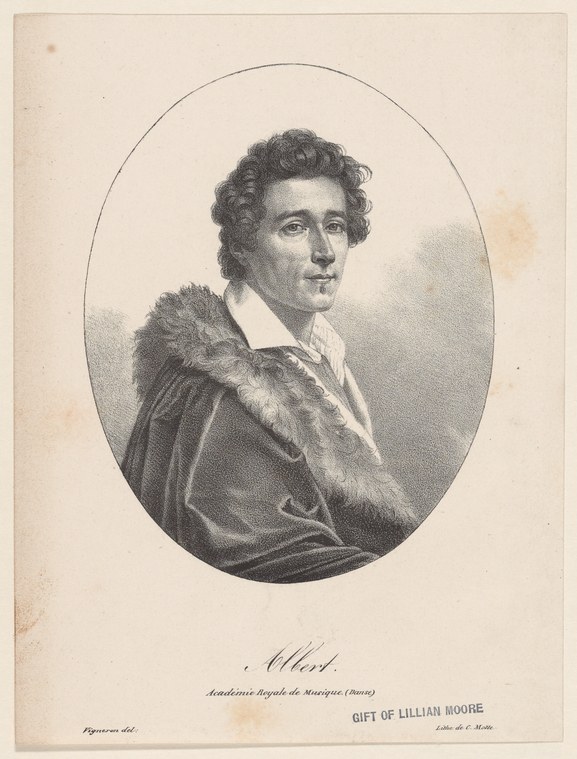
Albert. Académie Royale de Musique (Danse)
Unknown artist
- Collection:
- Prints depicting dance
- Source:
- New York Public Library
- Rights:
- Public domain — free to use, share and adapt.
- Recorded as:
- Public Domain
This print documents the visibility and cultural status of male ballet dancers at the Paris Opera during the Romantic period, when the art form was consolidating its aesthetic principles and its audience. As a circulated image, it shows how dancers were promoted and consumed as celebrities, and how their public identity was shaped through portraiture and print.
What you are looking at
A three-quarter-length portrait of a young man, shown from the waist up against a plain background, enclosed in a oval frame. He wears a dark coat or jacket with what appears to be fur trim or collar around the shoulders, worn casually off one shoulder in a deliberately informal pose. Beneath it is a white collar or cravat. His dark, wavy hair is styled in the Romantic fashion of the early 19th century, swept back from his face. His gaze is directed toward the viewer with a composed, introspective expression. The print is executed in stipple or fine engraving technique, creating soft tonal gradations across the face and clothing. The oval format and the casual elegance of the dress suggest this is a portrait of an accomplished performer or artist—someone of standing and refinement.
The dancing
A single figure in repose, not actively dancing. The body is angled in three-quarter view, weight settled, one shoulder slightly forward. The pose conveys ease and confidence rather than physical exertion. There is no visible footwork, no extended limbs, no indication of movement or hold with a partner. The figure is portrait-posed, not in a theatrical or balletic attitude.
The dance depicted
The catalogue identifies this as Albert from the Académie Royale de Musique (the Paris Opera). Albert (likely Albert, the male ballet dancer who performed at the Opera in the early 19th century, possibly Albert Decombecque or a similar figure) would have been a danseur associated with Romantic ballet. However, this is a portrait print, not a depiction of dance in action. It documents the performer rather than the performance. Without additional identifying information, we cannot determine Albert's specific roles or repertory from the image alone.
How it was made
This is an engraving, most likely a stipple or combination engraving executed on copper plate. The soft modeling of the face and the delicate gradations of tone are characteristic of late 18th or early 19th-century portraiture engraving. The technique allowed for the reproduction of subtle facial features and soft focus effects that suited the Romantic sensibility of the period. Such prints were produced in editions and distributed as part of theatrical programs, collections, or marketed separately to audiences interested in dance and opera performers. The notation "Lith. de C. Motte" at the bottom suggests involvement of the lithographer Charlemagne Motte, though the primary medium appears to be engraving.
About this work
This is a portrait engraving of Albert, a male dancer at the Académie Royale de Musique (Paris Opera) in the early 19th century. The work belongs to the tradition of theatrical portraiture—images of celebrated performers circulated to document and promote them to their public. Rather than showing Albert in costume or in a moment of choreographed movement, the artist has presented him in a Romantic-era portrait format: informal dress, introspective gaze, and refined execution emphasizing the performer's personality and gentility. Such prints are evidence of how Romantic-era dance was consumed and celebrated: as much through the personality and presence of the dancer as through the spectacle of the stage itself.
How to look at it
This is not a dance image but a performer portrait. Attend to what the artist chose to convey about Albert: the informal elegance, the thoughtful expression, the absence of theatrical costume or attitude. Notice the soft modeling and the care taken with the face—the print's quality indicates Albert was considered a significant enough performer to merit skilled execution. The oval frame and restrained background were conventional formats for theatrical portraiture, signaling that this is a documented performer of professional standing, not an anonymous figure.
The artist
The print is unsigned by the primary artist but attributed to "Lith. de C. Motte" (Charlemagne Motte, a known lithographer of the period). The work may be after a drawing or painting by another hand. The execution and style suggest a commercial theatrical portrait shop or publisher producing prints for sale to opera-goers and collectors.
The period
This portrait dates to the early 19th century, the height of Romantic ballet. The Paris Opera was the center of European ballet at this time, and male dancers, though increasingly secondary to female principals in narrative ballets, remained important figures in the repertory. The Romantic period elevated the aesthetic of restraint and introspection in portraiture, moving away from the bombast of Baroque and Neoclassical theatrical imagery. The casual drape of fabric and the unidealized but refined presentation of the sitter reflect this shift. Circulated theatrical portraits were a significant medium through which audiences engaged with performers between performances.
Where it lives
The work is held in the New York Public Library's collection of prints depicting dance. It is catalogued as a gift of Lillian Moore, the dance historian and collector. Moore's collection, donated to NYPL, is a foundational resource for the study of theatrical dance history.
Questions about this work
Who was Albert?
The catalogue identifies him only as Albert from the Académie Royale de Musique, the Paris Opera, in the early 19th century. Without further biographical information in the record, we cannot determine his full identity or career beyond what this portrait suggests: he was an accomplished male dancer of sufficient prominence to merit a printed portrait distributed to the public.
Why is this a portrait and not a dance scene?
This represents how Romantic-era theatrical portraits worked. Rather than depicting a specific scene or role, the artist presented the performer as a refined, educated gentleman—emphasizing personality and presence over athletic display. This approach reflected the Romantic valorization of the individual artist's subjective inner life.
What does the engraving technique tell us?
The use of engraving (likely stipple engraving) indicates professional production for broad circulation. These prints were sold to theatre-goers, collected in theatrical annuals, and kept as souvenirs, making them a primary medium for the public's engagement with dance performers outside the theatre.
More dance artwork





