49 works in this view — arrow keys or swipe to move between them.
Dance in Art
Le bal champêtre
Unknown artist
- Collection:
- Prints depicting dance
- Source:
- New York Public Library
- Rights:
- Public domain — free to use, share and adapt.
- Recorded as:
- Public Domain
The work illustrates a crucial distinction in 18th-century dance: the difference between formal, choreographed dancing (which would be taught and performed) and the graceful, improvisational movement expected of genteel figures in social space. For historians of dance in painting, it shows how artists used the *fête champêtre* to present movement and the body as expressions of refined sociability rather than technical skill.
What you are looking at
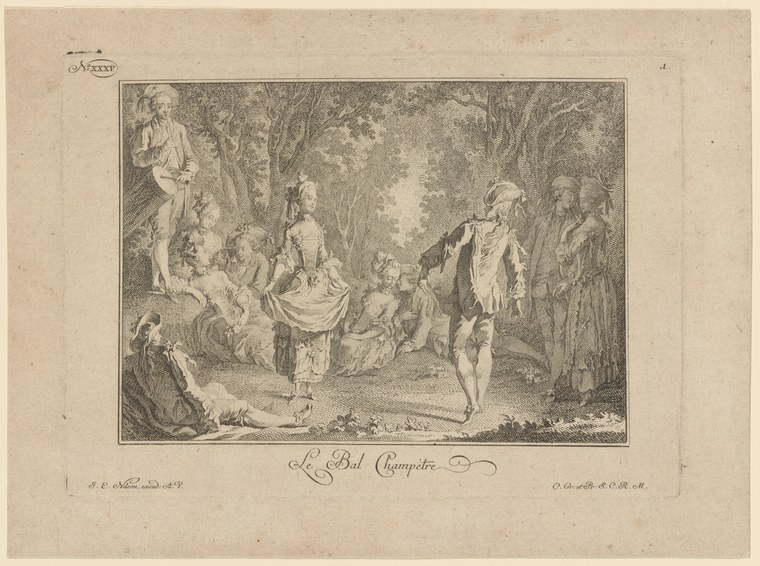
A woodland pastoral scene depicting a leisurely gathering of elegantly dressed figures in a clearing among tall trees. In the foreground, couples and groups engage in social interaction—some seated on the ground in animated conversation, others standing in graceful poses. The central figures wear fashionable dress of the 18th century: women in flowing skirts and fitted bodices, men in coats, breeches, and hats. The composition is organized around a focal point where several figures cluster, with others distributed throughout the scene in a loose, naturalistic arrangement. The lighting is soft and diffuse, filtered through the foliage, creating a romantic, idealized atmosphere. The engraving technique renders fine detail in the trees and fabrics while maintaining an airy, pastoral quality typical of rococo leisure imagery.
The dancing
The bodies display the relaxed, refined posture of courtly leisure rather than formal dance technique. Several figures are seated or reclining on the ground in postures of ease and conversation. Those standing adopt the characteristic S-curve stance of 18th-century gentility, with weight shifted to one leg, arms gesturing expressively in conversation or held lightly at the sides. The few figures who appear to be in motion show no evidence of structured dance positions or partnered holds—the movement is social and improvisational rather than choreographic.
The dance depicted
While titled 'Le bal champêtre' (The country ball or country dance), this engraving depicts a social gathering rather than formal dancing. The figures are engaged in promenade, conversation, and leisurely movement through a pastoral setting. If any dancing occurs, it is not the primary action depicted. The work illustrates the 18th-century *fête champêtre*—a fashionable artistic genre representing aristocratic recreation in idealized nature—rather than documenting a specific dance form. The relaxed, scattered composition and emphasis on courtship, conversation, and social ease over choreographed movement distinguish this from dance-instruction or performance imagery.
How it was made
This is an engraving, likely from the mid-18th century, executed with fine line work and cross-hatching to create tonal gradation and depth. The technique allows for precise rendering of fabric folds, facial features, and the play of light through trees, while the print medium enabled wide distribution as a fashionable image of aristocratic leisure. The signature or attribution marks visible in the lower margin (though not clearly legible in this reproduction) suggest a professional production, probably French given the title and style.
About this work
This engraving depicts a fashionable *fête champêtre*—a popular 18th-century artistic subject representing aristocratic recreation in an idealized pastoral setting. The title promises a country dance, but the image prioritizes social gathering, courtship, and leisurely movement over structured choreography or performance. The work belongs to a large body of rococo leisure imagery that circulated among the educated classes, reflecting ideals of refined pleasure, naturalistic grace, and erotic possibility within the safety of picturesque landscape. For dance history, it documents not a specific dance technique but the broader culture of social movement and courtship that framed recreational dancing in the period.
How to look at it
Attend to the arrangement of the figures: no two partners are in closed hold, and no lines of dancers are visible. Instead, bodies are scattered, seated, or standing in attitudes of conversation and observation. Notice the dress—flowing skirts, fitted bodices, coats and hats—which establishes the historical and social register. The artist has chosen a moment of social ease rather than a moment of dance action; the title may promise a dance, but the engraving depicts the intervals between dancing, or the social life of which dancing was a part.
The artist
The artist is unknown from the catalogue record. The style, technique, and subject matter are consistent with mid-18th-century French or Franco-German rococo engraving, but without a signature or attribution, the maker cannot be identified with confidence. The work was likely produced by a professional engraver working from a painting (possibly by a more famous artist) for distribution to collectors of fashionable leisure imagery.
The period
The *fête champêtre* became a dominant artistic genre in France and across Europe during the 18th century, particularly in the rococo period (1730–1780). These works represented a courtly fantasy of escape to idealized nature, where aristocrats dressed in fashionable finery engaged in flirtation, music, and graceful movement. Simultaneously, social dancing—minuets, contredanses, and country dances—was a central feature of aristocratic life, but the *fête champêtre* typically subordinated dance as one element of a larger narrative of leisure and courtship. In painting and prints, the genre offered opportunities to depict the clothed body in informal motion and proximity, addressing erotic interest through the language of refinement and nature.
Where it lives
This engraving is held in the New York Public Library's collection of prints depicting dance. It represents a print culture of fashion imagery and leisure that circulated widely among educated European consumers in the 18th century.
Questions about this work
Is there an actual dance happening in this picture?
Not visibly. While the title promises a country ball, the figures depicted are engaged in social interaction—conversation, promenade, courtship—rather than coordinated dancing. The work belongs to a tradition of *fête champêtre* paintings and prints that use dance as one element of aristocratic leisure and fantasy, often representing the social and romantic possibilities of dancing rather than the dancing itself.
What does 'bal champêtre' mean?
It translates roughly as 'country ball' or 'country dance.' In 18th-century French, it referred both to actual rural dancing and to the fashionable artistic genre depicting aristocrats at leisure in idealized pastoral settings. The title evokes informality and pleasure, distinguishing this from the formal dances of the court.
Why would someone from the 18th century own a print like this?
Prints of leisure and fashion scenes were collected and displayed by educated, affluent Europeans as expressions of taste and refinement. They were relatively affordable compared to paintings, widely available, and offered imaginative escape into fantasies of courtship, nature, and refined pleasure. For women in particular, such prints offered socially acceptable images of female beauty, leisure, and erotic possibility.
More dance artwork





