49 works in this view — arrow keys or swipe to move between them.
Dance in Art
Társas-csárdás: (hármas)
Unknown artist
- Collection:
- Prints depicting dance
- Source:
- New York Public Library
- Rights:
- Public domain — free to use, share and adapt.
- Recorded as:
- Public Domain
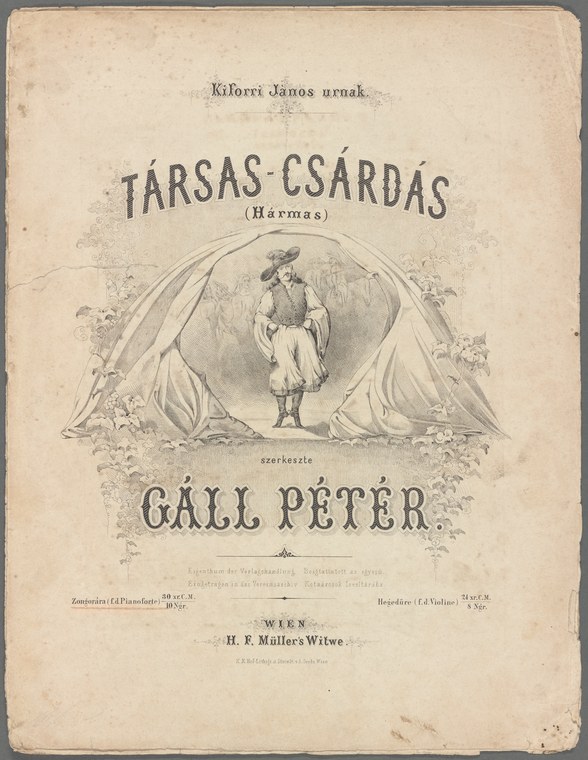
This print documents the moment when Hungarian folk dance was entering European urban culture and ballroom practice, and it reveals how that transition was mediated through theatrical publicity. The choice to depict a single, composed figure rather than the dance in motion tells us something important about how the csárdás was being presented to and understood by non-Hungarian audiences in the 19th century.
What you are looking at
A solitary male dancer stands center stage beneath a billowing tent or canopy, silhouetted against a bright interior. His stance is upright and poised, with one leg bearing weight while the other appears ready to move. He wears a loose white shirt, dark breeches, and a hat—the costume of a working man or soldier rather than a courtier. The background is atmospheric but indistinct; the frame of the tent and draped fabric create an intimate, almost theatrical space. The composition is romantic and melancholic, emphasizing the figure's isolation and poise. The engraving technique renders the scene in fine grayscale tones, with delicate cross-hatching that suggests fabric texture and volume.
The dancing
A single dancer in three-quarter profile, weight settled on the back leg, the front leg relaxed and ready. The torso is upright and dignified; the arms hang naturally at the sides, one slightly forward. The head is level and composed. There is no apparent tension or effort—the body suggests ease and readiness rather than exertion. The stance is neither ballroom nor acrobatic, but poised and grounded, consistent with social or folk dance preparation.
The dance depicted
The title *Társas-csárdás (hármas)* indicates a Hungarian csárdás—a couple or group dance that alternates between a slow, measured section (lassan) and a fast, spirited section (friss). The subtitle hármas suggests this is a version for three dancers or a triple formation. The figure shown is in a moment of stillness or preparation, not mid-movement, which was common in prints used to document or advertise dance performances of the era. The costume and setting suggest this is the rural or folk version of the csárdás rather than its ballroom adaptation. The isolated male figure may represent the position a man would hold while awaiting his partners.
How it was made
A lithograph or engraving, created using stone or metal plates to achieve the fine tonal gradations and cross-hatching visible throughout. The delicate line work and subtle gray tones suggest a skilled craftsman; the framing text and decorative borders indicate this was a published theatrical or performance notice rather than a fine art print. The technique allowed for multiple impressions to be distributed widely—this was commercial and promotional rather than unique. The source imprint indicates publication in Vienna by H. E. Müller's Witwe (widow), a common publishing house for theatrical materials in the 19th century.
About this work
This is a lithographic advertisement or performance notice for a Hungarian csárdás, printed in Vienna in the 19th century. The image presents the dance not through narrative or multiple figures in action, but through a single male dancer in a moment of composed readiness, as if pausing before the music begins. The work sits at the intersection of folk documentation and theatrical promotion—the csárdás was already being absorbed into European ballroom and stage culture, and prints like this served to introduce it to urban audiences unfamiliar with Hungarian dance traditions.
The solitary figure creates a distinctive mood, quite unlike the energetic group scenes common in other dance prints of the period. Instead of showing the vivacity and speed for which the csárdás was famous, the artist chose to emphasize poise, grace, and the formal preparation of the body—qualities that would have made the dance legible and respectable to a Vienna audience encountering it perhaps for the first time.
How to look at it
The artist has chosen the moment just before the dance begins—not the leap or turn that would define the csárdás in motion, but the gathered readiness of a body about to dance. Notice the upright spine, the relaxed arms, the weight settled and ready. This was a moment valued in 19th-century theatrical dance training: the composed, dignified pose that preceded the action. The scale of the figure—centrally placed and monumental beneath the tent—suggests something ceremonial or solemn, which contrasts with what we know of the csárdás as a spirited, social dance. This tension between the form's energetic reputation and the print's quiet dignity tells us how the dance was being reframed for a Viennese or Central European audience.
The artist
The artist is not recorded. The engraving was published by H. E. Müller's Witwe (the widow of H. E. Müller) in Vienna, a firm known for theatrical ephemera and dance notices in the mid-to-late 19th century. The inscription attributes the work to a performer or choreographer named Gáll Péter (or Pál), whose name appears below the figure; he may have been the dancer who performed this role or the choreographer who staged this version.
The period
The 19th century saw European ballroom culture becoming increasingly fascinated with 'exotic' or 'authentic' national dances. The Hungarian csárdás was one of several folk dances adopted into ballroom practice and staged in concert halls and theaters. Vienna, the capital of the Austro-Hungarian Empire, was a center for this cultural traffic. During this period, printed dance notices and performance documents became a major genre, serving both as advertisements and as a form of cultural documentation. The csárdás itself was gaining status; it was entering orchestral and concert music through composers like Brahms and Liszt at exactly the time this print was being produced.
Where it lives
Published by H. E. Müller's Witwe in Vienna; held in the New York Public Library as part of its collection of prints depicting dance. The work is an ephemeral performance notice and was likely one of many distributed to theaters, concert halls, and patrons during a theatrical season.
Dance in this work
Questions about this work
What is a csárdás?
A Hungarian couples dance with two distinct sections: a slow, fluid introduction (lassan) and a fast, energetic finale (friss). It became one of the most widely adopted folk dances in European ballroom culture during the 19th century. The name comes from the csárda, a roadside tavern or inn where the dance was performed socially.
Why does the title say 'hármas'?
Hármas means 'triple' or 'for three' in Hungarian. This suggests the version advertised here was for three dancers rather than a couple, though the print shows only one figure. It may have been a formation used in theatrical performance, or the three may have referred to the musical structure.
Who was Gáll Péter?
The catalogue record does not identify him. He may have been the performer, choreographer, or company associated with this production. The name appears prominently below the figure, suggesting he had significant status or celebrity at the time of publication.
Why was this dance being advertised in Vienna?
Vienna was the capital of the Austro-Hungarian Empire and a major center for concert and theatrical dance. The csárdás, though a Hungarian folk dance, had become fashionable in urban European ballrooms and concert halls by the 19th century, and theatrical companies regularly staged versions of it for audiences.
More dance artwork





